Home
Class 12
PHYSICS
Find the net force acting on the wire sh...

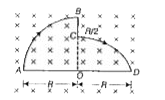
Find the net force acting on the wire shown in the figure.
[Take, B=1T, i = 2 A, R=0.5 m]

Text Solution

Verified by Experts
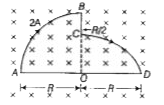

Force on wire `AB=|F_(1)|= i(R )B = iRB`
Force on wire `BC=|F_(2)|= i((R )/(2))B=(iRB)/(2)`
Force on wire `CD=|F_(3)|= i(R )B=iRB`
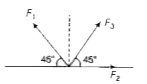
The direction of forces are shown in figure

`F_(X)=` components of forces along + X-axis
`=F_(2)+F_(3) cos 45^(@) -F_(1) cos 45^(@)`
`=F_(2)" " [ :. F_(1)=F_(3)]`
`F_(Y)=`components of forces along + Y-axis
`=F_(1) sin 45^(@) +F_(3) sin 45^(@)`
`=2F_(1) sin 45^(@) =sqrt(2)F_(1)`
Resultant force or net force on wire
`=sqrt((F_(x))^(2)+(F_(Y))^(2))=sqrt(F_(2)^(2) +(sqrt(2)F_(1))^(2))`
`=sqrt(((iRB)/(2))^(2)+(sqrt(2)iRB)^(2))`
`=sqrt(((iRB)^(2))/(4)+2(iRB)^(2))=sqrt((9(iRB)^(2))/(4))`
`=(3)/(2) iRB=(3)/(2) xx 2 xx 0.5 xx 1 = 1.5N`
Promotional Banner

Similar Questions

Explore conceptually related problems

Find the magnitude and direction of the torque acting on the square loop as shown in the diagram where B = 1.5 T along positive Z-axis.

In figure 12 PS is a diameter of a circle whose radius is 6cm . Two pint Q and R are taken on PS such that PQ= QR = RS . Two Semi-circles are drawn with PQ and QS as their respective diameters as shown in the figure. find the perimeter and the area of the shaded region shown in figure. (Take pi=3.14 )

Give the magnitude and direction of the net force acting on a stone of mass 0.1 kg, (a) just after it is dropped from the window of a stationary train,(b) just after it is dropped from the window of a train running at a constant velocity of 36 km/h,just after it is dropped from the window of a train accelerating with 1 ms^2,just after it is dropped from the window of a train accelerating with 1M/S2

One end of a string of length l is connected to a particle of mass m and the other to a small peg on a smooth horizontal table. If the particle moves in a circle with speed v the net force on the particle (directed towards the centre) is: (i)T,(II) T-(mv^2)//l, (iii) T+(MV^2)/l, (iv)0