Home
Class 12
PHYSICS
A thin dielectric disc uniformly distrib...

A thin dielectric disc uniformly distributed with charge q has radius r and is rotated n times per second about an axis perpendicular to the disc and passing through the centre. Find the magnetic induction at the centre of the disc.

Text Solution

Verified by Experts
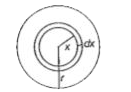
Consider a hypothetical ring of radius x and thickness dx of a disc as shown in the figure.

Charge on the ring.
`dq=q/(pir^2)xx(2pi"x"xxdx)`
Current due to rotation of charge on ring is
`di=(dq)/(T) = ndq`
`implies di =(nq2x dx)/(r^2)`
Magnetic field at the centre o due to current of the ring element.
`dB=(mu_0di)/(2x)= (mu_0nq2xdx)/(r^2(2x))`
`dB = (mu_0ndxq)/(r^2)`
`int_0^B dB = int_0^(r)(mu_0ndx q)/(r^2)`
`B = (mu_0nq)/r^2 int_0^r dx`
`B = (mu_0 nq)/r^2 xxr`
`B = (mu_0 nq)/(r)`
Promotional Banner

Similar Questions

Explore conceptually related problems

Find an expression for MI of a thin circular RING about an axis passing through its centre and perpendicular to the plane of the ring.

A disc of metal is melted and recast in the form of a solid sphere. What will happen to the moment of inertia about a vertical axis passing through the centre?

Calculate the moment of inertia of a circular disc passing through centre and perpendicular to its plane.

Torques of equal magnitude are applied to a hollow cylinder and a solid sphere, both having the same mass and radius. The cylinder is free to rotate about its standard axis of symmetry, and the sphere is free to rotate about an axis passing through its centre. Which of the two will acquire a greater angular speed after a given time?

A ring and a circular disc of different materials have equal masses and equal radii. Which one will have a larger moment of inertia about an axis passing through its centre of mass perpendicular to its plane?

Define moment of inertia and radius of gyration. Deduce an expression for MI of a circular disc about an axis passing through its centre. Two circular discs have their masses in the ratio 1:2 and their diameters 2:1 . Calculate the ratio of their moments of inertia

Two discs of moments of inertia /, and l2 about their respective axes (normal to the disc and passing through the centre), and rotating with angular speeds omega and omega are brought into contact face to face with their axes of rotation coincident, (a) What is the angular speed of the two-disc system? (b) Show that the kinetic energy of the combined system is less than the sum of the initial kinetic energies of the two discs. How do you account for this loss in energy? Take . omega ne omega

Given the M.I. of a dise of mass M and radius R about any of its diameter to be MR^2 /4. Find its M.I about an axis (i) passing through its centre and normal to it, and (ii) passing through a point at its edge and normal to it.

(a) Find the moment of inertia of a sphere about a tangent to the sphere, given the moment of inertia of the sphere about any of its diameters to be 2MR^2IS, where M is the mass of the sphere and R is the radius of the sphere(b) Given the moment of inertia of a disc of mass M and radius R about any of its diameters to be MR2I4, find its moment of inertia about an axis normal to the' disc and passing through a point on its edge.

