

Home
Class 12
PHYSICS
Two fixed, equal, positive charges, each...

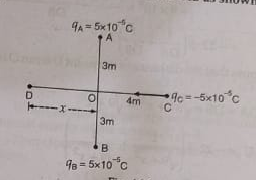
Two fixed, equal, positive charges, each of magnitude 5xx10^-5 coul are located at points A and B separated by a distance of 6m. An equal and opposite charge moves towards them along the line COD, the perpendicular bisector of the line AB.
The moving charge, when it reaches the point C at a distance of 4m from O, has a kinetic energy of 4 joules. Calculate the distance of the farthest point D which the negative charge will reach before returning towards C.

Promotional Banner

Topper's Solved these Questions

  • ELECTRIC POTENTIAL

    MODERN PUBLICATION|Exercise EXERCISE|38 Videos
  • ELECTRIC FIELD

    MODERN PUBLICATION|Exercise EXERCISE|95 Videos
  • ELECTRICAL MEASUREMENTS

    MODERN PUBLICATION|Exercise EXERCISE|44 Videos

Similar Questions

Explore conceptually related problems

Two point charges 4 mu C and -2 muC are separated by a distance of 1 m in air. At what point on the line joining the charge is electric potential zero?

Two point charges 4Q and Q are separated by a distance of 1 m in air. At what point on the line joining the two charges is the electric field intensity zero?

Two equal charges placed in air and separated by a distance of 2 m repel each other with a force of 10^-4 N. Calculate the magnitude of either of the charges.

The potential at a certain distance from a point charge is 600 volt and the electric field is 200 NC^-1 find the distance of the point from the charge.

Two fixed point charge 4Q and 2Q are separated by a distance x. where should a third point charge q be placed for ti to be in equilibrium?

Two equal charges placed in air separated by a distance 3 m repel each other with force 0.1 g f. Calculate the magnitude of either of the charges.

If the perpendicular distance of the point (6, 5, 8) from the Y-axis is 5lambda units, then lambda is equal to

Does the strength of electric field due to an infinity long line charge depend upon the distance of the obervation point from the line charge?

MODERN PUBLICATION-ELECTRIC POTENTIAL-EXERCISE
  1. Two fixed, equal, positive charges, each of magnitude 5xx10^-5 coul ar...

    Text Solution

    |

  2. Find an expression for line integral of electric intensity.

    Text Solution

    |

  3. The work done in moving a positive charge on an equipotential surface ...

    Text Solution

    |

  4. Show that the work done in moving a unit charge along a closed path is...

    Text Solution

    |

  5. Derive an expression for electric potential at a point due to a point ...

    Text Solution

    |

  6. Define electric potential. What is the SI unit of potential? Obtain an...

    Text Solution

    |

  7. Define electric potential at a point. Derive an expression for the pot...

    Text Solution

    |

  8. Derive an expression for the electric potential at a point along the a...

    Text Solution

    |

  9. Derive an expression for electric field intensity at a distance r from...

    Text Solution

    |

  10. Deduce an expression for electric potential due to an electric dipole ...

    Text Solution

    |

  11. Deduce an expression for electric potential due to an electric dipole ...

    Text Solution

    |

  12. How is electric field at a point related to potential gradient?

    Text Solution

    |

  13. How is electric field at a point related to potential gradient?

    Text Solution

    |

  14. What is the shape of equipotential surfaces for a uniform electric fie...

    Text Solution

    |

  15. Draw the equipotential surfaces due to an electric dipole. Locate the ...

    Text Solution

    |

  16. Obtain an expression for potential energy of the configuration of thr...

    Text Solution

    |

  17. Depict the equipotential surfaces for a system of two identical positi...

    Text Solution

    |

  18. Deduce the expression for the potential energy of a system of two poin...

    Text Solution

    |

  19. Two uniformly large parallel thin plates having charge densities +sigm...

    Text Solution

    |

  20. Two point charges q1 and q2 are kept at a distance of r(12) in air. De...

    Text Solution

    |

  21. Derive an expression for potential at a point due to a group of point ...

    Text Solution

    |