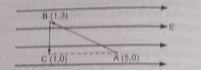
 At which point( of the two) is the electric potential more and why?


Topper's Solved these Questions
Similar Questions
Explore conceptually related problems
MODERN PUBLICATION-ELECTRIC POTENTIAL-EXERCISE
- A test charge q is moved without acceleration from A to C along the pa...
Text Solution
|
- Find an expression for line integral of electric intensity.
Text Solution
|
- The work done in moving a positive charge on an equipotential surface ...
Text Solution
|
- Show that the work done in moving a unit charge along a closed path is...
Text Solution
|
- Derive an expression for electric potential at a point due to a point ...
Text Solution
|
- Define electric potential. What is the SI unit of potential? Obtain an...
Text Solution
|
- Define electric potential at a point. Derive an expression for the pot...
Text Solution
|
- Derive an expression for the electric potential at a point along the a...
Text Solution
|
- Derive an expression for electric field intensity at a distance r from...
Text Solution
|
- Deduce an expression for electric potential due to an electric dipole ...
Text Solution
|
- Deduce an expression for electric potential due to an electric dipole ...
Text Solution
|
- How is electric field at a point related to potential gradient?
Text Solution
|
- How is electric field at a point related to potential gradient?
Text Solution
|
- What is the shape of equipotential surfaces for a uniform electric fie...
Text Solution
|
- Draw the equipotential surfaces due to an electric dipole. Locate the ...
Text Solution
|
- Obtain an expression for potential energy of the configuration of thr...
Text Solution
|
- Depict the equipotential surfaces for a system of two identical positi...
Text Solution
|
- Deduce the expression for the potential energy of a system of two poin...
Text Solution
|
- Two uniformly large parallel thin plates having charge densities +sigm...
Text Solution
|
- Two point charges q1 and q2 are kept at a distance of r(12) in air. De...
Text Solution
|
- Derive an expression for potential at a point due to a group of point ...
Text Solution
|