

Home
Class 12
PHYSICS
Work done to move a charge along a close...

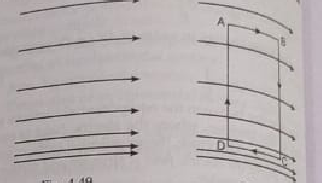
Work done to move a charge along a closed path inside an electric field is always zero. Use this fact to prove that it is impossible to produce an electric field in which all the lines of force would be parallel straight lines and the density of their distribution would constantly increase in a direction perpendicular to the lines of force as shown in Figure.​

Promotional Banner

Topper's Solved these Questions

  • ELECTRIC POTENTIAL

    MODERN PUBLICATION|Exercise EXERCISE|38 Videos
  • ELECTRIC FIELD

    MODERN PUBLICATION|Exercise EXERCISE|95 Videos
  • ELECTRICAL MEASUREMENTS

    MODERN PUBLICATION|Exercise EXERCISE|44 Videos

Similar Questions

Explore conceptually related problems

Prove that the work done in moving a unit charge along a closed path in an electric field is zero?

A charged particle is free to move in as electric field. Will it always move along an electric line of force?

The equipotential surfaces of a certain electric field are shown in the fig. It is known that V_1> V_2 . Use this pattern to reproduce approximately the lines of force of this field. Also indicate the region in which the intensity of the electric field is highest.

Force on a charge in electric and magnetic fields A charge particle follows a parabolic path in a uniform electric field and a charged particel moving in a uniform magnetic field has two kinds of motions lnear motion in the direction of magnetic field and circular motion in a plane perpendicular to the magnetic field. when charge q is moving perpendicular to the magnetic field B, the radius of the circular path is r=(mv)/(Bq) . If v and B makes an angle theta , then r=(mvsintheta)/(Bq) , and the time period T=(2pim)/(Bq) . When a charged particle q is moving with velocity vecv in a magnetic field vecB , the force is non-zero. It means.

Force on a charge in electric and magnetic fields A charge particle follows a parabolic path in a uniform electric field and a charged particel moving in a uniform magnetic field has two kinds of motions lnear motion in the direction of magnetic field and circular motion in a plane perpendicular to the magnetic field. when charge q is moving perpendicular to the magnetic field B, the radius of the circular path is r=(mv)/(Bq) . If v and B makes an angle theta , then r=(mvsintheta)/(Bq) , and the time period T=(2pim)/(Bq) . Under the influenece of a uniform magnetic field, a charged particles is moving in a circle of radius r with speed v. The time period of motion.

Force on a charge in electric and magnetic fields A charge particle follows a parabolic path in a uniform electric field and a charged particel moving in a uniform magnetic field has two kinds of motions lnear motion in the direction of magnetic field and circular motion in a plane perpendicular to the magnetic field. when charge q is moving perpendicular to the magnetic field B, the radius of the circular path is r=(mv)/(Bq) . If v and B makes an angle theta , then r=(mvsintheta)/(Bq) , and the time period T=(2pim)/(Bq) . If an electron and a proton having same momenta enter perpendicular to a magnetic field, then

Force on a charge in electric and magnetic fields A charge particle follows a parabolic path in a uniform electric field and a charged particel moving in a uniform magnetic field has two kinds of motions lnear motion in the direction of magnetic field and circular motion in a plane perpendicular to the magnetic field. when charge q is moving perpendicular to the magnetic field B, the radius of the circular path is r=(mv)/(Bq) . If v and B makes an angle theta , then r=(mvsintheta)/(Bq) , and the time period T=(2pim)/(Bq) . The time period of a charged particle undergoing a circular motion in uniform magnetic field is independent of its

Magnetic field lines show the direction (at every point) along which a small magnetised needle aligns (at the point). Do the magnetic field lines also represent the lines of force on a moving charged particle at every point ?

MODERN PUBLICATION-ELECTRIC POTENTIAL-EXERCISE
  1. Work done to move a charge along a closed path inside an electric fiel...

    Text Solution

    |

  2. Find an expression for line integral of electric intensity.

    Text Solution

    |

  3. The work done in moving a positive charge on an equipotential surface ...

    Text Solution

    |

  4. Show that the work done in moving a unit charge along a closed path is...

    Text Solution

    |

  5. Derive an expression for electric potential at a point due to a point ...

    Text Solution

    |

  6. Define electric potential. What is the SI unit of potential? Obtain an...

    Text Solution

    |

  7. Define electric potential at a point. Derive an expression for the pot...

    Text Solution

    |

  8. Derive an expression for the electric potential at a point along the a...

    Text Solution

    |

  9. Derive an expression for electric field intensity at a distance r from...

    Text Solution

    |

  10. Deduce an expression for electric potential due to an electric dipole ...

    Text Solution

    |

  11. Deduce an expression for electric potential due to an electric dipole ...

    Text Solution

    |

  12. How is electric field at a point related to potential gradient?

    Text Solution

    |

  13. How is electric field at a point related to potential gradient?

    Text Solution

    |

  14. What is the shape of equipotential surfaces for a uniform electric fie...

    Text Solution

    |

  15. Draw the equipotential surfaces due to an electric dipole. Locate the ...

    Text Solution

    |

  16. Obtain an expression for potential energy of the configuration of thr...

    Text Solution

    |

  17. Depict the equipotential surfaces for a system of two identical positi...

    Text Solution

    |

  18. Deduce the expression for the potential energy of a system of two poin...

    Text Solution

    |

  19. Two uniformly large parallel thin plates having charge densities +sigm...

    Text Solution

    |

  20. Two point charges q1 and q2 are kept at a distance of r(12) in air. De...

    Text Solution

    |

  21. Derive an expression for potential at a point due to a group of point ...

    Text Solution

    |