

Home
Class 12
PHYSICS
The diagram shows a piece of pure semico...

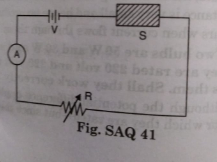
The diagram shows a piece of pure semiconductor S, in series with a varaible resistor R and a source of constant voltage V. Would you increase or decrease the value of R to keep the reading of ammeter (A) constant, when semiconductor S is heated? Give reason.

Promotional Banner

Topper's Solved these Questions

  • ELECTRIC CURRENT. RESISTANCE AND E.M.F

    MODERN PUBLICATION|Exercise EXERCISE|64 Videos
  • DISPERSION

    MODERN PUBLICATION|Exercise EXERCISE|54 Videos
  • ELECTRIC FIELD

    MODERN PUBLICATION|Exercise EXERCISE|95 Videos

Similar Questions

Explore conceptually related problems

A 110 V d.c. heater is used on an a.c. source, such that the heat produced is the same. What would be the r.m.s. value of the alternating voltage?

Direction. In the follwing questions, a statement of assertion is followed by a statement of reason. While answering a question, you are required to choose the correct are out of the given four responses and mark it as (A). If both assertion and reason are true and reason is the correct explanation of the assertion, (B) if both assertion and reason are true but reason is not correct explanation of the assertion. (C) if asssertion is true, but reason if false, (D) if both assertion and reason are false Assertion : The range of an ammeter can be both increased or decreased. Reason : The required shunt resistance can be calculated by using the relation, R= (GS)/(G +S)

The diode used in the circuit shown in the adjacent figure has a constant voltage drop of 0.5V at all currents and a maximum power rating of 100mW.What should be the value of resistor R connected in series with the diode for obtaining maximum current?

Figure 3.33 shows a potentiometer with a cell of 2.0 V and internal resistance 0.40 Omega maintaining a potential drop across the resistor wire AB. A standard cell which maintains a constant emf of 1.02 V (for very moderate currents upto a few mA) gives a balance point at 67.3 cm length of the wire. To ensure very low currents drawn from the standard cell, a very high resistance of 600 k Omega is put in series with it, which is shorted close to the balance point. The standard cell is then replaced by a cell of unknown emf epsilon and the balance point found similarly, turns out to be at 82.3 cm length of the wire. Would the circuit work well for determining an extremely small emf, say of the order of a few mV (such as the typical emf of a thermo-couple)? If not, how will you modify the circuit?:

In a series RC circuit, R = 30 ohm, C = 0.25 mu F, V = 100 V, omega = 10000 rad//s . Find the current in the circuit and calculate the voltage across the resistor and capacitor. Is the algebraic sum of these voltages more than the source voltage ? If yes, resolve the paradox.

MODERN PUBLICATION-ELECTRIC CURRENT. RESISTANCE AND E.M.F-EXERCISE
  1. The diagram shows a piece of pure semiconductor S, in series with a va...

    Text Solution

    |

  2. What is drift velocity of electrons? How do you explain the flow of cu...

    Text Solution

    |

  3. Derive an expressions between drift velocity of elctron and electric c...

    Text Solution

    |

  4. Define drift velocity of electricity and establish its relation with v...

    Text Solution

    |

  5. Explain the term drift velocity of electrons. Hence obtain the express...

    Text Solution

    |

  6. Prove that the current density of a metallic conductor is directly pro...

    Text Solution

    |

  7. Define 'relaxation time' in a conductor. Explain how it varies with in...

    Text Solution

    |

  8. What is the effect of temperature on relaxation time in a metal?

    Text Solution

    |

  9. Derive an expression for drift velocity of free electrons in a conduct...

    Text Solution

    |

  10. Define relaxation time of the electrons drifting in a conductor. How i...

    Text Solution

    |

  11. What is drift velocity?

    Text Solution

    |

  12. What are ohmic and non-ohmic resistors? Give one example of each.

    Text Solution

    |

  13. Deduce Ohm's law using the concept of drift velocity.

    Text Solution

    |

  14. Discuss the various situations, which describe the failure of Ohm's la...

    Text Solution

    |

  15. Resistance of a conductor depends on:

    Text Solution

    |

  16. Resistance of a conductor depends on:

    Text Solution

    |

  17. On what factors resistivity of the material depend?

    Text Solution

    |

  18. Explain how the resistivity of a conductor depends upon relaxation tim...

    Text Solution

    |

  19. Define 'relaxation time' in a conductor. Explain how it varies with in...

    Text Solution

    |

  20. Define the term resistivity and write its S.I. unit. Derive the expres...

    Text Solution

    |

  21. What do you understand by electrical resistivity and give its relation...

    Text Solution

    |