

Home
Class 12
PHYSICS
Two students X and Y performs an experim...

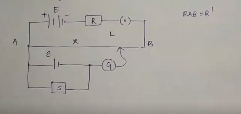
Two students X and Y performs an experiment on potentiometer separately using the ciruit diagram shown in the fig keeping other things unchanged
X increases the value of resistance R.
How would these changes affect the position of null point in each case and why?

Promotional Banner

Topper's Solved these Questions

  • ELECTRICAL MEASUREMENTS

    MODERN PUBLICATION|Exercise EXERCISE|44 Videos
  • ELECTRIC POTENTIAL

    MODERN PUBLICATION|Exercise EXERCISE|38 Videos
  • ELECTROMAGNETIC INDUCTION

    MODERN PUBLICATION|Exercise EXERCISE|146 Videos

Similar Questions

Explore conceptually related problems

Two students X and Y performs an experiment on potentiometer separately using the ciruit diagram shown in the fig keeping other things unchanged Y decreases the value of resistance S in the set up. How would these changes affect the position of null point in each case and why?

Three students X,Y and Z performed an experiment for studying the variation of alternating currents with angular frequency in a series LCR-circuit and obtained the graphs shown in the figure They all used a.c sources of the same r.m.s. value and inductances of the same value. What can we conclude about the resistance values used by them

Three students X,Y and Z performed an experiment for studying the variation of alternating currents with angular frequency in a series LCR-circuit and obtained the graphs shown in the figure They all used a.c sources of the same r.m.s. value and inductances of the same value. What can we conclude about the capacitance value. What can we conclude about nature of the impedance of the set up at frequency omega_0 ?

Two small charged metal sphere A and B are situated in a vaccum. The distance between the centres of the spheres is 12.0 cm, as shown in the fig. The charge on each sphere may be assumed to be a point charge at the centre of the sphere. Point P is a movable point that lies on the line joining the centres of the sphere and is distance x fromt he centre of sphere A. The variation with distance x fo the electric field strength E at point P as shown in the figure. Use fig to state and explain the distance x at which the rate of change of potential with distance is maximum and minimum.

Two identical plane metallic surfaces A and B are kept parallel to each other in air separated by a distance of 1.09 cm as shown in Fig. HQ 6. Surface A is given a positive Potential of 10 V and outer surface of B is earthed. What is the work done in moving a charge of 20 muC from point X to Y. Where X is situated on surface A?

The management committee of a residential colony decided to award some of its members (say x) for honesty, some (say y) for helping others and some other (sayz) for supervising the workers to keep the colony neat and clean. The sum of all the awardees is 12. Three times the sum of the awardees for cooperation and supervision added to two times the number of awardees for honesty is 33. If the sum of the number of awardees for honesty and supervision is twice the number of awardees for helping others. Using matrix method, find the number of awardees of each category, Apart form these values, namely honesty, cooperation and supervisio, suggest one more value, which the management of the colony must include for award.

The existence of negatively charged particle in an atom was shown by J.J. Thomson as a result of the studies of the passage of electricity through gases at extremely low pressure known as discharge tube experiments. When a high voltage of the order of 10,000 volts or more was impressed across the electrodes, some sort of invisible rays moved from the negative electrode to the positive electrode these rays are called as cathode rays. Cathode rays travel in straight path in absence of electrical and magnetic field . Cathode rays consist of material part and charged particles? Cathode rays produce X-rays and light is emitted when they strike on ZnS screen. Cathode rays penetrate through thin sheets of aluminium and other metals . They affect the photogenic plate and passes heating effect when they strike on metal foil. The raito of charge to mass i.e charge/mass is same for all the cathode rays irrespective of the gas used in the tube. The existence of positively charged particle in an atom was shown be E. Goldstein. He repeated the same discharge tube experiments by using a perforated cathode. It was observed that when a high potential difference was applied between the electrodes, not only cathode rays were produced but also a new type of rays were produced simultaneoulsy from anode moving towards cathode and passes through the holes or canal of the cathode. These termed as canal rays or anode rays. These rays travel in straight lines and consists of positively charged particles. These rays have kinetic energy and produces heating effect also. The e/m ratio of these rays is smaller than that of electrons. Unlike cathode rays, their e/m value is dependent upon the nature of the gas taken in the tube. These rays produced flashes of light on ZnS screen and can pass throughs thin metal foils. They can produce physical and chemical changes and are capable to produce ionisation in gases. For cathode rays the value of e/m:

The existence of negatively charged particle in an atom was shown by J.J. Thomson as a result of the studies of the passage of electricity through gases at extremely low pressure known as discharge tube experiments. When a high voltage of the order of 10,000 volts or more was impressed across the electrodes, some sort of invisible rays moved from the negative electrode to the positive electrode these rays are called as cathode rays. Cathode rays travel in straight path in absence of electrical and magnetic field . Cathode rays consist of material part and charged particles? Cathode rays produce X-rays and light is emitted when they strike on ZnS screen. Cathode rays penetrate through thin sheets of aluminium and other metals . They affect the photogenic plate and passes heating effect when they strike on metal foil. The raito of charge to mass i.e charge/mass is same for all the cathode rays irrespective of the gas used in the tube. The existence of positively charged particle in an atom was shown be E. Goldstein. He repeated the same discharge tube experiments by using a perforated cathode. It was observed that when a high potential difference was applied between the electrodes, not only cathode rays were produced but also a new type of rays were produced simultaneoulsy from anode moving towards cathode and passes through the holes or canal of the cathode. These termed as canal rays or anode rays. These rays travel in straight lines and consists of positively charged particles. These rays have kinetic energy and produces heating effect also. The e/m ratio of these rays is smaller than that of electrons. Unlike cathode rays, their e/m value is dependent upon the nature of the gas taken in the tube. These rays produced flashes of light on ZnS screen and can pass throughs thin metal foils. They can produce physical and chemical changes and are capable to produce ionisation in gases. Which is not true with respect to cathode rays?

The existence of negatively charged particle in an atom was shown by J.J. Thomson as a result of the studies of the passage of electricity through gases at extremely low pressure known as discharge tube experiments. When a high voltage of the order of 10,000 volts or more was impressed across the electrodes, some sort of invisible rays moved from the negative electrode to the positive electrode these rays are called as cathode rays. Cathode rays travel in straight path in absence of electrical and magnetic field . Cathode rays consist of material part and charged particles? Cathode rays produce X-rays and light is emitted when they strike on ZnS screen. Cathode rays penetrate through thin sheets of aluminium and other metals . They affect the photogenic plate and passes heating effect when they strike on metal foil. The raito of charge to mass i.e charge/mass is same for all the cathode rays irrespective of the gas used in the tube. The existence of positively charged particle in an atom was shown be E. Goldstein. He repeated the same discharge tube experiments by using a perforated cathode. It was observed that when a high potential difference was applied between the electrodes, not only cathode rays were produced but also a new type of rays were produced simultaneoulsy from anode moving towards cathode and passes through the holes or canal of the cathode. These termed as canal rays or anode rays. These rays travel in straight lines and consists of positively charged particles. These rays have kinetic energy and produces heating effect also. The e/m ratio of these rays is smaller than that of electrons. Unlike cathode rays, their e/m value is dependent upon the nature of the gas taken in the tube. These rays produced flashes of light on ZnS screen and can pass throughs thin metal foils. They can produce physical and chemical changes and are capable to produce ionisation in gases. Select the incorrect statement.

The measurement of an unknown resistance R is to be carried out using wheatstone bridge(see Fig. EP 3.10). Two students perform an experiment in two ways. The first student takes R_2 = 10 Omega and R_1 = 5 Omega . The other student takes R_2 = 1000 Omega and R_1 = 500 Omega . In the standard arm, both takes R_3 = 5 Omega . Both find R = R_2/R_1 R_3 = 10 Omega within errors.

MODERN PUBLICATION-ELECTRICAL MEASUREMENTS-EXERCISE
  1. Two students X and Y performs an experiment on potentiometer separatel...

    Text Solution

    |

  2. State and explain Kirchhoff's laws.

    Text Solution

    |

  3. State and explain Kirchhoff's laws.

    Text Solution

    |

  4. State and explain Kirchhoff's laws.

    Text Solution

    |

  5. Derieve condition of a balanced wheatstone's bridge.

    Text Solution

    |

  6. Using Kirchoff's law, derive the condition for the balance of a Wheats...

    Text Solution

    |

  7. Using Kirchoff's law, derive the condition for the balance of a Wheats...

    Text Solution

    |

  8. State Wheatstone bridge principle. Use kirchoff'slaws to obtain the re...

    Text Solution

    |

  9. State Wheatstone bridge principle. Use kirchoff'slaws to obtain the re...

    Text Solution

    |

  10. Draw the circuit diagram of Wheatstone bridge. Under what condtion, no...

    Text Solution

    |

  11. Draw the circuit diagram of Wheatstone bridge. Under what condtion, no...

    Text Solution

    |

  12. With help of circuit diagram, explain how a meter bridge can be used t...

    Text Solution

    |

  13. Explain the principle of Wheatstone bridge for determining and unknown...

    Text Solution

    |

  14. What is a slide wire bridge? How can you find unknown resistance by it...

    Text Solution

    |

  15. With help of circuit diagram, explain how a meter bridge can be used t...

    Text Solution

    |

  16. Draw a circuit diagram for determining the unknown resistance R using ...

    Text Solution

    |

  17. Draw a circuit diagram of a meter bridge and write the necessary mathe...

    Text Solution

    |

  18. Draw a cricuit diagram of a metre bridge arranged to find the value of...

    Text Solution

    |

  19. Draw a cricuit diagram of a metre bridge arranged to find the value of...

    Text Solution

    |

  20. Draw a neatly labelled diagram of a potentionmeter and explain its pri...

    Text Solution

    |

  21. Explain the principle on which the working of a potentiometer is based...

    Text Solution

    |