

Home
Class 12
PHYSICS
An electron gun G emits electons of ener...

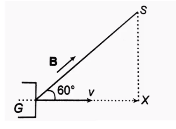
An electron gun G emits electons of energy 2 keV travelling in the positive x-direction. The electons are required to hit the spot S where GS=0.1 m, and the line GS makes an angle of `60^@` with the x-axis as shown in figure. A uniform magnetic field B parallel to GS exists in the region outside the electron gun.

Promotional Banner

Topper's Solved these Questions

  • FORCE ON A CHARGE

    MODERN PUBLICATION|Exercise EXERCISE|59 Videos
  • ELECTROMAGNETIC WAVES

    MODERN PUBLICATION|Exercise EXERCISE|66 Videos
  • FORCE ON A CURRENT

    MODERN PUBLICATION|Exercise EXERCISE|105 Videos

Similar Questions

Explore conceptually related problems

There is an electric field E in x-direction. If the work done on moving a charge of 0.2C through a distance of 2m along a line making a angle 60^@ with x-axis is 4 J, then what is the value of E?

A long straight wire AB carries a current of 4A. A proton P travels at 4x10^6ms^-1 parallel to the wire, 0.2m from it and in a direction opposite to the current as shown in figure. Calculate the force which the magnetic field of current exerts on the proton. Also specify the direction of the force.

An electron moves along x direction. It enters into a region of uniform magnetic field B directed along -z direction as shown in the figure. Draw the shape of trajectory followed by the electron after entering the field.

A rectangular loop PQRS made from a uniform wire has length a, width b and mass m. It is free to rotate about the arm PQ, which remains hinged along a horizontal line taken as the y-axis (see figure). Take the vertically upward direction as the z-axis. A uniform magnetic field vec(B) = (3 hat(i) + 4hat(k)) B_(0) exists in the region. The loop is held in the x-y plane and a current I is passed through it. The loop is now released and is found to stay in the horizontal position in equilibrium What is the direction of the current I in PQ?

A small retangular coil ABCD contains 140 turns of wire. The sides AB and BC of the coil are of length 4.5 and 2.8 cm respectively, as shown in the figure The coil is held between the poles of a large magnet so that the coil can rotate about an axis thorugh its centre. The magnet produces a uniform magnetic field of flux density B between its poles. When the current in the coil is 170 mA, the maximum torque produced in the coil is 2.1 xx 10^-3 N m . For the coil in the position for maximum torque, state whether the plane of the coil is parallel to, or normal to , the direction of the magnetic field.

A small retangular coil ABCD contains 140 turns of wire. The sides AB and BC of the coil are of length 4.5 and 2.8 cm respectively, as shown in the figure The coil is held between the poles of a large magnet so that the coil can rotate about an axis thorugh its centre. The magnet produces a uniform magnetic field of flux density B between its poles. When the current in the coil is 170 mA, the maximum torque produced in the coil is 2.1 xx 10^-3 N m . The current in the coil in (a) is switched off and the coil s positioned as shown in the figure. The coil is then turned thorugh an angle of 90^@ in a time of 0.14 s. Calculate the average e.m.f. induced in the coil.

A uniform electric field of strength 2xx10^3NC^-1 is established between two parallel plates of length 0.1 m held horizontally at a distance 0.02 m apart. An electron is projected at a speed of 6xx10^6 ms^-1 making an angle 45^@ as shown in the figure The field is directed vertically upwards. Will the electron strike the either plate? If it strikes the plate, where does it do so?

The region between x=0 and x=L is filled with uniform steady magnetic field B_0hatk . A particle of mass m, positive charge q and velocity v_0hati travels along x-axis and enters the region of the magnetic field. Neglect the gravity throughout the question. Find the value of L if the particle emerges from the region of magnetic field with its final velocilty at an angel 30^@ to its initial velocity.

A conducting rod PQ of length 20 cm and resistance 0.1 Omega rests on two smooth parallel rqails of negligible resistance AA' and CC'. It can slide on the rails and the arrangement is positioned betwaeen the poles of a permanent magnet producing unifrom magnetic field B=0.4 T. The rails, the rod and the magneitc field are in the three mutually perpendicular directions as shown in the figure. if hte ends A and C of the rails are short cicuited, find the External force required to move the rod with uniform velocity v=10cm/s.

A conducting rod PQ of length 20 cm and resistance 0.1 Omega rests on two smooth parallel rqails of negligible resistance AA' and CC'. It can slide on the rails and the arrangement is positioned betwaeen the poles of a permanent magnet producing unifrom magnetic field B=0.4 T. The rails, the rod and the magneitc field are in the three mutually perpendicular directions as shown in the figure. if hte ends A and C of the rails are short cicuited, find the Power required to move the rod with velocity v= 10 cm/s

MODERN PUBLICATION-FORCE ON A CHARGE-EXERCISE
  1. An electron gun G emits electons of energy 2 keV travelling in the pos...

    Text Solution

    |

  2. Show that the path followed by a charged particle inside the electric ...

    Text Solution

    |

  3. Show that the path followed by a charged particles moving in a directi...

    Text Solution

    |

  4. An electron and a proton,moving parallel to each other in the same dir...

    Text Solution

    |

  5. A stream of elelctrons travelling with speed vms^-1 at right angles to...

    Text Solution

    |

  6. A hydrogen ion of mass m and charge q travels with a speed v along a c...

    Text Solution

    |

  7. A particle of mass m, with charge q moving with a uniform speed v, nor...

    Text Solution

    |

  8. A particle of mass m, with charge q moving with a uniform speed v, nor...

    Text Solution

    |

  9. Write down the expression for the Lorentz force on a charged particle.

    Text Solution

    |

  10. Write an expression for the force expereinced by a charged particle mo...

    Text Solution

    |

  11. Write a relation for the force vecF acting on a charge carrier q movin...

    Text Solution

    |

  12. Discuss the circular motion of a charged particle under the action of ...

    Text Solution

    |

  13. Deduce an expression for the frequency of revolution of a charged part...

    Text Solution

    |

  14. A charge q moving in a straight line is accelerated by a potential dif...

    Text Solution

    |

  15. A charge q moving in a straight line is accelerated by a potential dif...

    Text Solution

    |

  16. An electron beam of velocity v moving in the plane of paper enters a r...

    Text Solution

    |

  17. A particle with charge q moving with a velocity v in the plane of the ...

    Text Solution

    |

  18. A particle of mass m, with charge q moving with a uniform speed v, nor...

    Text Solution

    |

  19. A particle of mass m, with charge q moving with a uniform speed v, nor...

    Text Solution

    |

  20. Discuss the motion of charged particle in uniform magnetic field, when...

    Text Solution

    |

  21. Show that the frequency revolution of a charged pawrticle in a uniform...

    Text Solution

    |