

Home
Class 12
PHYSICS
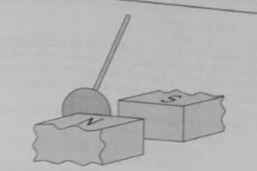
A metal disc is winging freely between t...

A metal disc is winging freely between the poles of an electromagnet, as shown in the figure. When the electromagnet is switched on, the disc comes to rest after a few oscillations. Explain why eddy currents are induced in the metal disc.

Promotional Banner

Topper's Solved these Questions

  • ELECTROMAGNETIC INDUCTION

    MODERN PUBLICATION|Exercise EXERCISE|146 Videos
  • ELECTRICAL MEASUREMENTS

    MODERN PUBLICATION|Exercise EXERCISE|44 Videos
  • ELECTROMAGNETIC WAVES

    MODERN PUBLICATION|Exercise EXERCISE|66 Videos

Similar Questions

Explore conceptually related problems

A metal disc is winging freely between the poles of an electromagnet, as shown in the figure. When the electromagnet is switched on, the disc comes to rest after a few oscillations. Use Faraday's law of electromagnetic induction to explain why an e.m.f. is induced in the disc.

A small retangular coil ABCD contains 140 turns of wire. The sides AB and BC of the coil are of length 4.5 and 2.8 cm respectively, as shown in the figure The coil is held between the poles of a large magnet so that the coil can rotate about an axis thorugh its centre. The magnet produces a uniform magnetic field of flux density B between its poles. When the current in the coil is 170 mA, the maximum torque produced in the coil is 2.1 xx 10^-3 N m . The current in the coil in (a) is switched off and the coil s positioned as shown in the figure. The coil is then turned thorugh an angle of 90^@ in a time of 0.14 s. Calculate the average e.m.f. induced in the coil.

Figure shows a metal rod PQ resting on the smooth rails AB and positioned between the poles of a permanent magnet. The rails, the rod, and the magnetic field are in three mutual perpendicular directions. A galvanometer G connects the rails through a switch K. Length of the rod =15 cm, B = 0.50 T, resistance of the closed loop containing the rod = 9.0 mOmega Assume the field to be uniform. What is the induced emf in the moving rod if the magnetic field is parallel to the rails instead of being perpendicular? :

Figure shows a metal rod PQ resting on the smooth rails AB and positioned between the poles of a permanent magnet. The rails, the rod, and the magnetic field are in three mutual perpendicular directions. A galvanometer G connects the rails through a switch K. Length of the rod =15 cm, B = 0.50 T, resistance of the closed loop containing the rod = 9.0 mOmega Assume the field to be uniform. What is the retarding force on the rod when K is closed? :

Figure shows a metal rod PQ resting on the smooth rails AB and positioned between the poles of a permanent magnet. The rails, the rod, and the magnetic field are in three mutual perpendicular directions. A galvanometer G connects the rails through a switch K. Length of the rod =15 cm, B = 0.50 T, resistance of the closed loop containing the rod = 9.0 mOmega Assume the field to be uniform. Is there an excess charge built up at the ends of the rods when K is open? What if K is closed? :

Figure 6.20 shows a metal rod PQ resting on the smooth rails AB and positioned between the poles of a permanent magnet. The rails, the rod, and the magnetic field are in three mutual perpendicular directions. A galvanometer G connects the rails through a switch K. Length of the rod =15 cm, B = 0.50 T, resistance of the closed loop containing the rod = 9.0 mOmega Assume the field to be uniform. Suppose K is open and the rod is moved with a speed of 12 cm s^-1 in the direction shown. Give the polarity and magnitude of the induced emf. :

Figure shows a metal rod PQ resting on the smooth rails AB and positioned between the poles of a permanent magnet. The rails, the rod, and the magnetic field are in three mutual perpendicular directions. A galvanometer G connects the rails through a switch K. Length of the rod =15 cm, B = 0.50 T, resistance of the closed loop containing the rod = 9.0 mOmega . Assume the field to be uniform and the rod is moved with a speed of 12 cm/s. How much power is dissipated as heat in the closed circuit? What is the source of this power? :

Figure shows a metal rod PQ resting on the smooth rails AB and positioned between the poles of a permanent magnet. The rails, the rod, and the magnetic field are in three mutual perpendicular directions. A galvanometer G connects the rails through a switch K. Length of the rod =15 cm, B = 0.50 T, resistance of the closed loop containing the rod = 9.0 mOmega Assume the field to be uniform. How much power is required (by an external agent) to keep the rod moving at the same speed (= 12 cm s^-1 ) when K is closed? How much power is required when K is open? :

Figure 6.20 shows a metal rod PQ resting on the smooth rails AB and positioned between the poles of a permanent magnet. The rails, the rod, and the magnetic field are in three mutual perpendicular directions. A galvanometer G connects the rails through a switch K. Length of the rod =15 cm, B = 0.50 T, resistance of the closed loop containing the rod = 9.0 mOmega Assume the field to be uniform. With K open and the rod moving uniformly, there is no net force on the electrons in the rod PQ even though they do experience magnetic force due to the motion of the rod. Explain. :

A metal disc of radius 200 cm is rotated at a constant angular speed of 60 rad s^-1 in a plane at right angles to an external field of magnetic induction 0.05 Wb m^-1 . Find the e.m.f. induced between the centre and a point on the rim.

MODERN PUBLICATION-ELECTROMAGNETIC INDUCTION-EXERCISE
  1. A metal disc is winging freely between the poles of an electromagnet, ...

    Text Solution

    |

  2. Explain the concept of magnetic flux linked with a surface.

    Text Solution

    |

  3. What is electromagnetic induction ? State its laws.

    Text Solution

    |

  4. What is electromagnetic induction ? State its laws.

    Text Solution

    |

  5. What is electro-magnetic induction?

    Text Solution

    |

  6. What is electromagnetic induction ? State its laws.

    Text Solution

    |

  7. State Lenz’s law of electromagnetic induction.

    Text Solution

    |

  8. State and explain Faraday’s law of electromagnetic induction.

    Text Solution

    |

  9. State and explain Faraday’s law of electromagnetic induction.

    Text Solution

    |

  10. Is Lenz's law in accordance with the law of conservation of energy?

    Text Solution

    |

  11. State Lenz’s law.Give one example to illustrate it.

    Text Solution

    |

  12. Show that Lenz's law obeys the law of conservation of energy.

    Text Solution

    |

  13. State Lenz’s law of electromagnetic induction.

    Text Solution

    |

  14. Will an induced current be always produced whenever there is change of...

    Text Solution

    |

  15. Derive an expression for induced e.m.f. developed in a conductor of le...

    Text Solution

    |

  16. Derivea expression for inducede.m.f. whenacoilrotates in a uniform mag...

    Text Solution

    |

  17. Derive an expression for induced current, when a coductor of length l ...

    Text Solution

    |

  18. A straight conductor 1 meter long moves a right angles to both, its le...

    Text Solution

    |

  19. What is electromagnetic induction ? State its Faraday's laws. Find an ...

    Text Solution

    |

  20. What is electromagnetic induction ? State its Faraday's laws. Find an ...

    Text Solution

    |

  21. A rectangular conductor LMNO is placed in a uniform magnetic field vec...

    Text Solution

    |