Home
Class 12
PHYSICS
Three students X,Y and Z performed an ex...

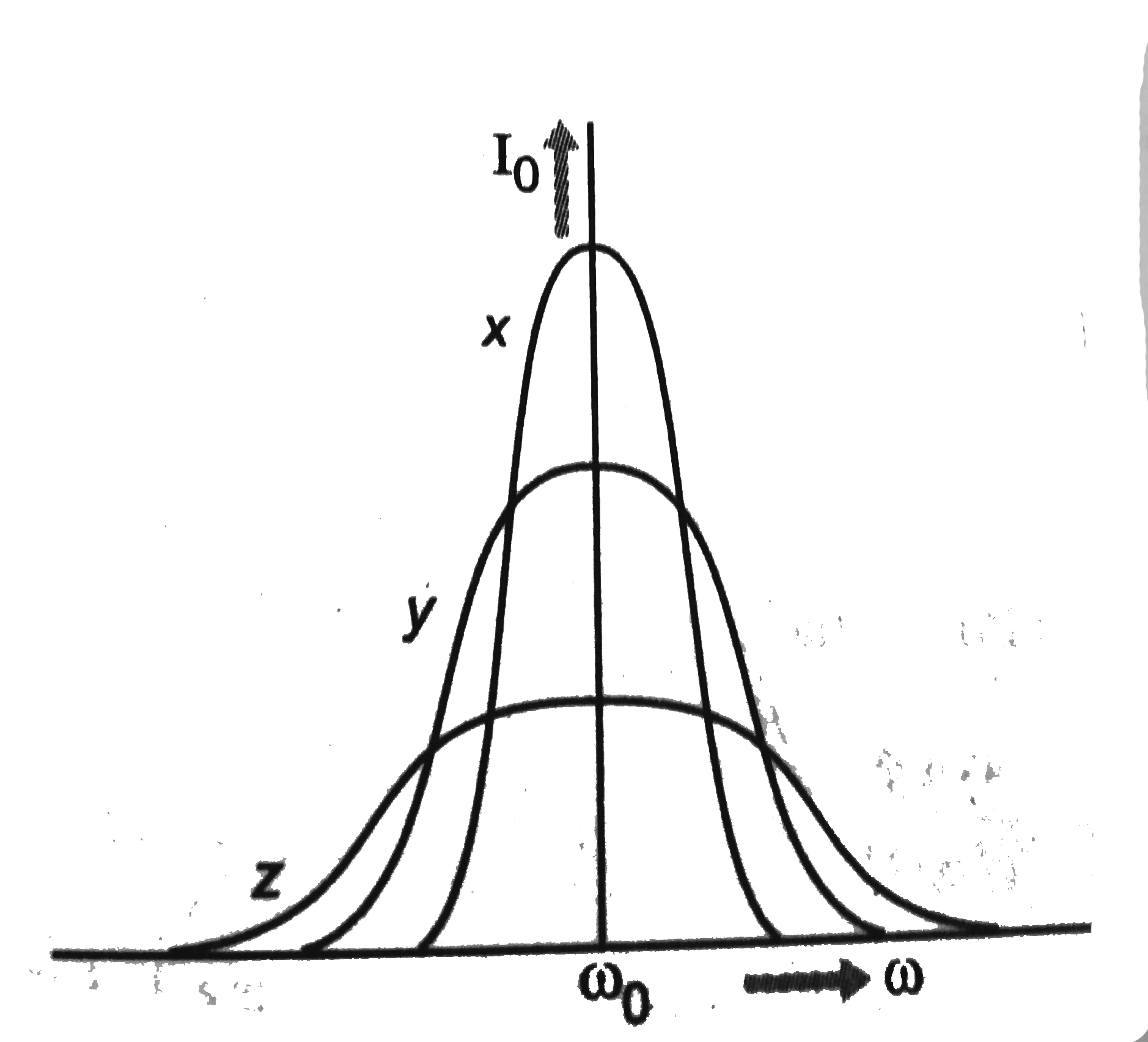
Three students X,Y and Z performed an experiment for studying the variation of alternating currents with angular frequency in a series LCR-circuit and obtained the graphs shown in the figure
They all used a.c sources of the same r.m.s. value and inductances of the same value. What can we conclude about the
resistance values used by them

Promotional Banner

Topper's Solved these Questions

  • ALTERNATING CURRENTS

    MODERN PUBLICATION|Exercise EXERCISE|201 Videos
  • CAPACITOR

    MODERN PUBLICATION|Exercise EXAMPLE|262 Videos

Similar Questions

Explore conceptually related problems

Three students X,Y and Z performed an experiment for studying the variation of alternating currents with angular frequency in a series LCR-circuit and obtained the graphs shown in the figure They all used a.c sources of the same r.m.s. value and inductances of the same value. What can we conclude about the capacitance value. What can we conclude about nature of the impedance of the set up at frequency omega_0 ?

Two students X and Y performs an experiment on potentiometer separately using the ciruit diagram shown in the fig keeping other things unchanged X increases the value of resistance R. How would these changes affect the position of null point in each case and why?

A 110 V d.c. heater is used on an a.c. source, such that the heat produced is the same. What would be the r.m.s. value of the alternating voltage?

Two students X and Y performs an experiment on potentiometer separately using the ciruit diagram shown in the fig keeping other things unchanged Y decreases the value of resistance S in the set up. How would these changes affect the position of null point in each case and why?

The variation of inductive reactance (X_L) of an inductor with the frequency of the ac sources of 100 V and variable frequency is shown in the figure. When this inductor is used in series with a capacitor of unknown value and a resistor of 10 Omega at 300 s^1 , maximum power dissipation occurs in the circuit. calculate the capacitance of the capacitor.

The existence of negatively charged particle in an atom was shown by J.J. Thomson as a result of the studies of the passage of electricity through gases at extremely low pressure known as discharge tube experiments. When a high voltage of the order of 10,000 volts or more was impressed across the electrodes, some sort of invisible rays moved from the negative electrode to the positive electrode these rays are called as cathode rays. Cathode rays travel in straight path in absence of electrical and magnetic field . Cathode rays consist of material part and charged particles? Cathode rays produce X-rays and light is emitted when they strike on ZnS screen. Cathode rays penetrate through thin sheets of aluminium and other metals . They affect the photogenic plate and passes heating effect when they strike on metal foil. The raito of charge to mass i.e charge/mass is same for all the cathode rays irrespective of the gas used in the tube. The existence of positively charged particle in an atom was shown be E. Goldstein. He repeated the same discharge tube experiments by using a perforated cathode. It was observed that when a high potential difference was applied between the electrodes, not only cathode rays were produced but also a new type of rays were produced simultaneoulsy from anode moving towards cathode and passes through the holes or canal of the cathode. These termed as canal rays or anode rays. These rays travel in straight lines and consists of positively charged particles. These rays have kinetic energy and produces heating effect also. The e/m ratio of these rays is smaller than that of electrons. Unlike cathode rays, their e/m value is dependent upon the nature of the gas taken in the tube. These rays produced flashes of light on ZnS screen and can pass throughs thin metal foils. They can produce physical and chemical changes and are capable to produce ionisation in gases. For cathode rays the value of e/m:

The existence of negatively charged particle in an atom was shown by J.J. Thomson as a result of the studies of the passage of electricity through gases at extremely low pressure known as discharge tube experiments. When a high voltage of the order of 10,000 volts or more was impressed across the electrodes, some sort of invisible rays moved from the negative electrode to the positive electrode these rays are called as cathode rays. Cathode rays travel in straight path in absence of electrical and magnetic field . Cathode rays consist of material part and charged particles? Cathode rays produce X-rays and light is emitted when they strike on ZnS screen. Cathode rays penetrate through thin sheets of aluminium and other metals . They affect the photogenic plate and passes heating effect when they strike on metal foil. The raito of charge to mass i.e charge/mass is same for all the cathode rays irrespective of the gas used in the tube. The existence of positively charged particle in an atom was shown be E. Goldstein. He repeated the same discharge tube experiments by using a perforated cathode. It was observed that when a high potential difference was applied between the electrodes, not only cathode rays were produced but also a new type of rays were produced simultaneoulsy from anode moving towards cathode and passes through the holes or canal of the cathode. These termed as canal rays or anode rays. These rays travel in straight lines and consists of positively charged particles. These rays have kinetic energy and produces heating effect also. The e/m ratio of these rays is smaller than that of electrons. Unlike cathode rays, their e/m value is dependent upon the nature of the gas taken in the tube. These rays produced flashes of light on ZnS screen and can pass throughs thin metal foils. They can produce physical and chemical changes and are capable to produce ionisation in gases. Which is not true with respect to cathode rays?

The existence of negatively charged particle in an atom was shown by J.J. Thomson as a result of the studies of the passage of electricity through gases at extremely low pressure known as discharge tube experiments. When a high voltage of the order of 10,000 volts or more was impressed across the electrodes, some sort of invisible rays moved from the negative electrode to the positive electrode these rays are called as cathode rays. Cathode rays travel in straight path in absence of electrical and magnetic field . Cathode rays consist of material part and charged particles? Cathode rays produce X-rays and light is emitted when they strike on ZnS screen. Cathode rays penetrate through thin sheets of aluminium and other metals . They affect the photogenic plate and passes heating effect when they strike on metal foil. The raito of charge to mass i.e charge/mass is same for all the cathode rays irrespective of the gas used in the tube. The existence of positively charged particle in an atom was shown be E. Goldstein. He repeated the same discharge tube experiments by using a perforated cathode. It was observed that when a high potential difference was applied between the electrodes, not only cathode rays were produced but also a new type of rays were produced simultaneoulsy from anode moving towards cathode and passes through the holes or canal of the cathode. These termed as canal rays or anode rays. These rays travel in straight lines and consists of positively charged particles. These rays have kinetic energy and produces heating effect also. The e/m ratio of these rays is smaller than that of electrons. Unlike cathode rays, their e/m value is dependent upon the nature of the gas taken in the tube. These rays produced flashes of light on ZnS screen and can pass throughs thin metal foils. They can produce physical and chemical changes and are capable to produce ionisation in gases. Select the incorrect statement.

LCR circuit connected to a variable frequency 230 V source . L=5.0 H, C=80 micro F and R=40 ohm. Keeping the source frequency equal to the resonating frequency of the series LCR circuit, if the three elements, L, C and R are arranged in parallel, show that the total current in the parallel LCR circuit is minimum at this frequency. Obtain the current rms value in each branch of the circuit for the elements and source.

A 2 mu F capacitor 100 ohm resistor and 8 H inductor are connected in series with an a.c. source. What should be the frequency of soure for which the current drawn in the circuit is maximum? If peak value of emf of the source is 200 V, find the maximum current, inductive reactance, capactive reactance,

MODERN PUBLICATION-ALTERNATING CURRENTS-EXERCISE
  1. What is the quality factor (Q) in an a.c. circuit?

    Text Solution

    |

  2. Three students X,Y and Z performed an experiment for studying the vari...

    Text Solution

    |

  3. Three students X,Y and Z performed an experiment for studying the vari...

    Text Solution

    |

  4. What is sharpness of resonance?

    Text Solution

    |

  5. Why does an LC circuit produce oscillations?

    Text Solution

    |

  6. Why does an LC circuit produce oscillations?

    Text Solution

    |

  7. Explain briefly, how the pehnomenon of resonance in the circuit can be...

    Text Solution

    |

  8. In an a.c. circuit, why is there no power consumption for an ideal ind...

    Text Solution

    |

  9. Prove mathematically that the average power over a complete cycle of a...

    Text Solution

    |

  10. Prove that in an a.c. circuit, an ideal capacitor does nt dissipate po...

    Text Solution

    |

  11. The instantaneous current and voltage in an a.c. circuit given by I = ...

    Text Solution

    |

  12. What do you mean by power factor? On what factors does it depend?

    Text Solution

    |

  13. Explain the importance of power factor.

    Text Solution

    |

  14. For circuit used for transporting electric power, a low power factor i...

    Text Solution

    |

  15. Why power factor correction is must in heavy machinery?

    Text Solution

    |

  16. Power factor can often be improved by the use of capacitor of appropri...

    Text Solution

    |

  17. Which is more dangerous in use a.c. or d.c.? Explain, why?

    Text Solution

    |

  18. Why 200 V a.c. more dangerous than 220 V d.c.?

    Text Solution

    |

  19. Why 200 V a.c. more dangerous than 220 V d.c.?

    Text Solution

    |

  20. Why is the use of A.C. voltage preferred over D.C. voltage? Give two r...

    Text Solution

    |

