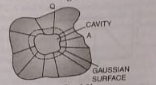
 a charge Q. Show that the entire charge must appear on the outer surface of the conductor.


Topper's Solved these Questions
Similar Questions
Explore conceptually related problems
MODERN PUBLICATION-TEXUAL QUESTIONS -EXERCISE
- A conductor A with cavity as shown in the figure a charge Q. Show t...
Text Solution
|
- A charge q is placed at the centre of line joining two equal charges Q...
Text Solution
|
- Two opposite corners of a square carry Q charges each and the other tw...
Text Solution
|
- A copper ball of density 8.6 g cm^-3 cm in diameter is immersed in oil...
Text Solution
|
- Two point charges of +16muC and -9muC are placed 8 cm apart in air. D...
Text Solution
|
- A spherical conductor of radius 12 cm has a charge of 1.6 xx 10^-7C di...
Text Solution
|
- An electric dipoole, when placed at an angle 30^@ with a uniform elect...
Text Solution
|
- A charged ball B hangs from a silk thread S, which makes an angle thet...
Text Solution
|
- A charged particle q is placed at the centre O of the cube (ABCDEFGH) ...
Text Solution
|
- Two charged conducting spheres A and B having radii a and b connected ...
Text Solution
|
- On moving a charge of 20 C by 2 cm, 2 J of work is done. Then, the pot...
Text Solution
|
- The potential at a point at distance x from some charge placed on X-ax...
Text Solution
|
- Capacitance (in F) of a spherical conductor of radius 1 m is
Text Solution
|
- A sheet of aluminium foil of negligible thickness is introduced betwee...
Text Solution
|
- A parallel plate capacitor is made by stacking n equally spaced plates...
Text Solution
|
- If n capacitors are connected in parallel to a V volt source, then tot...
Text Solution
|
- A battery is used to charge a parallel plate capacitor till the potent...
Text Solution
|
- A parallel plate capacitor with air between the plates has capacitance...
Text Solution
|
- A fully charged capacitor has a capacitance 'C'. It is discharged thro...
Text Solution
|
- The unit of permittivity of free space (E0) is :
Text Solution
|
- When air is replaced by a dielectric medium of dielectric constant K, ...
Text Solution
|