

Home
Class 12
PHYSICS
Fig.110 shows a capacitor made of two ci...

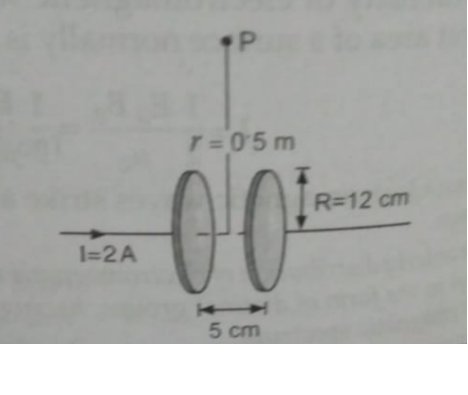
Fig.110 shows a capacitor made of two circular plates each of radius R=12 cm and separated by 5 cm.The capacitor is being charged by an external source (not shown in the figure).Use modified Ampere's circuital law to determine magnetic field at the point P at a distance of 0.5 m from the centre of the plats in the plane midway between them,when the chargingg current is 2A?
.

Promotional Banner

Topper's Solved these Questions

  • ELECTROMAGNETIC WAVES

    MODERN PUBLICATION|Exercise EXERCISE|66 Videos
  • ELECTROMAGNETIC INDUCTION

    MODERN PUBLICATION|Exercise EXERCISE|146 Videos
  • FORCE ON A CHARGE

    MODERN PUBLICATION|Exercise EXERCISE|59 Videos

Similar Questions

Explore conceptually related problems

Figure shows a capacitor made of two circular plates each of radius 12 cm, and separated by 5.0 cm. The capacitor is being charged by an external source (not shown in the figure). The charging current is constant and equal to 0.15A. Obtain the displacement current across the plates. :

Fig. TBQ 8.1 shows a capacitor made of two circular plates each of radius 12 cm, and separated by 5.0 cm. The capacitor is being charged by an external source (not shown in the figure). The charging current is constant and equal to 0.15 A. Calculate the capacitance and rate of change of potential difference between the plates.

Figure 8.6 shows a capacitor made of two circular plates each of radius 12 cm, and separated by 5.0 cm. The capacitor is being charged by an external source (not shown in the figure). The charging current is constant and equal to 0.15A. Is Kirchhoffs first rule (junction rule) valid at each plate of the capacitor? Explain. :

Figure 8.6 shows a capacitor made of two circular plates each of radius 12 cm, and separated by 5.0 cm. The capacitor is being charged by an external source (not shown in the figure). The charging current is constant and equal to 0.15A. Calculate the capacitance and the rate of change of potential difference between the plates. :

A capacitro is made of two circular plates each of radius 0*25 m [Fig 1.09] .It is being charged by an external source.What is the magnetic field at a piont P at adistnce of 0.5 m from the entre of the plates in the plane midway between them,when the charging current is 1 A? .

A parallel plate capacitor (Fig. 8.7) made of circular plates each of radius R = 6.0 cm has a capacitance C = 100 pF. The capacitor is connected to a 230 V ac supply with a (angular) frequency of 300 rad s^-1 . Determine the amplitude of B at a point 3.0 cm from the axis between the plates. :

The magnetic field B due to a current carrying circular loop of radius 12cm at its centre is 0.5xx10^-4T . Find the magnetic field due to this loop at a point on the axis at a distance of 5.0cm from the centre.

Two identical short bar magnets each of magnetic moment 12.5Am^2 are placed at a separation of 10cm between their centres, such that their axes are perpendicular to each other. Find the magnetic field at a point midway between the two magnets.

The two parallel circular loops of wire shown in fig each have a radius R = 20 cm and are separated by a distance a = 0.5 cm. The bottom loop is held fixed and the top loop hangs from one end of the arm of an equal arm balance. Since a is much smaller than R, the magnetic field produced by one loop at the other is practically the same as if both were long straight wires. if the current in each loop is 20 A. How much additional mass m must be added to the right-hand pan of the balance to keep the loops separated by 0.5 cm, when the currents are turned on?

The two parallel circular loops of wire shown in fig each have a radius R = 20 cm and are separated by a distance a = 0.5 cm. The bottom loop is held fixed and the top loop hangs from one end of the arm of an equal arm balance. Since a is much smaller than R, the magnetic field produced by one loop at the other is practically the same as if both were long straight wires. if the curret in each loop is 20 A, how big is the force of attraction of one loop for the other?

MODERN PUBLICATION-ELECTROMAGNETIC WAVES-EXERCISE
  1. Fig.110 shows a capacitor made of two circular plates each of radius R...

    Text Solution

    |

  2. Why did Maxwell introduce the concept of displacement current ?Explain...

    Text Solution

    |

  3. What is displacement current?

    Text Solution

    |

  4. What is displacement current?

    Text Solution

    |

  5. Considering the case of a parallel plate capacitor being charged,tell ...

    Text Solution

    |

  6. Show that the displacement current produced is equal to the conduction...

    Text Solution

    |

  7. What is the source of displacement current?

    Text Solution

    |

  8. A capacitor ,made of two parallel plates,each of area A and separaion ...

    Text Solution

    |

  9. What are electromagnetic waves?

    Text Solution

    |

  10. What are e.m. waves?How are they produced?

    Text Solution

    |

  11. Draw a labelled diagram of Hertz's experiment set up to produce electr...

    Text Solution

    |

  12. Explain with the help of a diagram, Hertz experiment for the productio...

    Text Solution

    |

  13. Hertz,in his historical experiment ,produced stationary electromagneti...

    Text Solution

    |

  14. Draw a labelled diagram of Hertz's experiment set up to produce electr...

    Text Solution

    |

  15. The source of electromagnetic waves can be a charge.

    Text Solution

    |

  16. How does a charge q oscillating at certain frequency produce electroma...

    Text Solution

    |

  17. Why is it not possible to produce electro-megnetic waves in the visibl...

    Text Solution

    |

  18. What are electromagnetic waves?

    Text Solution

    |

  19. Prove that electromagnetic waves are transverse in nature.

    Text Solution

    |

  20. What do you understand by electromagnetic waves? Give their important ...

    Text Solution

    |

  21. What do you understand by electromagnetic waves? Give their important ...

    Text Solution

    |