

Home
Class 12
PHYSICS
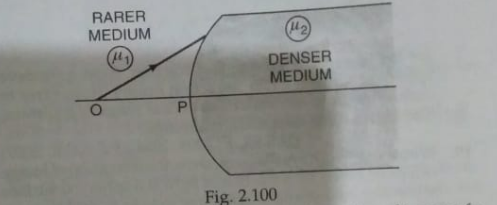
Fig.2.100 shows a convex spherical surfa...

Fig.2.100 shows a convex spherical surface with centre of curature C,separating the two media of refractive indices `mu_1` and `mu_2`.
.
Draw a ray diagram showing the formation of imge of a point object O lying on the principal axis.Derive the relationship between the object and image distances in terms of the refractie indices of the wo media and the radius of curvature R of the surface.

Promotional Banner

Topper's Solved these Questions

  • REFRACTION OF LIGHT

    MODERN PUBLICATION|Exercise EXERCISE|168 Videos
  • REFLECTION OF LIGHT

    MODERN PUBLICATION|Exercise EXERCISE|57 Videos
  • SEMICONDUCTOR DEVICES

    MODERN PUBLICATION|Exercise EXERCISE|174 Videos

Similar Questions

Explore conceptually related problems

Draw a ray diagram to show how the image is formed when the object is placed between f and 2 f distances from a convex lens.Deduce the relation between the distances of he oject and the image from the lens and the focal length of the lens under this condition.

A ocnvex refracting surface of radius of curvature 20 cm separeates two media of refractive indices 4//3 and 1.60.An object is placed in the first medium (mu=4//3) at a distance of 200 cm from the refractign surface.Calculate the position of the image formed.

A spherical convex surface of radius of curvature 20 cm, made of glass (mu=1.5) is placed in air. Find the positon of the image formed, if a point object is placed at 30 cm in front of the convex surface on the principal axis.

By giving sign-conventions, derive the lens formula relating object distance, image distance and focal length for a thin convex lens. Draw a ray diagram to show the formation of image of an object placed between optical centre and focus of a convex lens.

A ray of light passes through four transparent media with refractive indices mu_(1),mu_(2),mu_(3), and mu_(4) as shown in figure. The surfaces of all media are paralle. If the emerent ray CD is parallel to the incident ray AB, we must have

By stating the sign conventions and assumptions used, derive the relation between distance of object, distance of image and radius of curvature of convex spherical surfaces, when refraction takes from optically rarer to optically denser medium.

A convex lens of focal lenght 20 cm is placed coaxially wih a convex mirror of radius of curvature 20 cm.the two are kept at 15 cm apart.A point object lies 60 cm in front of the convex lens.Draw a ray diagram to show the formation of the image by the combination.Determine the nature and position of the image formed.

A spherical surface radius of curvatue R seprates air (refractive index 1.0) from glass 9refractive index 1.5).The centre of curvature is in the glass.A point object P is placed in air is found to have a real image Q in the glass.The line PQ cuts the surface at a point O and PO = OQ[Fig.2.47].Find the distance of object from the shperical surface. .

MODERN PUBLICATION-REFRACTION OF LIGHT-EXERCISE
  1. Prove the following formula when refraction takes place at a convex sp...

    Text Solution

    |

  2. Prove the following formula when refraction takes place at a convex sp...

    Text Solution

    |

  3. Fig.2.100 shows a convex spherical surface with centre of curature C,s...

    Text Solution

    |

  4. Write formula for refraction of light from a single spherical surface.

    Text Solution

    |

  5. Derive the equation relating u,v and R in case of refraction i a medum...

    Text Solution

    |

  6. By stating the sign conventions and assumptions used, derive the relat...

    Text Solution

    |

  7. By stating the sign conventions and assumptions used, derive the relat...

    Text Solution

    |

  8. Starting new cartesian sign conventions, derive the relation. -frac(mu...

    Text Solution

    |

  9. Starting new cartesian sign conventions, derive the relation. -frac(mu...

    Text Solution

    |

  10. Starting new cartesian sign conventions, derive the relation. -frac(mu...

    Text Solution

    |

  11. Starting new cartesian sign conventions, derive the relation. -frac(mu...

    Text Solution

    |

  12. What is the relation between focal length and radius of curvature of a...

    Text Solution

    |

  13. By giving assumptions made, derive the lens maker formula for a double...

    Text Solution

    |

  14. Derive lens maker's formula for a thin concave lens.

    Text Solution

    |

  15. By stating the sign conventions and assumptions used, derive the relat...

    Text Solution

    |

  16. Derive lens maker's formula for a thin concave lens.

    Text Solution

    |

  17. By giving sign-conventions, derive the lens formula relating object di...

    Text Solution

    |

  18. Derive lens maker's formula for a thin concave lens.

    Text Solution

    |

  19. By giving assumptions made, derive the lens maker formula for a double...

    Text Solution

    |

  20. Derive lens maker's formula for a thin concave lens.

    Text Solution

    |