

Home
Class 12
PHYSICS
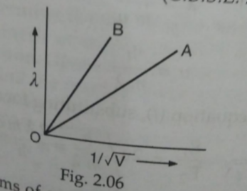
The two lines marked A and B in Fig.2.96...

The two lines marked A and B in Fig.2.96 show a plot of de-Broglie wavelength `(lambda)` as a function of `1//sqrtV` (V is the acceleratijng potential)j for two nuclei `_1H^2` and `_1H^3`.
Identify,which lines correspond to these nuclei?
.

Promotional Banner

Topper's Solved these Questions

  • Wave Nature of Matter

    MODERN PUBLICATION|Exercise EXERCISE|40 Videos
  • UNIT TEST-05

    MODERN PUBLICATION|Exercise EXERCISE|69 Videos

Similar Questions

Explore conceptually related problems

The two lines marked A and B in Fig.2.96 show a plot of de-Broglie wavelength (lambda) as a function of 1//sqrtV (V is the acceleratijng potential)j for two nuclei _1H^2 and _1H^3 . What does the slope of the lines represent? .

The two lines A nad B in Fig.2.06 show the plot of de-Broglie wavelength (lambda) as a function of 1//sqtV ( is the accelertaing potential ) for two particles having the same charge.Which of the two represents the particle sof heavier mass? .

Show that the de-Broglie wavelength lambda of electrons of energy E is givne by the relation: lambda= h /(sqrt(2 m E)) .

What will be the ratio of the radii of two nuclei of mass number A_1 and A_2 ?

Two particles A_1 and A_2 of masses m_1 , m_2(m_1>m_2) have the same de-Broglie wavelength then

Plot a graph showing variation of de-Broglie wavelength (lambda) associated with a charged particle of mass m, versus 1/sqrtV , where particle is accelerated. How does this graph give us the information regarding the magnitude of the charge of the particle?

For two particles A and B, curves are plotted sqrtV against de-Broglie wavelengths, where V is the potential on the particles. Which of the following relation is correct about the mass of particles?

Two nuclei have mass number in the ratio of 1:2, what is the ratio of their nuclear densities?

The figure VSAQ 29 shows a plot of three curves a,b,c, showing the variation of photocurrent in collector plate potential for three different intensities I_1 , I_2 and I_3 having frequencies v_1 , v_2 and v_3 respectively incident on a photosensitive surface. Point out the two curves for which the incident raidations have the same frequency but different intensities.

In the Rydberg equation , a spectral line corresponds to n1 = 3 and n2 = 5. Calculate the wavelength and frequency of this spectral line .

MODERN PUBLICATION-Wave Nature of Matter-EXERCISE
  1. The two lines marked A and B in Fig.2.96 show a plot of de-Broglie wav...

    Text Solution

    |

  2. What is photons? Prove that its rest mass is zero.

    Text Solution

    |

  3. Are matter waves electromagnetic?

    Text Solution

    |

  4. Write de Brogile hypothesis for matter wave and find an expression fo...

    Text Solution

    |

  5. Write de Brogile hypothesis for matter wave and find an expression fo...

    Text Solution

    |

  6. What do you men by dual nature of matter ?

    Text Solution

    |

  7. Derive de Broglie’s equation.

    Text Solution

    |

  8. Calculate the de-Brogile wavelength of an electron.

    Text Solution

    |

  9. Find the de Brogile wavelength associated with an electron accelerated...

    Text Solution

    |

  10. Show that the de-Broglie wavelength lambda of electrons of energy E is...

    Text Solution

    |

  11. Derive the expression for de Broglie wavelength associated with an ele...

    Text Solution

    |

  12. Show that de-Broglie hypothesis of matter wave supports the Bohr's con...

    Text Solution

    |

  13. Derive the expression for de Broglie wavelength associated with an ele...

    Text Solution

    |

  14. Explain the dual behaviour of matter.

    Text Solution

    |

  15. Describe an experiment which shows the wave nature of electron.

    Text Solution

    |

  16. Calculate the wavelength of matter waves associated with a particles o...

    Text Solution

    |

  17. Deterine de-Brogile wavelength associated with a ball of mass 150 g tr...

    Text Solution

    |

  18. Find de Broglie wavelength of wave associated with a particle of rest ...

    Text Solution

    |

  19. Is it possible to observe de -Broglie wave associated with a material ...

    Text Solution

    |

  20. the de-Brolie wavelength of an electron is 2 overset @A.Calculate its ...

    Text Solution

    |

  21. Find the wavelength for a beam of neutrons,whose kinetic energy is 100...

    Text Solution

    |