

Home
Class 12
PHYSICS
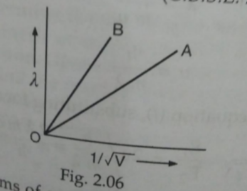
The two lines A nad B in Fig.2.06 show t...

The two lines A nad B in Fig.2.06 show the plot of de-Broglie wavelength `(lambda)` as a function of `1//sqtV` ( is the accelertaing potential ) for two particles having the same charge.Which of the two represents the particle sof heavier mass?
.

Promotional Banner

Topper's Solved these Questions

  • Wave Nature of Matter

    MODERN PUBLICATION|Exercise EXERCISE|40 Videos
  • UNIT TEST-05

    MODERN PUBLICATION|Exercise EXERCISE|69 Videos

Similar Questions

Explore conceptually related problems

The two lines marked A and B in Fig.2.96 show a plot of de-Broglie wavelength (lambda) as a function of 1//sqrtV (V is the acceleratijng potential)j for two nuclei _1H^2 and _1H^3 . What does the slope of the lines represent? .

The two lines marked A and B in Fig.2.96 show a plot of de-Broglie wavelength (lambda) as a function of 1//sqrtV (V is the acceleratijng potential)j for two nuclei _1H^2 and _1H^3 . Identify,which lines correspond to these nuclei? .

Plot a graph showing variation of de-Broglie wavelength (lambda) associated with a charged particle of mass m, versus 1/sqrtV , where particle is accelerated. How does this graph give us the information regarding the magnitude of the charge of the particle?

For two particles A and B, curves are plotted sqrtV against de-Broglie wavelengths, where V is the potential on the particles. Which of the following relation is correct about the mass of particles?

Two particles of equal masses m and m are connected by a light string of length 2l. A constant force F is applied continuously at the mid-point of the string, always along the perpendicular bisector of the straight line joining the two particles. Show that when the distance between the two particles is x, the acceleration of the particle is a = F/m = (x)/((1^2 - x^2) ^(1//2)

Two particles A_1 and A_2 of masses m_1 , m_2(m_1>m_2) have the same de-Broglie wavelength then

The two graphs drawn below show the variation electrostatic potential (V) with 1/r (r being distance of the field point from the point charge) for two point charges q_1 and q_2 . Which of the two charges has a larger magnitude and why?

In figure, the two graphs show the variation of electrostatic potential (V) with 1/r (r being distance of the field point form the point charge) for two point charges q_1 and q_2 Which of the two charges has a larger magnitude and why?

MODERN PUBLICATION-Wave Nature of Matter-EXERCISE
  1. The two lines A nad B in Fig.2.06 show the plot of de-Broglie waveleng...

    Text Solution

    |

  2. What is photons? Prove that its rest mass is zero.

    Text Solution

    |

  3. Are matter waves electromagnetic?

    Text Solution

    |

  4. Write de Brogile hypothesis for matter wave and find an expression fo...

    Text Solution

    |

  5. Write de Brogile hypothesis for matter wave and find an expression fo...

    Text Solution

    |

  6. What do you men by dual nature of matter ?

    Text Solution

    |

  7. Derive de Broglie’s equation.

    Text Solution

    |

  8. Calculate the de-Brogile wavelength of an electron.

    Text Solution

    |

  9. Find the de Brogile wavelength associated with an electron accelerated...

    Text Solution

    |

  10. Show that the de-Broglie wavelength lambda of electrons of energy E is...

    Text Solution

    |

  11. Derive the expression for de Broglie wavelength associated with an ele...

    Text Solution

    |

  12. Show that de-Broglie hypothesis of matter wave supports the Bohr's con...

    Text Solution

    |

  13. Derive the expression for de Broglie wavelength associated with an ele...

    Text Solution

    |

  14. Explain the dual behaviour of matter.

    Text Solution

    |

  15. Describe an experiment which shows the wave nature of electron.

    Text Solution

    |

  16. Calculate the wavelength of matter waves associated with a particles o...

    Text Solution

    |

  17. Deterine de-Brogile wavelength associated with a ball of mass 150 g tr...

    Text Solution

    |

  18. Find de Broglie wavelength of wave associated with a particle of rest ...

    Text Solution

    |

  19. Is it possible to observe de -Broglie wave associated with a material ...

    Text Solution

    |

  20. the de-Brolie wavelength of an electron is 2 overset @A.Calculate its ...

    Text Solution

    |

  21. Find the wavelength for a beam of neutrons,whose kinetic energy is 100...

    Text Solution

    |