


Topper's Solved these Questions
Similar Questions
Explore conceptually related problems
MODERN PUBLICATION-d-AND f- BLOCK ELEMENTS-EXERCISE
- Write the iupac name of the compound : [Co Cl2 (NH3)4 ]^(+)
Text Solution
|
- Match the properties given in Column I with the metals given in Column...
Text Solution
|
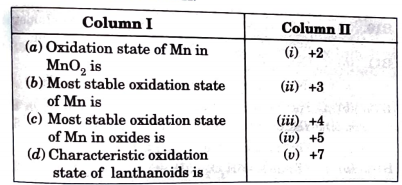
- Match the statements given in Column I with the oxidation states given...
Text Solution
|
- Match the solutions given in Column I and the colours given in Column ...
Text Solution
|
- Write the iupac name of the compound : [Co (en)3 ]^(+3)
Text Solution
|
- Match the properties given in Column I with the metals given in Column...
Text Solution
|
- Assertion : Cu^(2+) iodide is not known. Reason : Cu^(2+) oxidises I^...
Text Solution
|
- Write the IUPAC name of the following: Al[Co (en)3]
Text Solution
|
- Write the IUPAC name of the following: Mg[Ni Cl4]
Text Solution
|
- Assertion : Cu cannot liberate hydrogen from acids. Reason : Because i...
Text Solution
|
- Assertion : The highest oxidation state of osmium is +8. Reason : Osmi...
Text Solution
|
- Explain the following observation : Cu^+ ion is not known in aqueous s...
Text Solution
|
- Why is equropium (II) more stable than cerium (II) (Eu = 63, Ce =58) g...
Text Solution
|
- Which ion has maximum size in Lanthanoid series ?
Text Solution
|
- Write the general electronic configuration of lanthanoids.
Text Solution
|
- Why does Mn(II) shows maximum paramagnetic character among the dival...
Text Solution
|
- How would you account for the irregular variation of ionisation enthal...
Text Solution
|
- Write chemical reaction for preparation of K2Cr207 from chromite ore.
Text Solution
|
- What is meant by ‘disproportionation’? Give two examples of disproport...
Text Solution
|
- Compare the chemistry of actinides with that of Lanthanides with speci...
Text Solution
|