A
B
C
D
Text Solution
Verified by Experts



Topper's Solved these Questions
Similar Questions
Explore conceptually related problems
MODERN PUBLICATION-COORDINATION COMPOUNDS-EXERCISE
- Match the complex ions given in Column I with the hybridisation and nu...
Text Solution
|
- Match the complex species given in Column I with the possible isomeris...
Text Solution
|
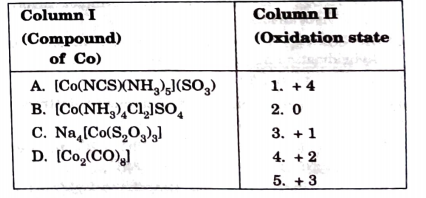
- Match the compounds given in Column I with the oxidation state of coba...
Text Solution
|
- Name the type of isomerism exhibited by the following pair of isomers ...
Text Solution
|
- Write the number of unpaired electron in given compound : [Cr(H2O)6]Cl...
Text Solution
|
- Assertion : Linkage isomerism arises in coordination compounds contain...
Text Solution
|
- Assertion : Complexes of MX6 and MX5L type (X and L are unidentate) do...
Text Solution
|
- Assertion : ([Fe(CN)6]^(3-) ion shows magnetic moment corresponding to...
Text Solution
|
- Give one example of linkage isomer.
Text Solution
|
- Why does NH3 readily form complexes but NH4^(+) does not ?
Text Solution
|
- Give evidence that [CO(NH3)5Cl]S04 and [CO(NH3)5(S04)]Cl are ionisati...
Text Solution
|
- Name central metal atom present in haemoglobin and Vitamin B12.
Text Solution
|
- Name one example of a hexadentate ligand.
Text Solution
|
- Write the IUPAC name of the following : K3[Fe (CN)5 NO]
Text Solution
|
- Write the IUPAC name of the compound [Cr(NCS)(NH3)5] [ZnCl4].
Text Solution
|
- Draw the structures of optical isomers of: [Cr(C2O4)3]^3-
Text Solution
|
- Draw the structures of optical isomers of : Cr(NH3)2Cl2 (en)]^+
Text Solution
|
- The hexaquo manganese(II) ion contains five unpaired electrons, while ...
Text Solution
|
- What is meant by stability of a coordination compound in solution? Sta...
Text Solution
|
- Explain non-ionic nature of CoCl3 .3NH3 on the basis of Werner’s coord...
Text Solution
|