Home
Class 14
REASONING
In each of the following questions one/t...

In each of the following questions one/two statements are given followed by two conclusions and assumption (I) and (II). You have to consider the two statements to be true even if they seem to be at variance from commonly known facts. You have to decide which of the given conclusions and assumption, if any , follow from the given statement.
Statements :
All hens are cocks.
No cock is black.
Conclusions :
I. All cocks are hens.
II. No hen is black.

A

Only conclusion 1 is valid

B

Only conclusion II is valid

C

Both the conclusions are valid

D

Both the conclusions are invalid

Text Solution

Verified by Experts

The correct Answer is:
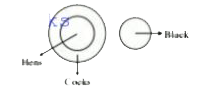
B

Promotional Banner

Topper's Solved these Questions

  • PRACTICE SET 1

    UPKAR PUBLICATION |Exercise PART-I GENERAL INTELLIGENCE|50 Videos

Similar Questions

Explore conceptually related problems

In each of the following questions one/two statements are given followed by two conclusions and assumptions (I) and (II). You have to consider the two statements to be true even if they seem to be at variance from commonly known facts. You have to decide which of the given conclusions and assumptions, if any, follow from the given statement. Statement : He is too industrious to be poor. Assumptions : I. Very industrious people also can be poor. II. Very lazy people can also be rich.

In each of the following questions, one/three statements are given followed by two/ three/four conclusions/assumptions I, II, III & IV. You have to consider the statements to be true even if they seem to be at variance from commonly known facts. You have to decide which of the given conclusions, if any, follow from the given statements. Statements: All students are boys. No boy is dull. Conclusions: I. There are no girls in the class. II. No student is dull.

In each of the following questions one/two statements are given followed by two conclusions I and II. You have to consider the two statements to be true even if they seem to be at variance from commonly known facts. You have to decide which of the given conclusions, if any, follow from the given statements. Statements: Dogs have four legs. Tables have four legs. Conclusions I. Tables are dogs. II. Dogs are tables.

In each of the following questions, two statements are given followed by two/four conclusions I, II, III and IV. You have to consider the two statements to be true even if they seem to be at variance from commonly known facts. You have to decide which of the given conclusions, if any, follow from the given statements. Statements : (a) All pens are papers. (b) No as a eraser paper. Conclusions : I. No eraser is a pen. II. Some papers are pens.

Two statements are given, each followed by two Conclusions/Assumptions I and II. You have to consider the statement to be true even if they seem to be variance from commonly known facts. You have to decide which of the given conclusions/assumptin, if any, follows from the given statements. Statements : (i) Some papers are pens. (ii) All the pencils are pens. Conclusions : I. Some pens are pencils. II. Some pens are papers.

In the following question, two statements are given each followed by two Conclusions I and II. You have to consider the statements to be true even if they seem to be at variance from commonly known facts. You have to decide which of the given Conclusions, if any, follows from the given statements. Statements : I. All dogs are bullocks. II. All bullocks are goats. Conclusions : I. All dogs are goats. II. All goats are dogs.

In each of the following questions, two statements are given followed by two/four conclusions I, II III and IV. You have to consider the two statements to be true even if they seem to be at variance from commonly known facts. You have to decide which of the given conclusions, if any, follow from the given statements. Statements : (a) All peacocks are lions. (b) Some tigers are peacocks. Conclusions : I. Some lions are not tigers. II. All tigers are lions. III. Some tigers are lions. IV. All peacocks are tigers.

In each of the following questions, two statements are given followed by two/four conclusions I, II, III and IV. You have to consider the two statements to be true even if they seem to be at variance from commonly known facts. You have to decide which of the given conclusions, if any, follow from the given statements. Statements : (a) All benches are table. (b) No table is chair. Conclusion: I. All benches are chiars II. All tables are benches III. No tables are benches IV. No benches are chairs

In each of the following questions one/two statements are given followed by two conclusions I and II. You have to consider the two statements to be true even if they seem to be at variance from commonly known facts. You have to decide which of the given conclusions, if any, follow from the given statements. Statements : All animals are birds. Some animals are human beings. Conclusions : I. Some human beings are birds. II. Some birds are human be ings.

In each of the following questions, two statements are given followed by two/four conclusions I, II, III and IV. You have to consider the two statements to be true even if they seem to be at variance from commonly known facts. You have to decide which of the given conclusions, if any, follow from the given statements. Statements : (a) All buses are houses. (b) Some houses are lakes. Conclusions : I. Some buses are lakes. II. Some lakes are buses. III. Some lakes are houses. IV. Some houses are buses.

UPKAR PUBLICATION -PRACTICE SET -6-Part-1 (General Intelligence)
  1. the given alternatives select the word which can be formed using the l...

    Text Solution

    |

  2. Of the six members of a panel sitting in a row E is to the left of B, ...

    Text Solution

    |

  3. In each of the following questions one/two statements are given follow...

    Text Solution

    |

  4. In each of the following questions one/two statements are given follow...

    Text Solution

    |

  5. Out of four figures which figure will best represent the relationship ...

    Text Solution

    |

  6. Which of the answer figure is not made up of only by the components of...

    Text Solution

    |

  7. From the following two different appearances of dice find out the numb...

    Text Solution

    |

  8. From the given answer figures, select the one in which the question fi...

    Text Solution

    |

  9. Which number is present only in one geometrical figure ?

    Text Solution

    |

  10. How many squares are there in the given figure ?

    Text Solution

    |

  11. Which answer figure will com plete the pattern in the question figure ...

    Text Solution

    |

  12. A series is given, with one term missing. Choose the correct alternati...

    Text Solution

    |

  13. A series is given, with one term missing. Choose the correct alternati...

    Text Solution

    |

  14. If 4 cats can kill 4 rats in 4 minutes, how many minutes will it take ...

    Text Solution

    |

  15. From the given alternative words, select the word which cannot be form...

    Text Solution

    |

  16. If MUSTARD is written as 132119201184, how is PROFUSE written in that ...

    Text Solution

    |

  17. If 53 +31 = 2,45 + 27 = 1,69 + 32 = 3, then 97 +26 = ?

    Text Solution

    |

  18. The 3 equations follow the same numerical operation. Find the missing ...

    Text Solution

    |

  19. An official meeting is attended by 130 department employees. Of them, ...

    Text Solution

    |

  20. In the give diagram, Circle represents professional, Square represents...

    Text Solution

    |

