Home
Class 11
PHYSICS
A solid sphere of uniform density and ra...

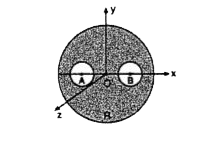
A solid sphere of uniform density and radius 4 units is located with its centre of at the origin O of co
ordinates. Two spheres of equal radii 1 unit with their centres at A(-2,0,0) and B(2,0,0) respectively are taken ou
of the solid leaving behind spherical cavities as shown in figure. Then which of the following statements are true?
(a) The gravitational force due to this object at the origin is zero.
(b) The gravitational force at the point B(2,0,0) is zero.
The gravitational potential is the same at all points on the circle `y^(2)+Z^(2)=36`
(d) The gravitational potential is the same at all points on the circle `y^(2)+Z^(2)=4`

Text Solution

Verified by Experts

Considering the sphere to be made of spheres A and B of radius 1 unit and the remainder R, `M=(4/(3))pi4^(3)P`
and `M_(A)=M_(B)=(4/(3))piI^(3)p=(M/(64))`
(a) As the force at the centre of a sphere is zero `overset rarr F_(A)+overset rarr F_(B)+ overset rarr F_(R)=0` and `overset rarr F_(B)` are equal and opposite for
point O, i.e., `overset rarr F_(A)+ overset rarr F_(B)=0,` so `overset rarr F_(R)=0,` i.e., statement (a) is true.
(b) As the force at a distance r `(lt R)` from the centre of a solid sphere. `F=(("GM"m)/(R^(3)))r` so F due to whole sphere
at B will be `(("GMm")/(4^(3)))2.` So
`overset rarr F_(A)+ overset rarr F_(B)+ overset rarr F_(R)=((2"GMm")/(64))`
Howerver, `F_(B)=0` as the point B at the centre of sphere B and `F_(A)=[G(M//64)m//4^(2)]` as the point B is
outside it . so
`F_(R)=(2"GMm")/(64)-("GMm")/(64 xx 16) =("GMm")/(64)[2-(1)/(16)]ne 0`
i.e., statement (b) is not true.
(C) For a circle `y^(2)+z^(2)=36` , the radius of the circle =6 and so the point is outside the sphere and as for external
point `V=-(("GM")/(r)).`
`V_(A)+V_(B)+V_(R)=-(("GM")/(6))`
Now as for spheres A and B the distance of the point on the cirlce `r= sqrt(6^(2)+2^(2))=sqrt(40)` and the point is
outside the spheres A and B, so
`V_(A)=V_(B)=(-G(M//64))/(sqrt(40))`
`:. V_(R)=-("GM")/(6)-2[-("GM")/(64 sqrt (40))]=-("GM")/(2)`
`[(1)/(3)-(1)/(32 sqrt(10))]`= constant.
i.e., potential at all points of the circle `y^(2)+z^(2)=36` is same, so statement (C) is true.
(d) For a circle `y^(2)+z^(2)=4,` the radius of the circle =2 and so the point is inside the sphere at a distance (4-2)=
2 units from its centre so
`:. V=-("GM")/(2R^(3))(3R^(2)-r^(2))=-("GM")/(2 xx 64)(48-4)=-(22"GM")/(64)`
so `V_(A)+V_(B)+V_(R)=-((22"GM")/(64))`
But as for spheres A and B, the distance of the pont on the cirlce `r= sqrt(2^(2)+2^(2))=2 sqrt(2)` and the point
outside the sphere A or B, So `V_(A)=V_(B)=(-("GM"//64))/(2 sqrt (2))`
`:. V_(R)=-[(22"GM")/(64)-2("GM")/(64 xx 2 sqrt(2))]` = `-("GM")/(64)[22-(1)/(sqrt (2))]` = constant.
i.e., potential at all points of the cirle `y^(2)+z^(2)=4` is same , So statement (d) is true.
Promotional Banner
