Home
Class 11
PHYSICS
A small sphere of radius R is held again...

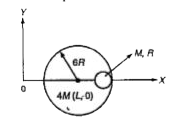
A small sphere of radius R is held against the inner surface of a larger sphere of radius 6 R. The masses of large and small sphere are 4 M and M respectively. This arrangement is placed on a horizontal table. There is no friction between any surfaces of contact. The small sphere is now released. Find the coordinates of the centre of the larger sphere when the smaller sphere reaches the other extreme position.

A

`(L-2R, 0)`

B

`(L+2R, 0)`

C

0, L + 2R

D

`(0, L-R)`

Text Solution

Verified by Experts

The correct Answer is:
B

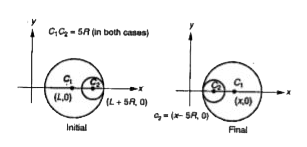
Since, all the surface are smooth, no external force is acting on the system in horizontal direction remains stationary.

x-coordinate of CM initially will be given by
`x_(1)=(m_(1)x_(1)+m_(2)x_(2))/(m_(1)+m_(2))=((4M)(L)+M(L+5R))/(4M+M)=(L+R)` -------(i)
Let (x, 0) be the coordinates of the centre of large sphere in final position. Then, x-coordinate of CM finally will be
`L+R=((x-5R)M+4Mx)/(5M)=(4x+x-5R)/5=x-R` -------(ii)
Equating Eqs. (i) and (ii), we have x = L + 2R.
Therefore, coordinates of large sphere, when the smaller sphere reaches the other extreme position, are (L + 2R, 0).
Promotional Banner

Similar Questions

Explore conceptually related problems

A metallic sphere of radius '4 cm' is melted and recast. How many small spheres of radius '1 cm' will get from it?

Calculate the surface area and volume of a sphere of radius '3 cm .'

A metal sphere of radius 12 centimetres is melted and recast into '27 .' small spheres of equal size. What is the radius of each small sphere?

A small metal sphere is falling through castor oil. Name the velocity of the sphere when the unbalanced force on it is zero

The flux of electricfield passing through the curved surface of the hemisphere of radius R, if vec(E) is radial to the sphere as shown :

A solid sphere of mass 3kg rolls on a horizontal surface with a linear speed of 30m/s . Find the total kinetic energy of the sphere.

The radius of a solid sphere is 6 centimetres. Find its volume and surface area.

