Home
Class 12
CHEMISTRY
For first order parallel reactions k(1) ...

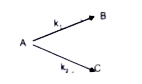
For first order parallel reactions `k_(1)` and `k_(2)` are 4 and 2 `min^(- 1)` respectively at 300 K.. If the activation energies for the formation of B and C are respectively 30,000 and 38,314 joule/mol respectively. The temperature at which B and C will be obtained in equimolar ratio is:

A

757.48 K

B

378.74 K

C

600 K

D

450 K

Text Solution

Verified by Experts

`ln""(k._(1))/(k_(1)) = (E_(1))/(R)[(1)/(T_(1)) - (1)/(T_(2))]` ……(i) `ln""(k._(2))/(k_(2)) = (E_(2))/(R)[(1)/(T_(1)) - (1)/(T_(2))]` ………(ii)
Solving we get (ii) - (i), `ln""(k._(2))/(k_(2)) - ln""(k._(1))/(k_(1)) = ((E_(2) - E_(1))/(R)) ((1)/(T_(1) - T_(2)))`
(for equimolar formation of B and C, `k._(2) = k._(1)`)
`ln((k_(1))/(k_(2))) = ((8314)/(8.314))((T_(2) - 300))/(300 xx T_(2)), ln 2 = (1000)((T_(2) - 300)/(300 xx T_(2))), T_(2) = 378.74 K`
Promotional Banner

Similar Questions

Explore conceptually related problems

For the first order reaction A to B + C , carried out at 27°C, 3.8 xx 10^(-16) % of the reactant molecules exists in the activated state. The E_a (activation energy) of the reaction is:

Critical temperatures of ammonia and CO_2 are 405.5K and 304K respectively. On cooling these gases from 500K, which gas will liquify first?

Rate contant k_2 of a reaction at 310 K is two time of its rate constant k_1 at 300 K.Calculate activation energy of the reaction.(log 2=0.3010,log 1=0)

For the reaction Ag_2O -> 2Ag+ frac{1}{2} O_2 (g) DeltaS and Delta H are 6.66J K^-1mol^-1 and 30.56 kJ mol^-1 respectively. The reaction will not be spontaneous at what temperature

For a reaction A + Brarr C + D . The order with respect to A is 1 and that of B is 2. How is the rate affected when the concentration of both A and B are doubled?

The position vectors of three points A,B,C are given to be i+3j+3k , 4i+4k , -2i+4j+2k respectively.Find vec(AB) and vec(AC)

A reaction has value of Delta H = -40 kcal mol^(-1) at 400 K. Below 400 K the reaction is spontaneous and above 400 K it is not. The value of DeltaG and Delta S at 400 K are respectively

