Home
Class 12
CHEMISTRY
The bromination of acetone that occurs ...

The bromination of acetone that occurs in acid solution is represented by `CH_(3)COCH_(3)(aq)+Br_(2)(aq)rarrCH_(3)COCH_(2)Br(aq)+H^(+)(aq)+Br^(-)(aq)`
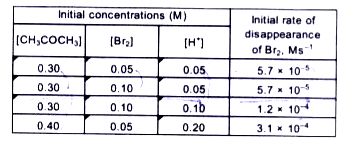
These kinetic data were obtained for given reaction concentration

Based on these data rate equation is

A

Rate `k[CH_(3)COCH_(3)][Br_(2)][H^(+)]^(2)`

B

Rate `k[CH_(3)COCH_(3)][Br_(2)][H^(+)]`

C

Rate `k[CH_(3)COCH_(3)][H^(+)]`

D

Rate `k[CH_(3)COCH_(3)][Br_(2)]`

Text Solution

Verified by Experts

Rate = `[k[CH_(3)COCH_(3)]^(alpha)[Br_(2)]^(beta)[H^(+)]^(gamma)`
`5.7 xx 10^(-5) = k[0.30]^(alpha)[0.05]^(beta)[0.05]^(gamma)` …(i) `5.7 xx 10^(-5) = k[0.30]^(alpha) [0.10]^(beta)[0.05]^(gamma)` …(ii)
`1.2 xx 10^(-4) = k [0.30]^(alpha)[0.10]^(beta)[0.10]^(gamma)` ...(iii) `3.1 xx 10^(-4) = k[0.40]^(alpha)[0.05]^(beta)[0.20]^(gamma)` ...(iv)
Dividing eq. (i) by eq. (ii), `1 = [(1)/(2)]^(beta)`, ie., `beta = 0`
Dividing eq. (ii) by eq. (iii), `1 = [(1)/(2)]^(gamma)`, ie., `gamma = 1`
Dividing eq. (i) by eq. (iv), `(5.7 xx 10^(-5))/(3.1 xx 10^(-4)) = [(3)/(4)]^(alpha) xx [(1)/(4)]^(1)`
`alpha = 1`. Thus, rate law will be, rate `= k[CH_(3)COCH_(3)]^(1)[H^(+)]^(1)`
Promotional Banner

Similar Questions

Explore conceptually related problems

CH_(3)COO C_(2)H_(5)(aq) + H_(2)O(l) overset(H^(+)(aq)) to CH_(3)COOH(aq) + C_(2)H_(5)OH(aq) . What type of reaction is this?

The equilibrium constant for the reaction HCO_(3)^(-)(aq)+HPO_(4)^(2-)(aq) iff CO_(3)^(2-)(aq)+H_(2)PO_(4)^(-)(aq) is approximately 10^(-3) . The strongest conjugate base in this reaction is

Balance the following equation by the half reaction method. Fe^(2+) (aq) + Cr_2O_7^(2-) (aq) +H^(+) (aq) rarr Fe^(3+) (aq) + Cr^(3+) (aq) +H_2O (I)

Is the chemical reaction given below right? Explain the reason: Mg(s)+Pb(NO_3)_2(aq)rarr Mg(NO_3)_2(aq)+Mg(s)

Classify the reactions in one of the reaction type studied in this unit. CH_3CH_2Br+hatSH rarr CH_3CH_2SH+Br^-

Chlorine undergoes the following change in the alkaline solution. Cl_2(g) + 2OH^- (aq) rarr ClO_3^- (aq) + Cl^(-) (aq) + H_2O (aq) Justify that this reaction is an example for disproportionation redox reaction.

Balance the following redox reaction by ion electron method H_2O_2 (aq) + Fe^(2+) (aq) toFe^(3+)(aq) + H_2O (l) (acid medium)

