Home
Class 14
MATHS
The given chart shows the number of stud...

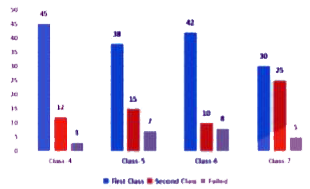
The given chart shows the number of students in Class 4, Class 5, Class 6 and Class 7 who got first class, second class andfailed in the final examinations.

Which class has the least number of students who passed?

A

Class 4

B

Class 6

C

Class 5

D

Class 7

Text Solution

Verified by Experts

The correct Answer is:

B
Promotional Banner

Similar Questions

Explore conceptually related problems

The given chart shows the number of students in Class 4, Class 5, Class 6 and Class 7 who got first class, second class and failed in the final examination. दिए गए आरेख कक्षा 4, कक्षा 5, कक्षा 6 और कक्षा 7 में उन छात्रों की संख्या को दशशाते हैं, जिन्होंने अंतिम परीक्षा में प्रथम श्रेणी, द्वितीय श्रेणी प्राप्त किया और जो असफल रहे। Which class has the least number of students who passed? किस कक्षा में सबसे कम छात्र उत्तीर्ण हुए हैं?

The given chart shows the number of students in Class 4, Class 5, Class 6 and Class 7 who got first class, second class and failed in the final examination. दिए गए आरेख कक्षा 4, कक्षा 5, कक्षा 6 और कक्षा 7 में उन छात्रों की संख्या को दशशाते हैं, जिन्होंने अंतिम परीक्षा में प्रथम श्रेणी, द्वितीय श्रेणी प्राप्त किया और जो असफल रहे। Which class has the highest number of students who passed? किस कक्षा में उत्तीर्ण होने वाले छात्रों की संख्या सबसे अधिक है?

The following graph shows the number of boys and girls in Class V, Class VI, Class VII and Class VIII. Study the graph and answer the question. What class has the maximum number of students?

The data below shows the number of students in class A having secured different marks. What is the mean marks of class A?

Direction: There are 1250 total students in 5 different classes in a school. The number of students in class I is 50 less than the number of students in class II. The number of class IV students is 50 more than the number of students in class II. The average number of students in class III and class V is 250. The number of students in class III is 10% less than the number of students in class I. The ratio of the total number of students of class V to the total number of students of class III is

Direction: There are 1250 total students in 5 different classes in a school. The number of students in class I is 50 less than the number of students in class II. The number of class IV students is 50 more than the number of students in class II. The average number of students in class III and class V is 250. The number of students in class III is 10% less than the number of students in class I. The total number of students of class IV and the number of students of class II is

Direction: There are 1250 total students in 5 different classes in a school. The number of students in class I is 50 less than the number of students in class II. The number of class IV students is 50 more than the number of students in class II. The average number of students in class III and class V is 250. The number of students in class III is 10% less than the number of students in class I. The average number of students of class II and class III is
