

Home
Class 11
BIOLOGY
Visit any nursery or botanical garden. O...

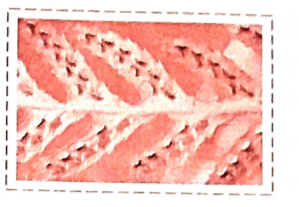
Visit any nursery or botanical garden. Observe some older leaves of fern plant. You can observe some brown spots on back side of the leaflets as shown in the picture given below. Collect more information about it.

Promotional Banner

Similar Questions

Explore conceptually related problems

Question based on paragraph While playing in a garden, Rahul noticed some ornamental plants. When he observed them carefully, he found some Powdery spots on the posterior surface of leaflets of plant. He was curious to observe the flowers or fruits of these plants, but he could not find any of these. Can you guess the plant observed by Rahul in the garden?

Question based on paragraph While playing in a garden, Rahul noticed some ornamental plants. When he observed them carefully, he found some Powdery spots on the posterior surface of leaflets of plant. He was curious to observe the flowers or fruits of these plants, but he could not find any of these. What is the use of powdery spots Present on posterior surface of leaflets?

Question based on paragraph While playing in a garden, Rahul noticed some ornamental plants. When he observed them carefully, he found some Powdery spots on the posterior surface of leaflets of plant. He was curious to observe the flowers or fruits of these plants, but he could not find any of these. Give two more examples of plants belonging to same division.

Question based on paragraph While playing in a garden, Rahul noticed some omamental plants. When he observed them carefully, he found some Powdery spots on the posterior surface of leaflets of plant. He was curious to observe the flowers or fruits of these plants, but he could not find any of these. Since, Rahul could not find any fruits or flowers, in which division he should place this plant?

Question based on paragraph While playing in a garden, Rahul noticed some ornamental plants. When he observed them carefully, he found some Powdery spots on the posterior surface of leaflets of plant. He was curious to observe the flowers or fruits of these plants, but he could not find any of these. If Rahul considers ‘the presence or absence of Organs’ as a criteria to classify this plant, which are the possible divisions?

Read the following paragraph and answer the following questions given below it : Construction of a compound microscope : (i) Acompound microscope consists of a metal tube fitted with two convex lenses at the two ends. These lenses are called the objective lens ( the lens directed towards the object ) and the eyepiece ( the lens directed towards the eye ). Both the lenses are small in size , but the cross section of the objective lens has a short focal length . the focal length of the eyepiece is more than that of the objective lens . (ii) The metal tube is mounted on a stand . thr principal axes of the objective lens and the eyepiece are along the same line . The distance between the object and objective lens can be changed with a screw . It is possible to change the distance between the objective lens and the eyepiece. Working : (i) The object to be observed is illuminated and placed in front of the objective lens. slightly beyond the focal length of the objective lens. it's real , inverted and enlarged image is formed by the objective lens on the other side. (ii) This intermediate image lies with in the focal length of the eyepiece. It serves as an object for the eyepiece. The eyepiece works as a simple microscope . the final image is virtual, highly enlarged and inverted with respect to the original object . It can be formed at the minimum distance of distinct vision from the eyepiece . The final image is observed by keeping the eye close to the eyepiece. Use: This microscope is used to observe blood cells , microorganisms , etc. Where do you place the object to be observed with a compound microscope ?