Home
Class 14
MATHS
Two statements are given followed by two...

Two statements are given followed by two conclusions I and II. You have to consider the two statements to be true even if they seem to be at variance with commonly known facts. You have to decide which of the given conclusions, if any, follows from the given statements :
Statements :
Some birds are parrots. Crow is a bird.
Conclusions :
I. Some parrots are birds.
II. Crow is not a parrot.
निम्नलिखित प्रश्न में दो कथन के आगे दो निष्कर्ष दिये गये हैं। आप सामान्यतः ज्ञात तथ्यों में अंतर होने पर भी कथनों की पड़ताल सत्य समझकर करें। आप तय करें कि दिये गये निष्कर्षों में से कौन-सा, यदि कोई हो, दिये गये कथन से निकलते हैं :
कथन : कुछ चिड़ियाँ तोते हैं। कौआ एक चिड़िया है।
निष्कर्ष :
I कुछ तोते चिड़ियाँ हैं।
II. कौआ एक तोता नहीं है।

A

Only conclusion I follows/केवल I अनुसरण करता है

B

Only conclusion II follows/केवल II अनुसरण करता है

C

Either conclusion I or II follows/केवल या तो I या II अनुसरण करता है

D

Neither conclusion I nor II follows/न तो I न ही II अनुसरण करता है।

Text Solution

Verified by Experts

The correct Answer is:
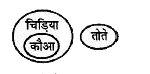
A

Promotional Banner

Similar Questions

Explore conceptually related problems

Two statements are given followed by two conclusions I and II. You have to consider the statements to be true, even if they seem to be at variance from commony known facts. You are to decide which of the given conclusions definitely follows from the given statements. Indicate your answer. Statements : All crows are birds All peacocks are crows. Conclusions : I. All peacocks are birds. II. All birds are peacocks.

In this question two statements are given, followed by two Conclusions, I and II. You have to consider the statements to be true even if they seem to be at variance from commonly known facts. You have to decide which of the given Conclusions, if any, follows from the given statements. Statements : I. All clouds are fogs. II. All fogs are white. Conclusions : I. Some white are clouds. II. Some fogs are clouds.

Two statements are given followed by two conclusions I and II. You have to consider the two statements to be true even if they seem to be at variance from commonly known facts. You have to decide which of the given conclusions, if any, follow from the given statements. Statements : (a) Some human creatures are angels. (b) All doctors are angels. Conclusions : I. Somc human creatures are doctors. II. Some doctors are human creatures.

In the question, two statements are given, followed by two conclusions I and II. You have to consider the statements to be true even if it seems to be at variance from commonly known facts. You have to decide which of the given conclusion, if any, follow(s) from the given statements. Statement 1: No ties are bows. Statement 2: All bows are silk. Conclusion I: Some ties are silk. Conclusion II: Some silk are bows.

Two statements are given, each followed by two Conclusions/Assumptions I and II. You have to consider the statement to be true even if they seem to be variance from commonly known facts. You have to decide which of the given conclusions/assumptin, if any, follows from the given statements. Statements : (i) Some papers are pens. (ii) All the pencils are pens. Conclusions : I. Some pens are pencils. II. Some pens are papers.

In the question two statements are given, followed by two conclusions, I and II. You have to consider the statements to be true even if it seems to be at variance from commonly known facts. You have to decide which of the given conclusions, if any, follows from the given statements. Statement I: Some roses are flowers Statement II: Some red are roses Conclusion I: Some flowers are red Conclusion II: All red are flowers

In the question two statements are given, followed by two conclusions, I and II. You have to consider the statements to be true even if it seems to be at variance from commonly known facts. You have to decide which of the given conclusions, if any, follows from the given statements. Statement I: Some rugs are carpets Statement II: No mats are rugs Conclusion I: All carpets are mats Conclusion II: Some carpets are rugs

In the question, two statements are given, followed by two conclusions, I and II. You have to consider the statements to be true even if it seems to be at variance from commonly known facts. You have to decide which of the given conclusions, if any, follow(s) from the given statements. Statement I: No ties are bows. Statement 2: All bows are silk. Conclusion I: some ties are silk. conclusion II: Some silk are bows.

