Home
Class 11
CHEMISTRY
Both NH(3) and NF(3) have identical shap...

Both `NH_(3) and NF_(3)` have identical shapes and same state of hybridisation. Both N-H and N-F bonds have almost the same electronegativity difference. But still, the two molecules have different dipole moment values. How will you account for it ?

Text Solution

Verified by Experts
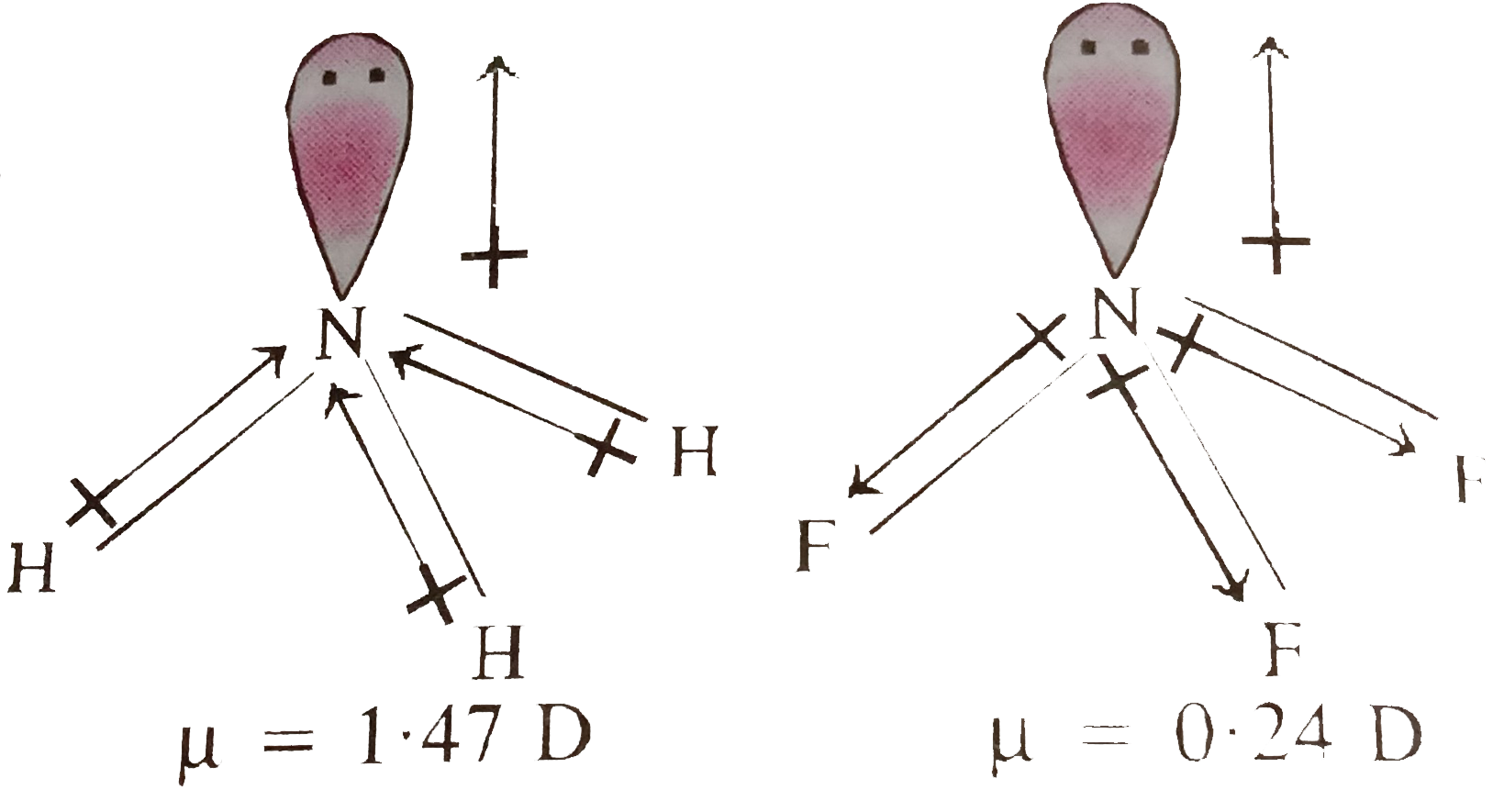
Both `NH_(3)` and `NF_(3)` have pyramidal geometries and the electronegativity difference of bonding atoms in both `NH_(3)` (3.0-2.1=0.9) and `NF_(3)` (4.0-3.0=1.0) mlecules are also nearly the same. But the dipole moment of `NH_(3)` (1.46D) is more than that of `NF_(3)` (0.24D). This is explained on the basis of the difference in the directions of the dipole moments. In `NH_(3)` the dipole moment pair. But in `NF_(3),` the dipole moments of the three N-F bonds are in the direction opposite to that of the lone pair. Therefore, the resultant dipole moment in `NH_(3)` is more than in `NF_(3).`
Promotional Banner

Similar Questions

Explore conceptually related problems

The hybridisation of oxygen in both water and diethyl ether molecules is the same but they differ in their bond angles. Explain.

BeF_(2) and H_(2)O are both tri-atomic molecules but have different shapes. Discuss.

What type of bond is formed between two elements, A and B if both of them are highly electronegative or they have huge difference in their electronegativities. Give examples.

B- F bond is polar but BF_3 does not have a dipole moment — why?

Indicate the type of bonds present in NH_(4)NO_(3) and state the mode of hybridisation of two N-atoms.

Two real gases have the same value of 'b' but the values of 'a' are different , molar volume of which of the gases will be less?

At identical temperature and pressure, the rate of diffusion of H_2 gas is 3sqrt3 times that of a hydrocarbon having molecular formular C_nH_(2n-2) . What is the value of n ?

Two identical light waves, propagating in the same direction, have a phase difference delta . After they superpose the intensity of the resulting wave will be proportional to

(i) What are the types of hybridisation of NH_(4)^(+),CO_(3)^(2-),H_(2)S and SF_(6) ? (ii) C-O bond is polar but CO_(2) does ot have a dipole moment. Why?

All the N-O bonds in NO_(3)^(-) have same bond length. Explain.

