Home
Class 12
CHEMISTRY
Potassium crystallises in a bcc lattice ...

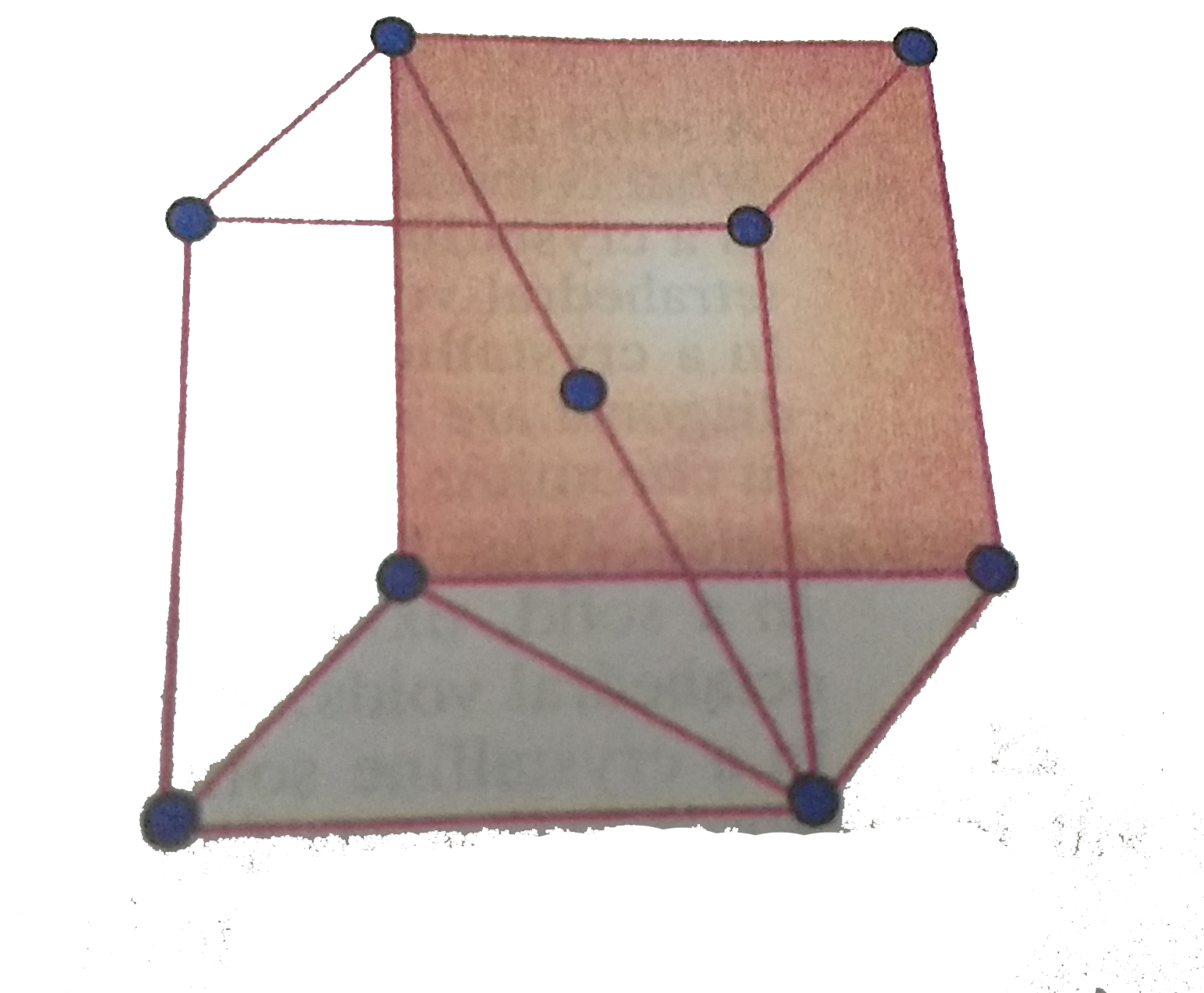
Potassium crystallises in a bcc lattice as shown in figure :
(a) What is the distance the nearest neighbours ?
(b) What is the distance between the next nearest neighbours ?
(c) How many nearest neighbours does each potassium atom have ?
(d) How many next nearest neighbours does each potassium atom have ?

Text Solution

Verified by Experts

(a) The body diagonal is `=sqrt3a=sqrt3xx5.20Å=9.01Å`
The nearest neighbours along that diagonal are at half distance apart `=(9.01)/(2)=4.50Å`
(b) The distance between the next nearest neighbours `=5.20Å` along the cell edge.
(c) Nearest neighbours which surround each potassium atom = 8
(d) Since the C.N. of each potassium atom is six, the next nearest neighbours which surround each potassium atom = 6.
Promotional Banner

Similar Questions

Explore conceptually related problems

What is the distance between two nearest neighbours in a bcc unit cell with an edge length of a?

Sodium crystallises in a body-centred cubic lattice with unit cells of edge length 4.29Å. Calculate the radius of a sodium atom and the distance between the nearest neighbours in the lattice.

Radius of particle in a fcc unit cell is 0.3535 times the edge length of the unit cell. What is the distance between two nearest neighbours in this unit cell?

The edge length of a face-centred cubic unit cell is xsqrt2 . The distance between two nearest neighbours in this unit cell is-

The edge length of body-centred cubic unit cell is asqrt3 . The distance between two nearest neighbours in this unit cell is-

The number of nearest neighbours and that of next nearest neighbours of an atom of a metal with face-centred cubic crystal structure, respectively, are-

An element crystallises in a body-centred cubic structure. The atomic radius of the element is 190pm. Calculate: (1) the distance between two nearest neighbours (2) the body diagonal and the edge length of the unit cell.

An element crystallises in a face-centred cubic lattice. The distance between the nearest neighbours in the unit cell is 282.8pm. Calculate the edge length of the unit cell, and the radius of an atom of the element.

Metallic potassium (atomi mass = 39) has a body centred crystal structure. In the unit cell of this crystal, the distance between two nearest neighbour is 4.52Å. The density of potassium (in kg*m^(-3) ) is-

Nickel crystallises in a cubic close-packed structure. In this structure, the distance between two nearest neighbours is 250pm. If the atomic mass of nickel is 58.7amu, then calculate the density of nickel crystal.
