Home
Class 12
CHEMISTRY
An organic compound [A] C(8)H(6) on reac...

An organic compound [A] `C_(8)H_(6)` on reacting with dilute sulphuric acid containing mercuric sulphate gives a compound [B] which can also be obtained from a reaction of bezene with acid chloride in the presence of anhydrous `AlCl_(3)`. The compound [B] when treated with iodine and aqueous NaOH yields [C] and a yellow compound [D]. Identify [A],[B],[C] and [D] with justification. Show how [B] is formed from [A].

Text Solution

Verified by Experts
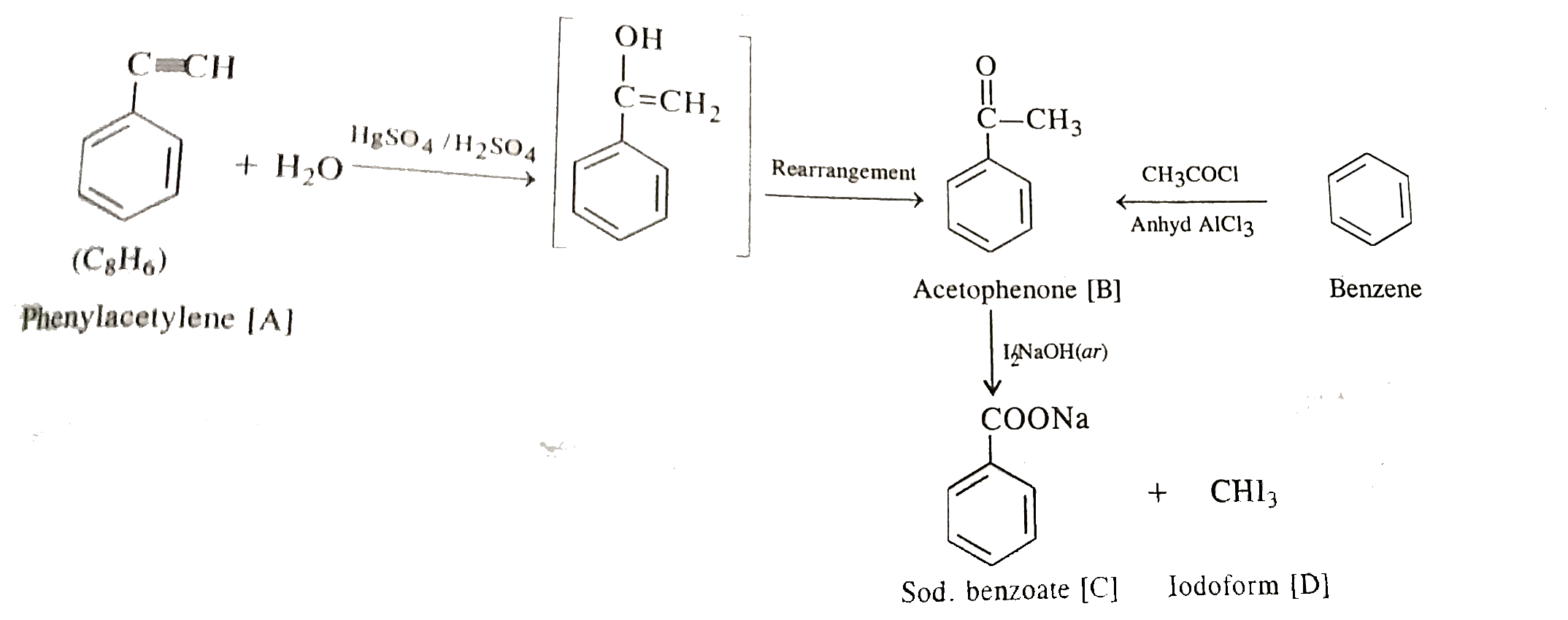
(i) As the compound [B] can be formed by reacting benzene with acid chloride in the presence of anydrous `AlCl_(3)`, It is an aromatic ketone.
(ii) Since the compound [B] gives iodofrom [D] as one of the product on reacting iodine and aquoeus `NaOH`, the compound [B] is acetophenone.
(iii) The compound [A] seems to be a derivative of acetylene since it undergoes hydration under acidic conditions to form [B] which is a ketone i.e., acetophenone.
The sequence may be shown as follows:
Promotional Banner

Similar Questions

Explore conceptually related problems

An organic compound A (C_8H_6) reacts with dilute H_2SO_4 in presence of mercuric chloride to produce another compound (B) . B is also obtained when benzene reacts with an acid chloride in presence of anhyd. AlCl_3 . Identify A and B and give the reactions involved.

When an aromatic compound A (C_7H_8) is oxidised by alkaline KMnO_4 solution, an organic acid (B) is produced. When B is heated with sodalime, another organic compound (C ) is obtained .When C is allowed to react with CH_3Cl in the presence of anhydrous AlCl_3 ,the starting compound A is regenerated. Identify A,B and C.

A ketone A, which undergoes halform reaction, gives compound B on reduction B on heating with sulphuric acid gives compounds C, which forms mono-ozonide D.D on hydrolysis in the presence of zinc dust gives only acetaldehyde. Identify A, B and C. Write down the reaction involved.

An organic compoud [A] which has characteristic odour on treatment with NaOH forms two compounds [B] and [C]. Compounds [B] has the molecule formula C_(7)H_(8)O . Which on oxidation gives back compound [A]-The compound [C] is the sodium salt of an acid [C]. When [C] is heated with sodalime, it yield an aromatic hydrocarbon [D]. Deduce the structures of [A], [B], [C] and [D].

An organic compound [A] with molecular formula C_(4)H_(8)O when reduced with NaBH_(4) gives compound [B] which reacts with HBr to form compound [C] (optically active) Identify A,B , C and wirte the two enantimoers of compound [C].

An element A occupies group number 15 and period number 3, reacts with chlorine to give compound B. The compound Bon hydrolysis gives a dibasic acidC. The compound C on heating undergoes auto oxidation and reduction to give a tribasic acid D. Identify the element A, compound B,C and D. Write the reactions.

An organic compound A( C_3H_8O ) on treatment with Cu dust at 573K gives B. B does not reduce Fehling's solution but gives a yellow precipitate of compound C with I_2//NaOH . Deduce the structures of A , B and C and their IUPAC names.

An organic compound A (C_3H_8O) on treatment with Cu dust at 573 K gives B. B does not reduce Fehling's solutioln but given a yellow precipitate of compound C with I_2\NaOH . Deduce the structrues of A, B and C and their IUPAC names.

An organic compound 'A' (C_2H_6O) reacts with sodium to form a compound 'B' with the evolution of hydrogen gas and gives a yellow compound 'C' when treated with iodine and NaOH. When heated with conc. H_2SO_4 at 140^@C it gives a compound 'D' C_4H_(10) which on treatment with HI at 100^@C gives 'E'. 'B' when heated with 'E' also gives back 'D'. Identify 'A' to 'E' and write equations for the reaction involved.

BF_(3) reacts with LiH and forms a compound A. The compound A reacts with water to give the compound B. A reacts with ammonia at 390 K and form C. Identify (A), (B) and (C).

