Home
Class 12
CHEMISTRY
An aldehyde (A) (C(11)H(8)O), which does...

An aldehyde (A) `(C_(11)H_(8)O)`, which does not undergo self aldol condensation, gives benzaldehyde and 2 mol of (B) on ozonolysis. Compound (B) on oxidation with silver ion gives oxalic acid. Identify the compounds (A) and (B).

Text Solution

Verified by Experts
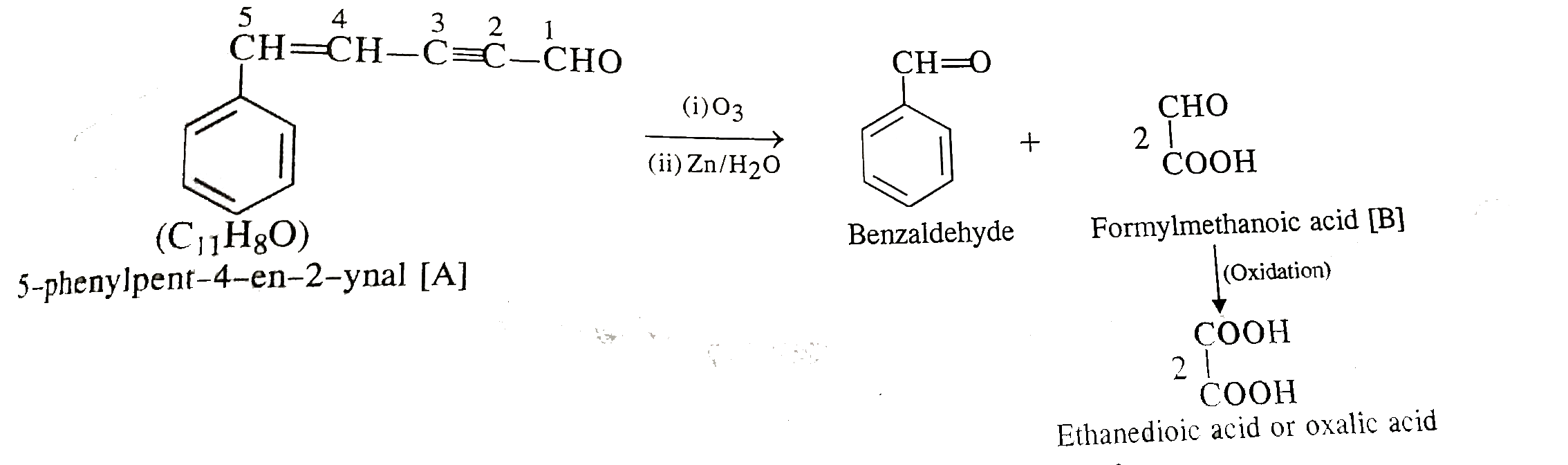
(i) As the compound 'A' `(C_(11)H_(8)O)` gives benzaldehyde as one of the products on ozonolysis, it must have a benzene nucleus or phenyl group `(C_(6)H_(5))`. The formula of the side chain is `(C_(11)H_(8)O - C_(6)H_(5)) = C_(5)H_(3)O`
(ii) Since the compound 'A' is an aldehyde therefore, the side chain may be written as `C_(4)H_(2)CHO`. Thus, the compound 'A' may be expressed as : `C_(6)H_(5)(C_(4)H_(2)CHO)`
(iii) As one mole of 'A' on ozonolysis gives two moles of 'B'. This mean that the size chain must have two unsaturated bonds and one of them must be a triple bond.
(iv) As the compound 'A' does not undergo Aldol condensation, there should no `alpha`-hydrogen atom. Keeping in view the above observations, the formula of the compound 'A' is `C_(6)H_(5)-CH=CH-C-=C-CHO`. The sequence of the reactions involved is as follows :
Promotional Banner

Similar Questions

Explore conceptually related problems

An element A occupies group number 15 and period number 3, reacts with chlorine to give compound B. The compound Bon hydrolysis gives a dibasic acidC. The compound C on heating undergoes auto oxidation and reduction to give a tribasic acid D. Identify the element A, compound B,C and D. Write the reactions.

An organic compound (A) with molecular formula C_(8)H_(8)O forms an orange-red precipitate with 2,4-DNP reagent and gives yellow precipitate on heating with iodine in the presence of sodium hydroxide. It neither reduces Tollens or Fehlings reagent, nor does it decolourise bromine water or Baeyerâs reagent. On drastic oxidation with chromic acid, it gives a carboxylic acid (B) having molecular formula C_(7)H_(6)O_(2) . Identify the compounds (A) and (B) and explain the reactions involved.

An organic compound (A) with molecular formula C_(6)H_(7)N gives (B) with HNO_(2)//HCl at 273 K. The aqueous solution of (B) on heating gives compound (C) which gives violet colour with neutral FeCl3. Identify the compounds A, B and C and write the equations.

An alkane A on ozobolysis yields acetone and an aldeyde. The aldehyde is easily oxidised to an acid B. When B is treated with bromine in presence of yields a compound C which on hydrolysis gives a hydroxyle acid D. This acid can also be obatined from acetone by the reaction with hydrogen cyanide followed by hydrolysis. Identify the compounds A, B C and D.

