Home
Class 14
MATHS
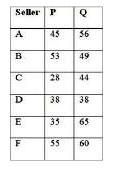
The Table shows the number of articles s...

The Table shows the number of articles sold by six different sellers (A, B, C, D, E and F) to two different shopkeepers P and Q. Some articles are purchased by other sellers also. Total articles purchased by shopkeepers P and Q is 300 and 500 respectively.

Total number of articles sold by seller C to shopkeeper Q is what percent of total number of articles sold by seller F to shopkeeper P?

A

0.75

B

0.84

C

0.78

D

0.8

Text Solution

Verified by Experts

The correct Answer is:

A
Promotional Banner

Similar Questions

Explore conceptually related problems

The Table shows the number of articles sold by six different sellers (A, B, C, D, E and F) to two different shopkeepers P and Q. Some articles are purchased by other sellers also. Total articles purchased by shopkeepers P and Q is 300 and 500 respectively. यह तालिका छः अलग-अलग विक्रेताओं ( A, B, C, D, E और F ) के द्वारा दो दुकानदारों (P और Q) को बेची गयी वस्तुओं की संख्या दर्शाती है | कुछ वस्तुएँ अन्य विक्रेताओं के द्वारा भी ख़रीदी जाती हैं | दुकानदार P और Q के द्वारा ख़रीदी गयी कुल वस्तुओं की संख्या क्रमशः 300 और 500 है | Total number of articles sold by seller C to shopkeeper Q is what percent of total number of articles sold by seller F to shopkeeper P’? विक्रेता C के द्वारा दुकानदार Q को बेची गयी वस्तुओं की कुल संख्या विक्रेता F के द्वारा दुकानदार P को बेची गयी वस्तुओं की कुल संख्या का कितना प्रतिशत है ?

The Table shows the number of articles sold by six different sellers (A, B, C, D, E and F) to two different shopkeepers P and Q. Some articles are purchased by other sellers also. Total articles purchased by shopkeepers P and Q is 300 and 500 respectively. यह तालिका छः अलग-अलग विक्रेताओं ( A, B, C, D, E और F ) के द्वारा दो दुकानदारों (P और Q) को बेची गयी वस्तुओं की संख्या दर्शाती है | कुछ वस्तुएँ अन्य विक्रेताओं के द्वारा भी ख़रीदी जाती हैं | दुकानदार P और Q के द्वारा ख़रीदी गयी कुल वस्तुओं की संख्या क्रमशः 300 और 500 है | What is the difference between total articles sold to P and Q by all the sellers other than A, B, C, D, E and F? A, B, C, D, E और F के अलावा अन्य विक्रेताओं के द्वारा P और Q को बेची गयी वस्तुओं की कुल संख्या में क्या अंतर है ?

The Table shows the number of articles sold by six different sellers (A, B, C, D, E and F) to two different shopkeepers P and Q. Some articles are purchased by other sellers also. Total articles purchased by shopkeepers P and Q is 300 and 500 respectively. यह तालिका छः अलग-अलग विक्रेताओं ( A, B, C, D, E और F ) के द्वारा दो दुकानदारों (P और Q) को बेची गयी वस्तुओं की संख्या दर्शाती है | कुछ वस्तुएँ अन्य विक्रेताओं के द्वारा भी ख़रीदी जाती हैं | दुकानदार P और Q के द्वारा ख़रीदी गयी कुल वस्तुओं की संख्या क्रमशः 300 और 500 है | What is the average number of articles sold to the shopkeeper P by the sellers A, B, C and D together ? दुकानदार P को विक्रेताओं A, B, C और D के द्वारा कुल मिलाकर बेची गयी वस्तुओं की संख्या का औसत क्या है?

Number of Redmi cellular sold by store R is what percent more than the total number of Samsung cellular phones sold by stores P and Q together ?

The total number of sold by P and Q together on Wednesday is how much percentage more than the number of mobiles sold by P and Q together on Tuesday ?

If 6 articles are sold for Rs 1 then there is a loss of 20%. In order to gain 20%, what must be the number of articles sold for Rs 1 ?

When the price of an article is increased by 15% the number of articles aold decreases by 20% What is the percentage change in the sales revenue? (Sales revenue = piece of each article X number of articles sold).

The cost of an article is Rs. 500 and on selling it, the shopkeeper got 6.4% profit. Find the selling price of article.
