Home
Class 14
MATHS
The Table shows the number of articles s...

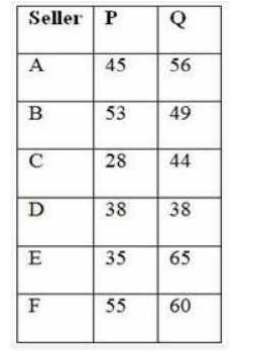
The Table shows the number of articles sold by six different sellers (A, B, C, D, E and F) to two different shopkeepers P and Q. Some articles are purchased by other sellers also. Total articles purchased by shopkeepers P and Q is 300 and 500 respectively.

What is the difference between total articles sold to P and Q by all the sellers other than A, B, C, D, E and F?

A

142

B

162

C

152

D

172

Text Solution

Verified by Experts

The correct Answer is:

A
Promotional Banner

Similar Questions

Explore conceptually related problems

The Table shows the number of articles sold by six different sellers (A, B, C, D, E and F) to two different shopkeepers P and Q. Some articles are purchased by other sellers also. Total articles purchased by shopkeepers P and Q is 300 and 500 respectively. Total number of articles sold by seller C to shopkeeper Q is what percent of total number of articles sold by seller F to shopkeeper P?

The Table shows the number of articles sold by six different sellers (A, B, C, D, E and F) to two different shopkeepers P and Q. Some articles are purchased by other sellers also. Total articles purchased by shopkeepers P and Q is 300 and 500 respectively. यह तालिका छः अलग-अलग विक्रेताओं ( A, B, C, D, E और F ) के द्वारा दो दुकानदारों (P और Q) को बेची गयी वस्तुओं की संख्या दर्शाती है | कुछ वस्तुएँ अन्य विक्रेताओं के द्वारा भी ख़रीदी जाती हैं | दुकानदार P और Q के द्वारा ख़रीदी गयी कुल वस्तुओं की संख्या क्रमशः 300 और 500 है | Total number of articles sold by seller C to shopkeeper Q is what percent of total number of articles sold by seller F to shopkeeper P’? विक्रेता C के द्वारा दुकानदार Q को बेची गयी वस्तुओं की कुल संख्या विक्रेता F के द्वारा दुकानदार P को बेची गयी वस्तुओं की कुल संख्या का कितना प्रतिशत है ?

The Table shows the number of articles sold by six different sellers (A, B, C, D, E and F) to two different shopkeepers P and Q. Some articles are purchased by other sellers also. Total articles purchased by shopkeepers P and Q is 300 and 500 respectively. यह तालिका छः अलग-अलग विक्रेताओं ( A, B, C, D, E और F ) के द्वारा दो दुकानदारों (P और Q) को बेची गयी वस्तुओं की संख्या दर्शाती है | कुछ वस्तुएँ अन्य विक्रेताओं के द्वारा भी ख़रीदी जाती हैं | दुकानदार P और Q के द्वारा ख़रीदी गयी कुल वस्तुओं की संख्या क्रमशः 300 और 500 है | What is the difference between total articles sold to P and Q by all the sellers other than A, B, C, D, E and F? A, B, C, D, E और F के अलावा अन्य विक्रेताओं के द्वारा P और Q को बेची गयी वस्तुओं की कुल संख्या में क्या अंतर है ?

The Table shows the number of articles sold by six different sellers (A, B, C, D, E and F) to two different shopkeepers P and Q. Some articles are purchased by other sellers also. Total articles purchased by shopkeepers P and Q is 300 and 500 respectively. यह तालिका छः अलग-अलग विक्रेताओं ( A, B, C, D, E और F ) के द्वारा दो दुकानदारों (P और Q) को बेची गयी वस्तुओं की संख्या दर्शाती है | कुछ वस्तुएँ अन्य विक्रेताओं के द्वारा भी ख़रीदी जाती हैं | दुकानदार P और Q के द्वारा ख़रीदी गयी कुल वस्तुओं की संख्या क्रमशः 300 और 500 है | What is the average number of articles sold to the shopkeeper P by the sellers A, B, C and D together ? दुकानदार P को विक्रेताओं A, B, C और D के द्वारा कुल मिलाकर बेची गयी वस्तुओं की संख्या का औसत क्या है?

What difference does the author note between the flute seller and the other hawkers?

An article is purchased for Rs 7500 and sold for Rs 9375. What is the profit%?

Loss If the selling price (S.P) of an article is less than the cost price (C.P) the difference between the cost price (S.P.) is called loss.

A shopkeeper marks the price of an article 25 % aboveits cost price. After allowing 10% discount on the marketprice, the article is sold for ₹720. Whatis the difference (in ₹) between the cost price and marketprice of the article?

An article is purchased for Rs 4200 and sold for Rs 4830. What is the profit percetnage?
