

Home
Class 7
PHYSICS
Refer the apparatus and procedure given ...

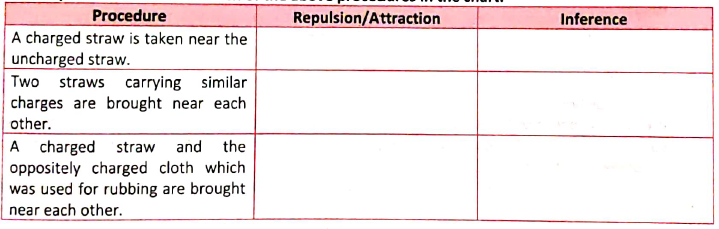
Refer the apparatus and procedure given on textbook page no. 53. Rcord your observations in each of the above procedures in the chart.

Promotional Banner

Topper's Solved these Questions

  • PROPERTIES OF NATURAL RESOURCES

    TARGET PUBLICATION|Exercise SOLVED|76 Videos

Similar Questions

Explore conceptually related problems

Refer the materials and procedure given on textbook page no. 52. Record your observations in the chart. : Repeat this procedure with each of the given materials.

Observe the figure of financial transactions given on textbook page 74 and answer the following questions : What does the symbol on the bag in the centre stand for?

Apparatus: Two plastic bottles, measuring cylinder, thermometer, etc Chemicals: Potassium nitrate, sodium hydroxide, water, etc. (Sodium hydroxide being corrosive, handle it carefully in presence of teacher.) Procedure: Take I 00 mL water in each of the two plastic bottles. Plastic being insulator of heat, the dissipation of heat can be prevented. Note the temperature of water in the bottles. Put 5 g potassium nitrate (KNO_3) in the bottle and shake well. Note the temperature of the solution formed. Put 5 g sodium hydroxide (NaOH) in the other bottle. Shake the bottle well. Note the temperature. In the first bottle, the process of dissolution of potassium nitrate took place while in the second bottle, the process of dissolution of sodium hydroxide took place As per your observation which one is exothermic process and which is an endothermic process?

Observe figure 7.1 given on page no. 81 of your textbook and explain the relationship between the given components.

To charge an object by induction. : Rub a comb or a balloon on your hair. As shown in the picture 8.4 on page 54 of your textbook, take the comb near a thin trickle of water from a tap what happes. Now draw the comb away from the trcikle and observe what happens. : Mark your observation with a tick. : When the charged comb is brought close to the flowing water, water gets attracted/repelled/remains as it was. : when the charged comb is taken away from the flowing water, it gets attracted.repelled/remains as it was initially.

Study the various compoents given in figure 7.5 on pages no . 84 your textbook and explain the bio-geo -chemical cycle in your own words.

Pictures of various organisms are given in figure 7.2 on page no. 82 of your textbook. Construct a food web from those pictures.

Manish was given aqueous solutions of silver nitrate, zinc sulphate and an iron nail. In the first experiment, he dipped iron nail in silver nitrate solution and observed that the solution turned brown. In second experiment, he dipped iron nail in zinc sulphate solution. However, no change was observed. Based on the above information, answer the following questions. Based on your observation, arrange Ag, Zn and Fe in decreasing order of their reactivity.

Apparatus: Two aluminium tins of the same size, two small galsses, water, thermometers, black paint, etc. : Procedure: Paint the outer surface of one tin black paint, and let it dry. Then in both tins, place one glass, each filled with water at the same temperature. cover the tins with lids. Keep them in the sun for two hours. Now measure the temperature of the water in the glasses in the two tins. What is the reason for the difference in the temperature?

Apparatus : Test tube, beakers, burner, etc. Chemicals : Glacial ethanoic acid, ethanol, concentrated sulphuric acid, etc. Procedure : Take 1 mL ethanol and 1 mL glacial ethanoic acid in a test tube. Add a few drops of concentrated sulphuric acid in it. Keeps this test tube in the beaker containing hot water (hot water bath) for five minutes. Then take 20-30 mL water in another beaker, and pour the above reaction mixture in it and smell it. What can you say about the smell of the reaction mixture?

TARGET PUBLICATION-STATIC ELECTRICITY-SOLVED
  1. Now take plastic rod. Rub one of its ends against a woollen cloth. Bri...

    Text Solution

    |

  2. Refer the materials and procedure given on textbook page no. 52. Recor...

    Text Solution

    |

  3. Refer the apparatus and procedure given on textbook page no. 53. Rcord...

    Text Solution

    |

  4. To charge an object by contact. : Rub a plastic comb against paper. T...

    Text Solution

    |

  5. To charge an object by induction. : Rub a comb or a balloon on your h...

    Text Solution

    |

  6. Keep a spent tubelight in a dark place. Rub it vigorouly with a thin p...

    Text Solution

    |

  7. Oral work : When do we say that asn object is electrically neutral?

    Text Solution

    |

  8. Oral work : When is an object said to be charged?

    Text Solution

    |

  9. Oral work : Why should the experiments of static electricity be perfo...

    Text Solution

    |

  10. Oral work : Which device is used to detect the electric charge on an ...

    Text Solution

    |

  11. Oral work : Name the device installed on the top of the buildings to ...

    Text Solution

    |

  12. Activities : Find out where is the concept os static electricity used...

    Text Solution

    |

  13. Fill in the blanks. : In …………….. Objects, the positive and negative c...

    Text Solution

    |

  14. Fill in the blanks. : Two like charges push each other away. This cal...

    Text Solution

    |

  15. Fill in the blanks. : Each atom is electrically …………

    Text Solution

    |

  16. Fill in the blanks. : Benjamin Franklin conducted an experiment of fl...

    Text Solution

    |

  17. Fill in the blanks. : When a charged object is brought near to a neut...

    Text Solution

    |

  18. Odd one out. : Copper, plastic, cotton, nylon.

    Text Solution

    |

  19. Odd one out. : Bringing rubbed silk cloth near neutral glass rod, bri...

    Text Solution

    |

  20. Distinguish between Charging by Conduction and Charging by Induction.

    Text Solution

    |