Home
Class 14
MATHS
Study the given graph and answer the que...

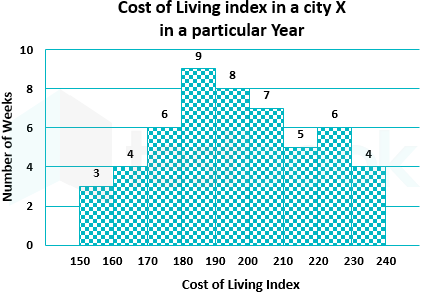
Study the given graph and answer the question that follows.
The number of weeks, in which the cost of living index was 160 or more but less than 190, is approximately what percent more than the number of weeks in which the cost of living index was 200 or more but less than 220 (correct to one decimal place)?

A

36.8

B

58.3

C

44.4

D

60.6

Text Solution

AI Generated Solution

The correct Answer is:

To solve the problem, we need to analyze the given graph to determine the number of weeks for two specific ranges of the cost of living index (C.I.) and then calculate the percentage difference. ### Step-by-Step Solution: 1. **Identify the Range for C.I. 160 to 190:** - We need to find the number of weeks where the cost of living index (C.I.) is **160 or more but less than 190**. - From the graph, we can see the following values: - Weeks with C.I. 160-170: **4 weeks** - Weeks with C.I. 170-180: **6 weeks** - Weeks with C.I. 180-190: **9 weeks** - Total weeks in this range = 4 + 6 + 9 = **19 weeks**. 2. **Identify the Range for C.I. 200 to 220:** - Now, we need to find the number of weeks where the C.I. is **200 or more but less than 220**. - From the graph, we can see the following values: - Weeks with C.I. 200-210: **7 weeks** - Weeks with C.I. 210-220: **5 weeks** - Total weeks in this range = 7 + 5 = **12 weeks**. 3. **Calculate the Percentage Increase:** - We need to find out how much more the number of weeks in the first range (160 to 190) is compared to the second range (200 to 220) as a percentage. - The formula for percentage increase is: \[ \text{Percentage Increase} = \left( \frac{\text{New Value} - \text{Old Value}}{\text{Old Value}} \right) \times 100 \] - Here, the New Value is 19 weeks (C.I. 160-190) and the Old Value is 12 weeks (C.I. 200-220). - Plugging in the values: \[ \text{Percentage Increase} = \left( \frac{19 - 12}{12} \right) \times 100 = \left( \frac{7}{12} \right) \times 100 \approx 58.33\% \] - Rounding to one decimal place, we get **58.3%**. ### Final Answer: The number of weeks in which the cost of living index was 160 or more but less than 190 is approximately **58.3%** more than the number of weeks in which the cost of living index was 200 or more but less than 220.
Promotional Banner

Similar Questions

Explore conceptually related problems

Study the given graph and answer the question that follows: The number of weeks, iin which the cost of living index was 160 or more but less than 190, is approximately what percent more than the number of weeks in which the cost of livinig index was 200 or more but less than 220 (correct to one decimal place)? दिए गए ग्राफ का अध्ययन करें और उस प्रश्न का उत्तर दें जो निम्न है: सप्ताह की संख्या, iin जो लिविंग इंडेक्स की लागत 160 या उससे अधिक है, लेकिन 190 से कम है, लगभग यही है। उन सप्ताहों की तुलना में प्रतिशत अधिक है जिनमें लिविन्ग इंडेक्स की लागत 200 या उससे अधिक थी लेकिन 220 से कम (एक दशमलव स्थान के लिए सही)?

Study the given graph and answer the question that follows . The number of students who obtained 20 marks or more but less than 60 marks is :

Study the given graph and answer the question that follows. The number of workers whose age is 32 years or more but less than 44 years is:

Study the given graph and answer the question that follows the number of workers whose age is 32 years or more but less than 44 years is:

Study the given pie chart and answr the question that follows The number of workers whose age is 36 years of more but less than 48 years in what percentage more than the number of workers whose age is less than 28 years

Study the graph and answer the question the number of workers in the factory whose weekly earnings are below Rs 5500 or more but less than Rs 7500 is

Study the graph and answer the question. The number of workers in the factory whose weekly earnings are ₹5,500 or more but less than Rs.7,500 is:

Study the graph and answer the question The number of workers in the factory whose daily wages are Rs 450 or more but less than Rs 600 is

Study the graph and answer the question The number of workers in the factory whose daily wages are Rs 500 or more but less than Rs 650 is what percentage more than the number of workers whose daily wages are Rs 650 or more but less than Rs 750

Study the graph and answer the question The number of families whose montly expenditures on education are Rs 2000 or more but less than Rs 4000 is
