Home
Class 12
CHEMISTRY
The following questions refer to the twe...

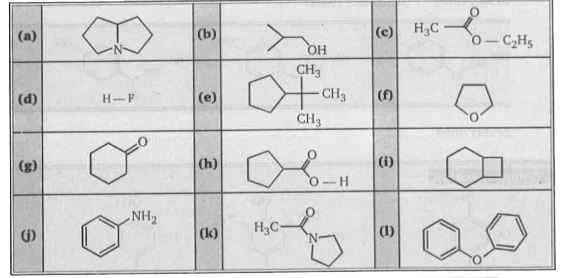
The following questions refer to the twelve compounds given below. You may enter as many as six choices in each answer box.

Which compounds will not participate in H-bonding ?

Text Solution

Verified by Experts

The correct Answer is:

e , i

Compounds do not have above properties cannot form H-bond.
Promotional Banner

Topper's Solved these Questions

  • GENERAL ORGANIC CHEMISTRY

    MS CHOUHAN|Exercise LEVEL - 2 (SUBJECTIVE PROBLEMS )|13 Videos
  • GENERAL ORGANIC CHEMISTRY

    MS CHOUHAN|Exercise LEVEL - 2 (SUBJECTIVE PROBLEMS )|13 Videos
  • CARBOXYLIC ACID AND THEIR DERIVATIVES

    MS CHOUHAN|Exercise LEVEL-2( SUBJECTIVE PROBLEMS)|1 Videos
  • GRIGNARD REAGENT

    MS CHOUHAN|Exercise Level-2 (Subjective Problems)|6 Videos

Similar Questions

Explore conceptually related problems

The following questions refer to the twelve compounds given below. You may enter as many as six choices in each answer box. Which compound may serve only as H-bond acceptors?

The following questions refer to the twelve compounds given below. You may enter as many as six choices in each answer box. Which may serve both as H-bond donors and acceptors?

The following questions refer to the compounds (A to G) shown below :

Identify the following double bonds either E, Z or None (N) in the compounds given below either.

Examine the ten structural formulas shown below and select those that satisfy each of the following conditions. Enter one or more letters (a through j) in each answer box, reflecting your choice for each. Which compounds undergo electrophilic nitration more rapidly than benzene ?

Examine the ten structural formulas shown below and select those that satisfy each of the following conditions. Enter one or more letters (a through j) in each answer box, reflecting your choice for each. Which compounds give meta substitution under electrophilic bromination conditions ?

Examine structures a through j, shown below, with respect to their symmetry or lack of it. Assume that the five-membered rings and the ring in compound g are planar. The wedge-hatched bonds in b, c, d & e designate specific configurations. Also, for the acyclic compounds assume stable anti conformations. Answer each of the following questions by writing letters (a through j), corresponding to your selections, in each answer box. If there is no structure that fits the description enter an x in the answer box. Which structures are chiral ?

Examine structures through a to j, shown below, with respect to their symmetry or lack of it. Assume that the five-membered rings and the ring in compound g are planar. The wedge-hatched bonds in b, c, d & e designate specific configurations. Also, for the acyclic compounds assume stable anti conformations. Answer each of the following questions by writing letters (a through j), corresponding to your selections, in each answer box. If there is no structure that fits the description enter an x in the answer box. Which structures have a plane of symmetry?

Examine structures through a to j, shown below, with respect to their symmetry or lack of it. Assume that the five-membered rings and the ring in compound g are planar. The wedge-hatched bonds in b, c, d & e designate specific configurations. Also, for the acyclic compounds assume stable anti conformations. Answer each of the following questions by writing letters (a through j), corresponding to your selections, in each answer box. If there is no structure that fits the description enter an x in the answer box. Which structures have a center of symmetry ?

The structural formula of ten compounds, (I) through (X) are drawn below, you may select any one of these structure. Answer the following question about that compound. A. How many chiral centre are present in this compound ? (a) 0 (b) 1 (c) 2 (d) 3 (e) 4 (f) 5 B. Is this compound chiral or achiral ? C. What symmetry element are present in this compound ? (a) None (b) Plane of symmetry (c) Center of symmetry

MS CHOUHAN-GENERAL ORGANIC CHEMISTRY -LEVEL - 2
  1. The following questions refer to the twelve compounds given below. You...

    Text Solution

    |

  2. The following questions refer to the twelve compounds given below. You...

    Text Solution

    |

  3. The following questions refer to the twelve compounds given below. You...

    Text Solution

    |

  4. Consider the following compounds and answer A and B. Which of th...

    Text Solution

    |

  5. Consider the following compounds and answer A and B. Which of th...

    Text Solution

    |

  6. Rank the non-bonding electrons indicated by the arrows in order of inc...

    Text Solution

    |

  7. In each of the following sections four nitrogen containing compounds a...

    Text Solution

    |

  8. For the two sets of acids shown below, rank their acidity most acidic ...

    Text Solution

    |

  9. For the two sets of acids shown below, rank their acidity most acidic ...

    Text Solution

    |

  10. In each of the following sections four compounds are listed. In the bo...

    Text Solution

    |

  11. In the two questions below, you are asked to rank the relative strengt...

    Text Solution

    |

  12. In the two questions below, you are asked to rank the relative strengt...

    Text Solution

    |

  13. In each of the following sections four compounds are listed. (Decreasi...

    Text Solution

    |

  14. Rank in the order of increasing basic strength.

    Text Solution

    |

  15. Compare acidic strength of the following (Write your answer in box).

    Text Solution

    |

  16. Arrange the hydrogens in increasing order of their acidic strengths.

    Text Solution

    |

  17. The compounds whose structures are shown below, incorporate a variety ...

    Text Solution

    |

  18. The compounds whose structures are shown below, incorporate a variety ...

    Text Solution

    |

  19. The compounds whose structures are shown below, incorporate a variety ...

    Text Solution

    |

  20. The compounds whose structures are shown below, incorporate a variety ...

    Text Solution

    |
