Text Solution
Verified by Experts
The correct Answer is:



Topper's Solved these Questions
ISOMERISM (STRUCTURAL & STEREOISOMERISM)
MS CHOUHAN|Exercise LEVEL 2 (SUBJECTIVE PROBLEMS)|17 VideosISOMERISM (STRUCTURAL & STEREOISOMERISM)
MS CHOUHAN|Exercise LEVEL 2 (SUBJECTIVE PROBLEMS)|17 VideosHYDROCARBONS (ALKYNES)
MS CHOUHAN|Exercise Level -1|32 VideosIUPAC NAME
MS CHOUHAN|Exercise LEVEL-2 (SUBJECTIVE PROBLEMS ) |1 Videos
Similar Questions
Explore conceptually related problems
MS CHOUHAN-ISOMERISM (STRUCTURAL & STEREOISOMERISM)-LEVEL 2
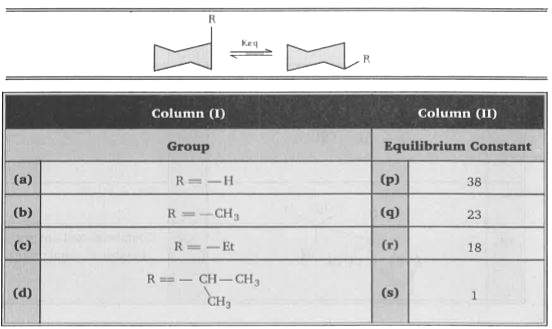
- Match the Column (I) and (II).
Text Solution
|
- Match the Column (I) and (II).
Text Solution
|
- Match the Column (I) and (II). (Matrix)
Text Solution
|
- Match the Column (I) and (II), (Matrix)
Text Solution
|
- Match the Column (I) and (II).
Text Solution
|
- Match the Column (I) and (II). (Matrix)
Text Solution
|
- Match the Column (I) and (II). (Matrix)
Text Solution
|
- Match the Column (I) and (II). (Matrix)
Text Solution
|
- Match the Column (I) and (II). (Matrix)
Text Solution
|
- Match the Column (I) and (II).
Text Solution
|
- Match the Column (I) and (II).
Text Solution
|
- Match the Column (I) and (II). (Matrix)
Text Solution
|
- Match the Column (I) and (II).
Text Solution
|
- Match the Column (I) and (II).
Text Solution
|
- Match the Column (I) and (II). (Matrix)
Text Solution
|
- Match the Column (I), (II) and (III). (Matrix)
Text Solution
|
- From the above compounds select : (A) two of which are chiral and con...
Text Solution
|
- Consider the structures and answer A, B & C Which of the compound is...
Text Solution
|
- Consider the given structures and answer A, B & C. Which of the isom...
Text Solution
|
- Identify relationship between following pairs : If they are enant...
Text Solution
|