Home
Class 12
CHEMISTRY
Which of the two stereoisomers of 4-t-bu...

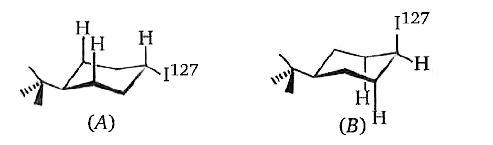
Which of the two stereoisomers of 4-t-butylcyclohexyl iodide `(""^(127) I^(-))` will undergo `S_(N)^(2)` substitution with `""^(128)I^(-)` faster, and why?

A

A will react faster because it is the more stable of the two isomers

B

A will react faster because it will yield a more stable product, and the transition state for both reactions is of the same energy

C

A will react faster because the approach of `""^(128) I^(-)` can depart unhindered.

D

B will react faster because it is less stable than A, and the transition state for both reactions is of the same energy

Text Solution

Verified by Experts

The correct Answer is:
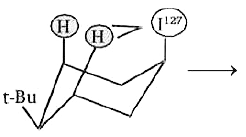
D


- due to 1,3 repulsion I.G. tendeny increase so rate of reaction
Promotional Banner

Topper's Solved these Questions

  • ALKYL HALIDES (SUBSTITUTION REACTIONS)

    MS CHOUHAN|Exercise LEVEL-2|41 Videos
  • ALKYL HALIDES (ELIMINATION REACTION)

    MS CHOUHAN|Exercise LEVEL-2|25 Videos
  • AMINES

    MS CHOUHAN|Exercise Level-2|1 Videos

Similar Questions

Explore conceptually related problems

Comprehension The first demonstration of the stereochemistry of the S_(N^2) reaction was carried out in 1934 by Prof. E.D Hughes and his colleagues at the University of London. They allowed (R) -2- iodooctane to react with radioactive iodide ion (""^(**)I-) The rate of substitution (rate constant K_5 ) was determined by measuring the rate of incorporation of radioactivity into the alkyl halide. The rate of loss of optical acitivity from the alkyl halide (rate constant K_0 ) was also determined under the same conditions: What ratio K_0//K_s is predicted for each of the following stereochemical scenarios : For inversion reaction :

Comprehension The first demonstration of the stereochemistry of the S_(N^2) reaction was carried out in 1934 by Prof. E.D Hughes and his colleagues at the University of London. They allowed (R) -2- iodooctane to react with radioactive iodide ion (""^(**)I-) The rate of substitution (rate constant K_5 ) was determined by measuring the rate of incorporation of radioactivity into the alkyl halide. The rate of loss of optical acitivity from the alkyl halide (rate constant K_0 ) was also determined under the same conditions: What ratio K_0//K_s is predicted for each of the following stereochemical scenarios : For equal amounts of both retention and inversion ?

Which of the following undergoes nucleophilic substitution exclusively by S_(N)1 mechanism?

Which of the following compounds would react faster with NaCN in an S_(N^2) reaction ?

Which one of the following compounds most readily undergoes substitution by S_(N)2 mechanism?

Which two of the following salts are used for preparing iodized salt? (i)KIO 3 ​ (ii)KI (iii)I 2 ​ (iv)HI

Which of the following alkyl halides most readily undergoes hydrolysis by S_(N)I mechanism?

If n is any positive integer then the value of (i^(4 n+1)-i^(4 m-1))/(2)=

MS CHOUHAN-ALKYL HALIDES (SUBSTITUTION REACTIONS)-LEVEL-2
  1. Which of the two stereoisomers of 4-t-butylcyclohexyl iodide (""^(127)...

    Text Solution

    |

  2. Statement - 1 : Nucleophilicity order in polar-protic solvent is I^(-)...

    Text Solution

    |

  3. Statement - 1 : CH(3) - CH(2) - Cl + Nal overset("Acetone") rarr CH(3)...

    Text Solution

    |

  4. Encircle whichever of the following:

    Text Solution

    |

  5. Encircle whichever of the following: undergoes S(N^2) reaction more...

    Text Solution

    |

  6. Encircle whichever of the following: undergoes S(N^1) reaction more r...

    Text Solution

    |

  7. Encircle whichever of the following: undergoes an E2 reaction to giv...

    Text Solution

    |

  8. Encircle whichever of the following: reacts with Nal to give (Z) - 1...

    Text Solution

    |

  9. Encircle whichever of the following: undergoes S(N^(1)) reaction mo...

    Text Solution

    |

  10. Encircle whichever of the following : undergoes S(N^2) reaction mor...

    Text Solution

    |

  11. Encircle whichever of the following : undergoes an E1 reaction more ...

    Text Solution

    |

  12. Encircle whichever of the following : undergoes an S(N^1) reaction m...

    Text Solution

    |

  13. Encircle whichever of the following : undergoes an S(N^2) reaction m...

    Text Solution

    |

  14. Encircle whichever of the following : undergoes an E2 reaction more ...

    Text Solution

    |

  15. Match the column :

    Text Solution

    |

  16. Matrix :

    Text Solution

    |

  17. Encircle whichever of the following : undergoes an S(N^2) reaction m...

    Text Solution

    |

  18. Encircle whichever of the following : undergoes an S(N^1) reaction m...

    Text Solution

    |

  19. Encircle whichever of the following : undergoes an S(N^1) reaction m...

    Text Solution

    |

  20. Reativity : Circle the reaction that reacts FASTER by S(N^2) in each p...

    Text Solution

    |

  21. Consider the potential energy diagram given below (X) Name the po...

    Text Solution

    |

