Home
Class 12
CHEMISTRY
The reaction, proceeds by the...........

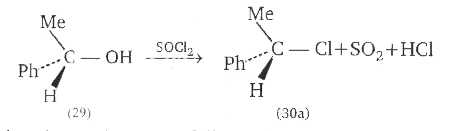
The reaction,
proceeds by the........... mechanism.

A

`S_(N^1)`

B

`S_(N^2)`

C

`S_(E^2)`

D

`S_(N^i)`

Text Solution

Verified by Experts

The correct Answer is:
A

`S_(N^1)` mechanism: retention of configuration: Retention of configuration, means the starting material and product have the same configuration.

The reaction has been shown to follow a second order rate equation rate `= k_2 [ROH][SOCl_2]` , but clearly cannot proceed by the simple `S_(N^2)` mode for this would lead to inversion ofconfiguration in the product, which is not observed.
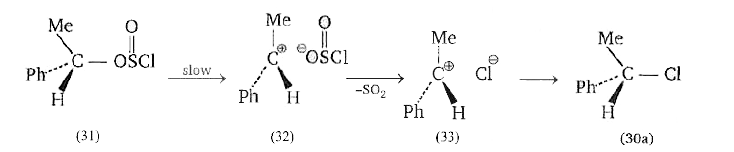
Carrying out the reaction under milder conditions allows of the isolation of an alkyl chlorosulphite , ROSOCl (31) , and this can be shown to be a true intermediate. The chlorosulphite is formed with retention ofconfiguration, the R-O bond not being broken during the reaction. The rate at which the alkyl chlorosulphite intermediate (31) breaks down to the product, RCl (30a), is found to increase with increasing polarity of the solvent, and also with increasing stability ofthe carbocation `R^(oplus)` : an ion pair, `R^(oplus Theta)` OSOCI (32), is almostcertainlyinvolved. Provided collapse ofthe ion pair to products thenoccurs rapidly, i.e., in the intimate ion pair (33) within a solvent cage, then attackby `Cl^(Theta)` is likely to occur on the same side of `R^(oplus)` from which `""^(Theta) OSOCl` departed, i.e., with retention of configuration:

Whether the breaking ofthe c-oand the S-Clbonds occurs simultaneously, orwhether the former occurs first, is still a matter of debate.
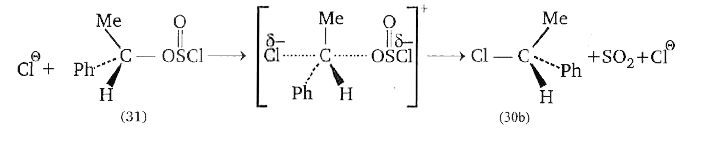
It is interesting that if the `SOCl_2` reaction on ROH (29) is carried out in the presence of pyridine, the product RCI is found now to have undergone inversion of configuration (30b). This occurs because the HCl produced during the formation of (31) from ROH and `SOCl_2` is converted by pyridine into `C_5H_5NH^(Theta)` and `Cl^(Theta)` being an effective nucleophile, attacks (31) from the back. in a normal `S_(N^2)` reaction with inversion of configuration.
Promotional Banner

Topper's Solved these Questions

  • ALKYL HALIDES (SUBSTITUTION REACTIONS)

    MS CHOUHAN|Exercise LEVEL-2|41 Videos
  • ALKYL HALIDES (ELIMINATION REACTION)

    MS CHOUHAN|Exercise LEVEL-2|25 Videos
  • AMINES

    MS CHOUHAN|Exercise Level-2|1 Videos

Similar Questions

Explore conceptually related problems

At a certain temperature 'T', endothermic reaction A rarr B proceeds virtually to the end. Determine the sign of Delta S for the reaction A rarr B and Delta G for the reverse reaction B rarr A .

The standard Gibbs energy change at 300 K for the reaction 2A hArr B+C is 2494.2 J. At a given time, the composition of the reaction mixture is [A]=(1)/(2), [B] =2 and [C]=(1)/(2) . The reaction proceeds in the : [R = 8.314 J/K/mol, e = 2.718]

Expain the SN^2 mechanism

The correct sequence of steps involved in the mechanism of Cannizzaro's reaction is

Two reactions proceed at 25^(@)C at the same rate . The temperature coefficient of the rate of first reaction is 2 and the that of second reaction is 2.5 . The ratio of rates of these reactions at 95^(@) C is :

MS CHOUHAN-ALKYL HALIDES (SUBSTITUTION REACTIONS)-LEVEL-2
  1. The reaction, proceeds by the........... mechanism.

    Text Solution

    |

  2. Statement - 1 : Nucleophilicity order in polar-protic solvent is I^(-)...

    Text Solution

    |

  3. Statement - 1 : CH(3) - CH(2) - Cl + Nal overset("Acetone") rarr CH(3)...

    Text Solution

    |

  4. Encircle whichever of the following:

    Text Solution

    |

  5. Encircle whichever of the following: undergoes S(N^2) reaction more...

    Text Solution

    |

  6. Encircle whichever of the following: undergoes S(N^1) reaction more r...

    Text Solution

    |

  7. Encircle whichever of the following: undergoes an E2 reaction to giv...

    Text Solution

    |

  8. Encircle whichever of the following: reacts with Nal to give (Z) - 1...

    Text Solution

    |

  9. Encircle whichever of the following: undergoes S(N^(1)) reaction mo...

    Text Solution

    |

  10. Encircle whichever of the following : undergoes S(N^2) reaction mor...

    Text Solution

    |

  11. Encircle whichever of the following : undergoes an E1 reaction more ...

    Text Solution

    |

  12. Encircle whichever of the following : undergoes an S(N^1) reaction m...

    Text Solution

    |

  13. Encircle whichever of the following : undergoes an S(N^2) reaction m...

    Text Solution

    |

  14. Encircle whichever of the following : undergoes an E2 reaction more ...

    Text Solution

    |

  15. Match the column :

    Text Solution

    |

  16. Matrix :

    Text Solution

    |

  17. Encircle whichever of the following : undergoes an S(N^2) reaction m...

    Text Solution

    |

  18. Encircle whichever of the following : undergoes an S(N^1) reaction m...

    Text Solution

    |

  19. Encircle whichever of the following : undergoes an S(N^1) reaction m...

    Text Solution

    |

  20. Reativity : Circle the reaction that reacts FASTER by S(N^2) in each p...

    Text Solution

    |

  21. Consider the potential energy diagram given below (X) Name the po...

    Text Solution

    |