Home
Class 12
CHEMISTRY
Wolff rearrangement When alpha-Diazok...

Wolff rearrangement
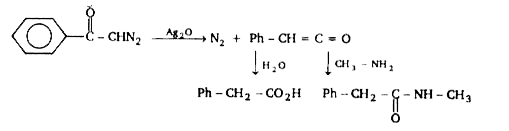
When `alpha`-Diazoketones are photo-irradiated or heated at high temperature or reacted with silver oxide or silver salts at room temperature, they loose nitrogen and rearrange to form ketene.
The ketenes reacts rapidly with water, alcohol and amines. Therefore, the reactions called Wolff-rearrangement.

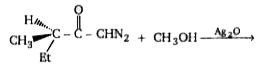
Major product of the reaction is :

A

B
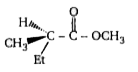
C
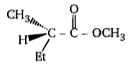
D

None of these

Text Solution

Verified by Experts

The correct Answer is:

D

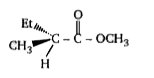
During rearrangement configuration not change
Promotional Banner

Topper's Solved these Questions

  • CARBENE AND NITRENE

    MS CHOUHAN|Exercise LEVEL-2 |5 Videos
  • CARBENE AND NITRENE

    MS CHOUHAN|Exercise LEVEL-2 |5 Videos
  • BIOMOLECULES

    MS CHOUHAN|Exercise LEVEL - 2|5 Videos
  • CARBOXYLIC ACID AND THEIR DERIVATIVES

    MS CHOUHAN|Exercise LEVEL-2( SUBJECTIVE PROBLEMS)|1 Videos

Similar Questions

Explore conceptually related problems

Wolff rearrangement When alpha -Diazoketones are photo-irradiated or heated at high temperature or reacted with silver oxide or silver salts at room temperature, they loose nitrogen and rearrange to form ketene. The ketenes reacts rapidly with water, alcohol and amines. Therefore, the reactions called Wolff-rearrangement. Product (A) is :

Wolff rearrangement When alpha -Diazoketones are photo-irradiated or heated at high temperature or reacted with silver oxide or silver salts at room temperature, they loose nitrogen and rearrange to form ketene. The ketenes reacts rapidly with water, alcohol and amines. Therefore, the reactions called Wolff-rearrangement. , Product (A) is :

Wolff rearrangement When alpha -Diazoketones are photo-irradiated or heated at high temperature or reacted with silver oxide or silver salts at room temperature, they loose nitrogen and rearrange to form ketene. The ketenes reacts rapidly with water, alcohol and amines. Therefore, the reactions called Wolff-rearrangement. , Product (A) is :

Wolff rearrangement When alpha -Diazoketones are photo-irradiated or heated at high temperature or reacted with silver oxide or silver salts at room temperature, they loose nitrogen and rearrange to form ketene. The ketenes reacts rapidly with water, alcohol and amines. Therefore, the reactions called Wolff-rearrangement. Ph-underset(14)overset(O)overset(||)C-CHN_(2)underset(H_(2)O)overset(Ag_(2)O)to (A) , Product (A) is :

Wolff rearrangement When alpha -Diazoketones are photo-irradiated or heated at high temperature or reacted with silver oxide or silver salts at room temperature, they loose nitrogen and rearrange to form ketene. The ketenes reacts rapidly with water, alcohol and amines. Therefore, the reactions called Wolff-rearrangement. HO-CH_(2)-CH_(2)-CH_(2)-overset(O)overset(||)C-CHN_(2) underset(Delta)overset(Ag_(2)O)to (A) , Product (A) is :

Write the IUPAC name of the product formed when aniline reacts with bromine water at room temperature and the equation for the reaction.

Assertion : Nitrogen and Oxygen are the main components in the atmosphere but these do not react to form oxides of nitrogen Reason : The reaction between nitrogen and oxygen requires high temperature.

Di-tert-glycols rearrange in the presence of acid to give alpa -tertiary ketones. The trivial name of the simplest glycol of this type is pinacol, and this type of reaction therefore is named pinacol rearrangement (in this specific case, the reaction is called a pinacol-pinacolone rearrangement). The rearrangement involves 4 steps. one of the hydroxyl groups is protonated in the first step. A molecule of water is eliminated in the second step and a tertiary carbocation is formed. The carbocation rearranges in the third step into a more stable carboxonium ion via a [1,2] rearrangement. In the last step, the carboxonium ion is deprotonated and the product ketone is obtained. How many products obtained in above reaction?

Di-tert-glycols rearrange in the presence of acid to give alpa -tertiary ketones. The trivial name of the simplest glycol of this type is pinacol, and this type of reaction therefore is named pinacol rearrangement (in this specific case, the reaction is called a pinacol-pinacolone rearrangement). The rearrangement involves 4 steps. one of the hydroxyl groups is protonated in the first step. A molecule of water is eliminated in the second step and a tertiary carbocation is formed. The carbocation rearranges in the third step into a more stable carboxonium ion via a [1,2] rearrangement. In the last step, the carboxonium ion is deprotonated and the product ketone is obtained. What is R.D.S. of pinacol-pinacolone rearrangement?

Di-tert-glycols rearrange in the presence of acid to give alpa -tertiary ketones. The trivial name of the simplest glycol of this type is pinacol, and this type of reaction therefore is named pinacol rearrangement (in this specific case, the reaction is called a pinacol-pinacolone rearrangement). The rearrangement involves 4 steps. one of the hydroxyl groups is protonated in the first step. A molecule of water is eliminated in the second step and a tertiary carbocation is formed. The carbocation rearranges in the third step into a more stable carboxonium ion via a [1,2] rearrangement. In the last step, the carboxonium ion is deprotonated and the product ketone is obtained.

MS CHOUHAN-CARBENE AND NITRENE -LEVEL-2 (Comprehension)
  1. Hoffmann bromamide reaction involves conversion of a carboxylic acid a...

    Text Solution

    |

  2. Hoffmann bromamide reaction involves conversion of a carboxylic acid a...

    Text Solution

    |

  3. Hoffmann bromamide reaction involves conversion of a carboxylic acid a...

    Text Solution

    |

  4. Hoffmann bromamide reaction involves conversion of a carboxylic acid a...

    Text Solution

    |

  5. Given is mechanism of Beckmann rearrangement. Rate determining...

    Text Solution

    |

  6. Given is mechanism of Beckmann rearrangement. On treatment ...

    Text Solution

    |

  7. Given is mechanism of Beckmann rearrangement. Which of the fol...

    Text Solution

    |

  8. Given is mechanism of Beckmann rearrangement. Product (A) o...

    Text Solution

    |

  9. Consider the given reaction for preparation of alkyne. (Fritsch reacti...

    Text Solution

    |

  10. Consider the given reaction for preparation of alkyne. (Fritsch reacti...

    Text Solution

    |

  11. Consider the given reaction for preparation of alkyne. (Fritsch reacti...

    Text Solution

    |

  12. Consider the given reaction for preparation of alkyne. (Fritsch reacti...

    Text Solution

    |

  13. Wolff rearrangement When alpha-Diazoketones are photo-irradiated or...

    Text Solution

    |

  14. Wolff rearrangement When alpha-Diazoketones are photo-irradiated or...

    Text Solution

    |

  15. Wolff rearrangement When alpha-Diazoketones are photo-irradiated or...

    Text Solution

    |

  16. Wolff rearrangement When alpha-Diazoketones are photo-irradiated or...

    Text Solution

    |

  17. Wolff rearrangement When alpha-Diazoketones are photo-irradiated or...

    Text Solution

    |

  18. Wolff rearrangement When alpha-Diazoketones are photo-irradiated or...

    Text Solution

    |

  19. Wolff rearrangement When alpha-Diazoketones are photo-irradiated or...

    Text Solution

    |