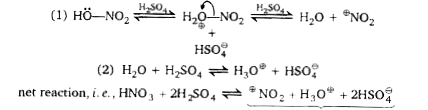
This is borne out by the fact that solutions of nitric acid in pure sulphuric acid show an almost four-fold molecular freezing-point depression (actually i `~~` 3.82), which has been interpreted as being due to formation of the four ions :
Topper's Solved these Questions
AROMATIC COMPOUNDS
MS CHOUHAN|Exercise LEVEL-2|11 Videos
AROMATIC COMPOUNDS
MS CHOUHAN|Exercise LEVEL-2 (COMPREHENSION)|16 Videos
AMINES
MS CHOUHAN|Exercise Level-2|1 Videos
BIOMOLECULES
MS CHOUHAN|Exercise LEVEL - 2|5 Videos
Similar Questions
Explore conceptually related problems
The degree of dissociation (alpha) of a weak electrolyte, A_(x)B_(y) is related to van't Hoff factor (i) by the expression :
The electrolyte solutions show abnormal colligative porperties.To account for this effect we define a quantity called the Van't Hoff factor given by i=("Actual number of particles in solution after dissociation")/("Number of formula units initially dissolved in solution") i=1 ("for non-electrolytes") igt1 ("for electrolytes, undergoing dissociation") ilt1 ("for solutes, undergoing association") Answer the following questions: Benzoic acid undergoes dimerization in bezene solution. The Van't Hoff factor i for the solutions is
The electrolyte solutions show abnormal colligative porperties.To account for this effect we define a quantity called the Van't Hoff factor given by i=("Actual number of particles in solution after dissociation")/("Number of formula units initially dissolved in solution") i=1 ("for non-electrolytes") igt1 ("for electrolytes, undergoing dissociation") ilt1 ("for solutes, undergoing association") Answer the following questions: certain substances trimerize when dissolved in a solvent A . The Van't Hoff factor i for the solutions is
For a solution of AlCl_(3) in water, the Van't Hoff factor (i) is greater than 1 .
Van't Hoff factor (i) for an aqueous solution of an electrolyte is
van't Hoff factor i is greater than one for aqueous solution containing potassium chloride why?
Van't Hoff's factor for a solution is less than one . What is the conclusion drawn from it ?
MS CHOUHAN-AROMATIC COMPOUNDS -LEVEL-2 (SUBJECTIVE PROBLEMS)
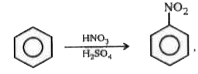 van't-Hoff factor (i) for this reaction is :