Home
Class 12
CHEMISTRY
Nucleophilic Aromatic substitution (SN(A...

Nucleophilic Aromatic substitution `(SN_(Ar))` :
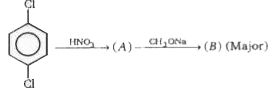
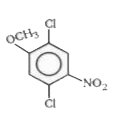
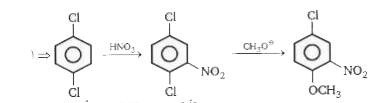
A substituted benzene derivative containing-`NO_2` and Cl group at p-position is subjected to Nu-substitution.


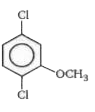
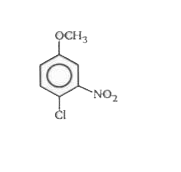
product (B) is :

A

B

C

D

Text Solution

Verified by Experts

The correct Answer is:
A

Promotional Banner

Topper's Solved these Questions

  • AROMATIC COMPOUNDS

    MS CHOUHAN|Exercise LEVEL-2 (SUBJECTIVE PROBLEMS)|3 Videos
  • AROMATIC COMPOUNDS

    MS CHOUHAN|Exercise LEVEL-2|11 Videos
  • AMINES

    MS CHOUHAN|Exercise Level-2|1 Videos
  • BIOMOLECULES

    MS CHOUHAN|Exercise LEVEL - 2|5 Videos

Similar Questions

Explore conceptually related problems

Nucleophilic Aromatic substitution (SN_(Ar)) : A substituted benzene derivative containing- NO_2 and Cl group at p-position is subjected to Nu-substitution. Product (A) is :

Nucleophilic Aromatic substitution (SN_(Ar)) : A substituted benzene derivative containing- NO_2 and Cl group at p-position is subjected to Nu-substitution. Match the column I and II :

Nucleophilic Aromatic substitution (SN_(Ar)) : A substituted benzene derivative containing- NO_2 and Cl group at p-position is subjected to Nu-substitution. Which is the best route for the synthesis of Starting from benzene of ?

Nucleophilic Aromatic substitution (SN_(Ar)) : A substituted benzene derivative containing- NO_2 and Cl group at p-position is subjected to Nu-substitution. Which of the following is most reactive toward SN_(Ar)

Which of the following 2-halo nitrobenzene is most reactive towards nucleophilic aromatic substitution ?

Under the specified conditions, substrate X undergoes substitution and elimination reactions to give products A-D. A and B are stereoisomers, but not enantiomers. C and D are enantiomers. A is not an isomer of C. Which of the following could be the starting material X? X overset(H_2O)underset(Delta) rarr A+B+C+D

Each of the six compounds shown at the bottom of the page has two aromatic (benzene) rings. In each case the two rings are different and are labeled A & B. If an electrophilic substitution, such as nitration or bromination, is carried out on each compound, then identify which ring (A or B) will be preferentially attacked, and indicate the orientation of the substitution (ortho/para, meta or all sites).

In solvolysis of 1,2-dimethyl propyl p-toluene sulfonate in acetic acid at 75^@C , how many (alkene + substitution) products will be formed ?

Halogenation is a substitution reaction, where halogen replaces one or more hydrogens of hydrocarbon. Chlorine free radical make 1^(@), 2^(@), 3^(@) radicals with almost equal ease, whereas bromine free radicals have a clear preference for the formation of tertiary free radicals. So, bromine is less reactive, and more slective whereas chlorine is less selective and more reactive. The relative rate of abstraction of hydrogen by Br is {:(3^(@),gt,2^(@),gt,1^(@)),((1600),,(82),,(1)):} The relative rate of abstraction of hydrogen by Cl is {:(3^(@),gt,2^(@),gt,1^(@)),((5),,(3.8),,(1)):} CH_(3) - underset(CH_(3))underset(|)overset(CH_(3))overset(|)(C) - CH_(2) - overset(CH_(3))overset(|)(CH) - CH_(3) overset(Br_(2)//hv)(rarr) underset("2, Bromo-2, 5, 5 trimethyl pentane (x%)")(CH_(3) - underset(CH_(3))underset(|)overset(CH_(3))overset(|)(C) - CH_(2) - underset(Br)underset(|)overset(CH_(3))overset(|)(C) - CH_(3)) What is the value of x (% yield of product) ?

