Home
Class 12
CHEMISTRY
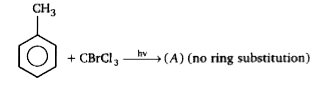
(no ring substitution) product (A) is :...

(no ring substitution) product (A) is :

A

`Ph-CH_2 -Cl`

B

`Ph-CH_2-Br`

C

`Ph-CH_2-C Cl_3`

D

`Ph -CH_2 -CBrCl_2`

Text Solution

Verified by Experts

The correct Answer is:

B

The use of light suggests a free radical mechanism. This means that the methane derivative will undergo homolytic fission. Since the C-Br bond is weaker than the C-Cl bond, it is reasonable to suppose that the former will be broken. Hence :
`CBrCl_3 overset(hv)to Br^(*) + ""^(*)C Cl_3`
`PhCH_3 overset(* C Cl_3 ) to CHCl_3+PhCH_2 ^(*) , overset(CBrCl_3)to PhCH_2 Br + ""^(*)C Cl_3 ,` etc
Attack by the free radical on toluene occurs at the methyl side - chain and not in the ring because the C-Hbond in Me is weaker than that of a ring-hydrogen atom and the benzyl free radical is far more stable than an aryl free radical. The other point that requires explanation is why toluene is attacked by the `CCl_3` free radical and not by the bromine free radical. Activation energies involving free radicals are usually very low and so the controlling factor is the heat of reaction (or, more correctly, the free energy of reaction). The more exothermic the reaction (greater is `Delta G`), the more favoured is that reaction. If the bromine atom attacks, the result is HBr, the bond of which is much weaker than the C-H bond formed when `""^(*)C Cl_3`attacks. Hence, reaction proceeds by the later route.
Promotional Banner

Topper's Solved these Questions

  • HYDROCARBONS (ALKENES)

    MS CHOUHAN|Exercise LEVEL-2|22 Videos
  • HYDROCARBONS (ALKANES)

    MS CHOUHAN|Exercise LEVEL - 2|11 Videos
  • HYDROCARBONS (ALKYNES)

    MS CHOUHAN|Exercise Level -1|32 Videos

Similar Questions

Explore conceptually related problems

Nucleophilic Aromatic substitution (SN_(Ar)) : A substituted benzene derivative containing- NO_2 and Cl group at p-position is subjected to Nu-substitution. product (B) is :

Nucleophilic Aromatic substitution (SN_(Ar)) : A substituted benzene derivative containing- NO_2 and Cl group at p-position is subjected to Nu-substitution. Product (A) is :

A hydrocarbon A (V.D. = 36) forms only one monochloro substitution product. A will be :

In solvolysis of 1,2-dimethyl propyl p-toluene sulfonate in acetic acid at 75^@C , how many (alkene + substitution) products will be formed ?

For an electrophilic aromatic substitution reaction :

Which of the following substitution of benzene is ortho-para in electrophilic substitution and ortho-para in nucleophilic substitution ?

The electrophilic aromatic substitution proceeds through a :

MS CHOUHAN-HYDROCARBONS (ALKENES)-LEVEL-2
  1. (no ring substitution) product (A) is :

    Text Solution

    |

  2. In each reagent box write a letter designating the best reagent and co...

    Text Solution

    |

  3. Propene (CH3 – CH = CH2) can be transformed to compounds (a to j) list...

    Text Solution

    |

  4. In each reaction box write a single letter designating the best reagen...

    Text Solution

    |

  5. Match the reagents a-j with products A-J. There is one best product fo...

    Text Solution

    |

  6. Match the column :

    Text Solution

    |

  7. Match the column I with column II and with column III (Matrix).

    Text Solution

    |

  8. Match the column I and II.

    Text Solution

    |

  9. Sum of molecular mass of A, B, C, D (i.e. A+B + C + D) is equal to :

    Text Solution

    |

  10. underset("(all isomers) ")(C2FClBrl) underset(Ni) overset(H2)to (A)(ex...

    Text Solution

    |

  11. How many products are formed by sum of P,Q,R,S ?

    Text Solution

    |

  12. Vladimir Markovnikov rule : Alkenes undergo electrophilic addition rea...

    Text Solution

    |

  13. Vladimir Markovnikov rule : Alkenes undergo electrophilic addition rea...

    Text Solution

    |

  14. Vladimir Markovnikov rule : Alkenes undergo electrophilic addition rea...

    Text Solution

    |

  15. Vladimir Markovnikov rule : Alkenes undergo electrophilic addition rea...

    Text Solution

    |

  16. Vladimir Markovnikov rule : Alkenes undergo electrophilic addition rea...

    Text Solution

    |

  17. Vladimir Markovnikov rule : Alkenes undergo electrophilic addition rea...

    Text Solution

    |

  18. CH3 - CH2-CH=CH2+CH2 OH overset(H^(o+))to CH3-CH2- underset(OCH3) un...

    Text Solution

    |

  19. CH3 - CH2-CH=CH2+CH2 OH overset(H^(o+))to CH3-CH2- underset(OCH3) un...

    Text Solution

    |

  20. CH3 - CH2-CH=CH2+CH2 OH overset(H^(o+))to CH3-CH2- underset(OCH3) un...

    Text Solution

    |

  21. CH3 - CH2-CH=CH2+CH2 OH overset(H^(o+))to CH3-CH2- underset(OCH3) un...

    Text Solution

    |
