Home
Class 12
CHEMISTRY
Consider the addition of HBr to 3,3-Dime...

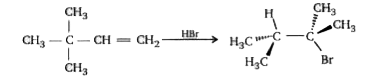
Consider the addition of HBr to 3,3-Dimethyl-1-butene shown below. What is the best mechanistic explanation for the formation of the observed product ?

A

Protonation of the alkene followed by a hydride shift and addition of bromide to the carbocation

B

Double bond shift in the alkene following by the protonation and addition of bromide to the carbocation

C

Addition of bromide to the alkene followed by a double bond shift and protonation

D

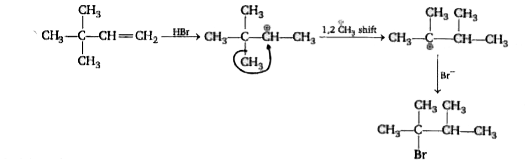
Protonation of the alkene followed by a methyl shift and addition of bromide to the carbocation

Text Solution

Verified by Experts

The correct Answer is:
D

Promotional Banner

Topper's Solved these Questions

  • HYDROCARBONS (ALKENES)

    MS CHOUHAN|Exercise LEVEL-2|22 Videos
  • HYDROCARBONS (ALKANES)

    MS CHOUHAN|Exercise LEVEL - 2|11 Videos
  • HYDROCARBONS (ALKYNES)

    MS CHOUHAN|Exercise Level -1|32 Videos

Similar Questions

Explore conceptually related problems

What is the product of 1, 4-addition in the reaction shown below?

Addition of HCI to 3,3-dimethyl-1-butene yields two products, one of which has a rearranged carbon skeleton. Among the following carbocations, select the possible intermediates in that reaction ?

Among the three compounds shown below, two yield the same product on reaction with warm HNO_3 . The exception is :

Consider the following reaction of boron trifluoride (BF_3) and acetone: Which of the following is the correct product of this reaction ? (Lone electron pairs are not shown explicitly).

What is the quadratic polynomial the sum of whose zeroes id (-3)/(2) and the product of the zeroes is -1

The back-side attack on 2-bromobutane by methoxide (CH_3O^-) gives the product shown below. Which Fischer projection represents 2-bromobutane used as the reactant in this reaction ?

Consider the bcc unit cells of the solids. 1 and 2 with the position of atoms as shown below. The radius of atom B is twice that of atom A. The unit cell edge length is 50% more in solid 2 than in 1. What is the approximate packing efficiency is solid 2?

Statement-1(Assertion) and Statement-2 (reason) Each of these question also has four alternative choices, only one of which is the correct answer. You have to select the correct choice as given below. (a) Statement-1 is true, Statement-2 is true, Statement-2 is a correct explanation for Statement-1 Statement-1 is true, Statement-2 is true, Statement-2 is not a correct explanation for Statement -1 (c) Statement -1 is true, Statement -2 is false (d) Statement -1 is false, Statement -2 is true Statement -1 log_x3.log_(x//9)3=log_81(3) has a solution. Statement-2 Change of base in logarithms is possible .

MS CHOUHAN-HYDROCARBONS (ALKENES)-LEVEL-2
  1. Consider the addition of HBr to 3,3-Dimethyl-1-butene shown below. Wha...

    Text Solution

    |

  2. In each reagent box write a letter designating the best reagent and co...

    Text Solution

    |

  3. Propene (CH3 – CH = CH2) can be transformed to compounds (a to j) list...

    Text Solution

    |

  4. In each reaction box write a single letter designating the best reagen...

    Text Solution

    |

  5. Match the reagents a-j with products A-J. There is one best product fo...

    Text Solution

    |

  6. Match the column :

    Text Solution

    |

  7. Match the column I with column II and with column III (Matrix).

    Text Solution

    |

  8. Match the column I and II.

    Text Solution

    |

  9. Sum of molecular mass of A, B, C, D (i.e. A+B + C + D) is equal to :

    Text Solution

    |

  10. underset("(all isomers) ")(C2FClBrl) underset(Ni) overset(H2)to (A)(ex...

    Text Solution

    |

  11. How many products are formed by sum of P,Q,R,S ?

    Text Solution

    |

  12. Vladimir Markovnikov rule : Alkenes undergo electrophilic addition rea...

    Text Solution

    |

  13. Vladimir Markovnikov rule : Alkenes undergo electrophilic addition rea...

    Text Solution

    |

  14. Vladimir Markovnikov rule : Alkenes undergo electrophilic addition rea...

    Text Solution

    |

  15. Vladimir Markovnikov rule : Alkenes undergo electrophilic addition rea...

    Text Solution

    |

  16. Vladimir Markovnikov rule : Alkenes undergo electrophilic addition rea...

    Text Solution

    |

  17. Vladimir Markovnikov rule : Alkenes undergo electrophilic addition rea...

    Text Solution

    |

  18. CH3 - CH2-CH=CH2+CH2 OH overset(H^(o+))to CH3-CH2- underset(OCH3) un...

    Text Solution

    |

  19. CH3 - CH2-CH=CH2+CH2 OH overset(H^(o+))to CH3-CH2- underset(OCH3) un...

    Text Solution

    |

  20. CH3 - CH2-CH=CH2+CH2 OH overset(H^(o+))to CH3-CH2- underset(OCH3) un...

    Text Solution

    |

  21. CH3 - CH2-CH=CH2+CH2 OH overset(H^(o+))to CH3-CH2- underset(OCH3) un...

    Text Solution

    |

