Home
Class 12
CHEMISTRY
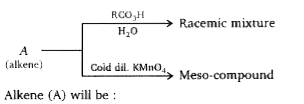
Alkene (A) will be :...


Alkene (A) will be :

A

cis-2-pentene

B

cis-2-hexene

C

cis-4-octene

D

trans-2-hexene

Text Solution

Verified by Experts

The correct Answer is:

C

Alkene (A) must be symmetrical alkene. Which give racemic mixture an anti-addition and meso-compound is syn-addition.
`therefore ` cis-4-octene is the answer.
Promotional Banner

Topper's Solved these Questions

  • HYDROCARBONS (ALKENES)

    MS CHOUHAN|Exercise LEVEL-2|22 Videos
  • HYDROCARBONS (ALKANES)

    MS CHOUHAN|Exercise LEVEL - 2|11 Videos
  • HYDROCARBONS (ALKYNES)

    MS CHOUHAN|Exercise Level -1|32 Videos

Similar Questions

Explore conceptually related problems

An unknown alkene (A) reacts with 3 mole of H_2 gas in presence of platinum catalyst to form 1-isopropyl-4-methyl cyclohexane. When unknown alkene (A) is ozonized and reduced, following product are obtained H- overset(O ) overset(|| )C -H " " H - overset(O ) overset(|| )C -CH_2 - overset(O ) overset(||)C- overset(O ) overset(||) C-CH_3 ," " CH_3 - overset(O ) overset(||)C-CH_2 - overset(O ) overset(||) C-H The alkene (A) is :

Ozonolysis of an alkene [A] followed by decomposition with water and a reducing agent gave a mixture of two isomers of the formula C_(3)H_(6)O . The structure of alkene is :

On catalytic reduction (H_(2)//Pt) how many alkenes will give n-butane ?

On catalytic reduction (H_(2)//Pt) how many alkenes will give 2-methylbutane ?

In the reaction of hydrogen bromide with an alkene (in the absence of peroxides), the first step of the reaction is the ............. to the alkene.

The ozonolysis of an alkene X followed by hydrolysis gives ethanal and propanone . X is

2-Propanol reacts with sulphuric acid at 170^(@)C , gives an alkene which reacts with bromine to give dibromoalkane. Alcoholic potassium hydroxide dehydrogenates the dibromo product to X. The structure of X is :

MS CHOUHAN-HYDROCARBONS (ALKENES)-LEVEL-2
  1. Alkene (A) will be :

    Text Solution

    |

  2. In each reagent box write a letter designating the best reagent and co...

    Text Solution

    |

  3. Propene (CH3 – CH = CH2) can be transformed to compounds (a to j) list...

    Text Solution

    |

  4. In each reaction box write a single letter designating the best reagen...

    Text Solution

    |

  5. Match the reagents a-j with products A-J. There is one best product fo...

    Text Solution

    |

  6. Match the column :

    Text Solution

    |

  7. Match the column I with column II and with column III (Matrix).

    Text Solution

    |

  8. Match the column I and II.

    Text Solution

    |

  9. Sum of molecular mass of A, B, C, D (i.e. A+B + C + D) is equal to :

    Text Solution

    |

  10. underset("(all isomers) ")(C2FClBrl) underset(Ni) overset(H2)to (A)(ex...

    Text Solution

    |

  11. How many products are formed by sum of P,Q,R,S ?

    Text Solution

    |

  12. Vladimir Markovnikov rule : Alkenes undergo electrophilic addition rea...

    Text Solution

    |

  13. Vladimir Markovnikov rule : Alkenes undergo electrophilic addition rea...

    Text Solution

    |

  14. Vladimir Markovnikov rule : Alkenes undergo electrophilic addition rea...

    Text Solution

    |

  15. Vladimir Markovnikov rule : Alkenes undergo electrophilic addition rea...

    Text Solution

    |

  16. Vladimir Markovnikov rule : Alkenes undergo electrophilic addition rea...

    Text Solution

    |

  17. Vladimir Markovnikov rule : Alkenes undergo electrophilic addition rea...

    Text Solution

    |

  18. CH3 - CH2-CH=CH2+CH2 OH overset(H^(o+))to CH3-CH2- underset(OCH3) un...

    Text Solution

    |

  19. CH3 - CH2-CH=CH2+CH2 OH overset(H^(o+))to CH3-CH2- underset(OCH3) un...

    Text Solution

    |

  20. CH3 - CH2-CH=CH2+CH2 OH overset(H^(o+))to CH3-CH2- underset(OCH3) un...

    Text Solution

    |

  21. CH3 - CH2-CH=CH2+CH2 OH overset(H^(o+))to CH3-CH2- underset(OCH3) un...

    Text Solution

    |
