Home
Class 12
CHEMISTRY
Vladimir Markovnikov rule : Alkenes unde...

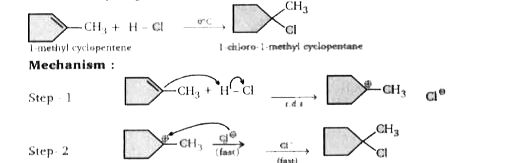
Vladimir Markovnikov rule : Alkenes undergo electrophilic addition reactions. It is triggered by the acid acting as a electrophile toward t-electrons of the double bond. Markovnikov's rule states that when an unsymmetrically substituted alkene reacts with a hydrogen halide, the hydrogen atom adds to the carbon that has the greater number of hydrogen, e.g.,

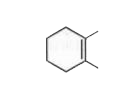
Which of the following is most reactive toward Markovnikov addition ?

A

B

C

D

Text Solution

Verified by Experts

The correct Answer is:

B

Promotional Banner

Topper's Solved these Questions

  • HYDROCARBONS (ALKENES)

    MS CHOUHAN|Exercise LEVEL-2|22 Videos
  • HYDROCARBONS (ALKANES)

    MS CHOUHAN|Exercise LEVEL - 2|11 Videos
  • HYDROCARBONS (ALKYNES)

    MS CHOUHAN|Exercise Level -1|32 Videos

Similar Questions

Explore conceptually related problems

Vladimir Markovnikov rule : Alkenes undergo electrophilic addition reactions. It is triggered by the acid acting as a electrophile toward t-electrons of the double bond. Markovnikov's rule states that when an unsymmetrically substituted alkene reacts with a hydrogen halide, the hydrogen atom adds to the carbon that has the greater number of hydrogen, e.g., In which of the following reactions, diastereomers will be formed ?

Vladimir Markovnikov rule : Alkenes undergo electrophilic addition reactions. It is triggered by the acid acting as a electrophile toward t-electrons of the double bond. Markovnikov's rule states that when an unsymmetrically substituted alkene reacts with a hydrogen halide, the hydrogen atom adds to the carbon that has the greater number of hydrogen, e.g., In which of the following reactions, product is racemic mixture ?

Vladimir Markovnikov rule : Alkenes undergo electrophilic addition reactions. It is triggered by the acid acting as a electrophile toward t-electrons of the double bond. Markovnikov's rule states that when an unsymmetrically substituted alkene reacts with a hydrogen halide, the hydrogen atom adds to the carbon that has the greater number of hydrogen, e.g., What is the energy profile for the given reaction ?

Vladimir Markovnikov rule : Alkenes undergo electrophilic addition reactions. It is triggered by the acid acting as a electrophile toward t-electrons of the double bond. Markovnikov's rule states that when an unsymmetrically substituted alkene reacts with a hydrogen halide, the hydrogen atom adds to the carbon that has the greater number of hydrogen, e.g., In which of following reactions carbocation rearrangement is possible ?

Vladimir Markovnikov rule : Alkenes undergo electrophilic addition reactions. It is triggered by the acid acting as a electrophile toward t-electrons of the double bond. Markovnikov's rule states that when an unsymmetrically substituted alkene reacts with a hydrogen halide, the hydrogen atom adds to the carbon that has the greater number of hydrogen, e.g., Identify the major products r_1, r_2, and r_3 in the given reactions.

MS CHOUHAN-HYDROCARBONS (ALKENES)-LEVEL-2
  1. In each reaction box write a single letter designating the best reagen...

    Text Solution

    |

  2. Match the reagents a-j with products A-J. There is one best product fo...

    Text Solution

    |

  3. Match the column :

    Text Solution

    |

  4. Match the column I with column II and with column III (Matrix).

    Text Solution

    |

  5. Match the column I and II.

    Text Solution

    |

  6. Sum of molecular mass of A, B, C, D (i.e. A+B + C + D) is equal to :

    Text Solution

    |

  7. underset("(all isomers) ")(C2FClBrl) underset(Ni) overset(H2)to (A)(ex...

    Text Solution

    |

  8. How many products are formed by sum of P,Q,R,S ?

    Text Solution

    |

  9. Vladimir Markovnikov rule : Alkenes undergo electrophilic addition rea...

    Text Solution

    |

  10. Vladimir Markovnikov rule : Alkenes undergo electrophilic addition rea...

    Text Solution

    |

  11. Vladimir Markovnikov rule : Alkenes undergo electrophilic addition rea...

    Text Solution

    |

  12. Vladimir Markovnikov rule : Alkenes undergo electrophilic addition rea...

    Text Solution

    |

  13. Vladimir Markovnikov rule : Alkenes undergo electrophilic addition rea...

    Text Solution

    |

  14. Vladimir Markovnikov rule : Alkenes undergo electrophilic addition rea...

    Text Solution

    |

  15. CH3 - CH2-CH=CH2+CH2 OH overset(H^(o+))to CH3-CH2- underset(OCH3) un...

    Text Solution

    |

  16. CH3 - CH2-CH=CH2+CH2 OH overset(H^(o+))to CH3-CH2- underset(OCH3) un...

    Text Solution

    |

  17. CH3 - CH2-CH=CH2+CH2 OH overset(H^(o+))to CH3-CH2- underset(OCH3) un...

    Text Solution

    |

  18. CH3 - CH2-CH=CH2+CH2 OH overset(H^(o+))to CH3-CH2- underset(OCH3) un...

    Text Solution

    |

  19. CH3 - CH2-CH=CH2+CH2 OH overset(H^(o+))to CH3-CH2- underset(OCH3) un...

    Text Solution

    |

  20. Match the column I and II :

    Text Solution

    |

