Home
Class 12
CHEMISTRY
Comprehension E2 raction rarr Elimina...

Comprehension
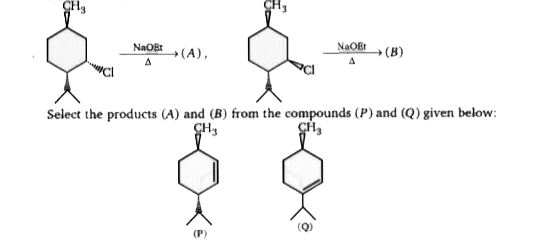
`E_2` raction `rarr` Elimination bimolecular
In the general mechanism of the `E_2` reaction a strong base abstract a proton on a carbon atom adjacent to the one of the leaving group. As the abstracts a proton , a double bond forms and the leaving group leaves.

A

A = P,B=P

B

A=Q,B= Q

C

A = Q,B= P

D

A=Q,B=P

Text Solution

Verified by Experts

Anti elimination
Promotional Banner

Topper's Solved these Questions

  • ALKYL HALIDES (ELIMINATION REACTION)

    MS CHOUHAN|Exercise LEVEL-2|25 Videos
  • ALDEHYDES AND KETONES

    MS CHOUHAN|Exercise LEVEL-2|20 Videos
  • ALKYL HALIDES (SUBSTITUTION REACTIONS)

    MS CHOUHAN|Exercise LEVEL-2|41 Videos

Similar Questions

Explore conceptually related problems

Di-tert-glycols rearrange in the presence of acid to give alpa -tertiary ketones. The trivial name of the simplest glycol of this type is pinacol, and this type of reaction therefore is named pinacol rearrangement (in this specific case, the reaction is called a pinacol-pinacolone rearrangement). The rearrangement involves 4 steps. one of the hydroxyl groups is protonated in the first step. A molecule of water is eliminated in the second step and a tertiary carbocation is formed. The carbocation rearranges in the third step into a more stable carboxonium ion via a [1,2] rearrangement. In the last step, the carboxonium ion is deprotonated and the product ketone is obtained. How many products obtained in above reaction?

Di-tert-glycols rearrange in the presence of acid to give alpa -tertiary ketones. The trivial name of the simplest glycol of this type is pinacol, and this type of reaction therefore is named pinacol rearrangement (in this specific case, the reaction is called a pinacol-pinacolone rearrangement). The rearrangement involves 4 steps. one of the hydroxyl groups is protonated in the first step. A molecule of water is eliminated in the second step and a tertiary carbocation is formed. The carbocation rearranges in the third step into a more stable carboxonium ion via a [1,2] rearrangement. In the last step, the carboxonium ion is deprotonated and the product ketone is obtained.

Di-tert-glycols rearrange in the presence of acid to give alpa -tertiary ketones. The trivial name of the simplest glycol of this type is pinacol, and this type of reaction therefore is named pinacol rearrangement (in this specific case, the reaction is called a pinacol-pinacolone rearrangement). The rearrangement involves 4 steps. one of the hydroxyl groups is protonated in the first step. A molecule of water is eliminated in the second step and a tertiary carbocation is formed. The carbocation rearranges in the third step into a more stable carboxonium ion via a [1,2] rearrangement. In the last step, the carboxonium ion is deprotonated and the product ketone is obtained.

Di-tert-glycols rearrange in the presence of acid to give alpa -tertiary ketones. The trivial name of the simplest glycol of this type is pinacol, and this type of reaction therefore is named pinacol rearrangement (in this specific case, the reaction is called a pinacol-pinacolone rearrangement). The rearrangement involves 4 steps. one of the hydroxyl groups is protonated in the first step. A molecule of water is eliminated in the second step and a tertiary carbocation is formed. The carbocation rearranges in the third step into a more stable carboxonium ion via a [1,2] rearrangement. In the last step, the carboxonium ion is deprotonated and the product ketone is obtained. What is R.D.S. of pinacol-pinacolone rearrangement?

Vladimir Markovnikov rule : Alkenes undergo electrophilic addition reactions. It is triggered by the acid acting as a electrophile toward t-electrons of the double bond. Markovnikov's rule states that when an unsymmetrically substituted alkene reacts with a hydrogen halide, the hydrogen atom adds to the carbon that has the greater number of hydrogen, e.g., Identify the major products r_1, r_2, and r_3 in the given reactions.

The following bimolecular elimination reaction (E_2) is carried out with different halogen leaving groups. The per cent yield of the two products (2·hexene and I-hexene) for each leaving group is listed below. Which ofthe following statement is (are) true concerning this series of E_2 reactions?

The atomic masses of Li, He and proton are 7.01823 amu, 4.00387 amu and 1.00715 amu respectively. Calculate the energy evolved in the reaction, 3^(Li^(7)) + 1^(HA^(1)) rarr 2 2^(He^(4)) + triangle E Given 1 amu = 931 MeV.

