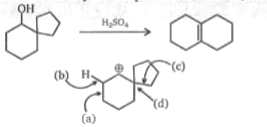
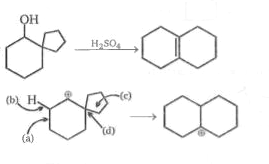
The following transfonnation involves a carbocation rearrangement. The carbocation is generated by protonation of the hydroxyl group, followed by the loss of water. Which bond has to migrate in the carbocation to yield the product indicated (after the deprotonation)
A
a
B
b
C
c
D
d
Text Solution
Verified by Experts
Topper's Solved these Questions
ALCOHOL,ETHERS AND EPOXIDES
MS CHOUHAN|Exercise LEVEL-2|24 Videos
ALCOHOL,ETHERS AND EPOXIDES
MS CHOUHAN|Exercise SUBJECTIVE PROBLEMS|1 Videos
5C ALKYL HALIDES
MS CHOUHAN|Exercise LEVEL-2 (SUBJECTIVE PROBLEMS)|1 Videos
ALDEHYDES AND KETONES
MS CHOUHAN|Exercise LEVEL-2|20 Videos
Similar Questions
Explore conceptually related problems
Which of the following carbocation will undergo rearrngement ?
Which of the following will form carbocation most readily ?
Which one amongst the following carbocations is most stable ?
Di-tert-glycols rearrange in the presence of acid to give alpa -tertiary ketones. The trivial name of the simplest glycol of this type is pinacol, and this type of reaction therefore is named pinacol rearrangement (in this specific case, the reaction is called a pinacol-pinacolone rearrangement). The rearrangement involves 4 steps. one of the hydroxyl groups is protonated in the first step. A molecule of water is eliminated in the second step and a tertiary carbocation is formed. The carbocation rearranges in the third step into a more stable carboxonium ion via a [1,2] rearrangement. In the last step, the carboxonium ion is deprotonated and the product ketone is obtained. How many products obtained in above reaction?
Di-tert-glycols rearrange in the presence of acid to give alpa -tertiary ketones. The trivial name of the simplest glycol of this type is pinacol, and this type of reaction therefore is named pinacol rearrangement (in this specific case, the reaction is called a pinacol-pinacolone rearrangement). The rearrangement involves 4 steps. one of the hydroxyl groups is protonated in the first step. A molecule of water is eliminated in the second step and a tertiary carbocation is formed. The carbocation rearranges in the third step into a more stable carboxonium ion via a [1,2] rearrangement. In the last step, the carboxonium ion is deprotonated and the product ketone is obtained. What is R.D.S. of pinacol-pinacolone rearrangement?
Di-tert-glycols rearrange in the presence of acid to give alpa -tertiary ketones. The trivial name of the simplest glycol of this type is pinacol, and this type of reaction therefore is named pinacol rearrangement (in this specific case, the reaction is called a pinacol-pinacolone rearrangement). The rearrangement involves 4 steps. one of the hydroxyl groups is protonated in the first step. A molecule of water is eliminated in the second step and a tertiary carbocation is formed. The carbocation rearranges in the third step into a more stable carboxonium ion via a [1,2] rearrangement. In the last step, the carboxonium ion is deprotonated and the product ketone is obtained.
Di-tert-glycols rearrange in the presence of acid to give alpa -tertiary ketones. The trivial name of the simplest glycol of this type is pinacol, and this type of reaction therefore is named pinacol rearrangement (in this specific case, the reaction is called a pinacol-pinacolone rearrangement). The rearrangement involves 4 steps. one of the hydroxyl groups is protonated in the first step. A molecule of water is eliminated in the second step and a tertiary carbocation is formed. The carbocation rearranges in the third step into a more stable carboxonium ion via a [1,2] rearrangement. In the last step, the carboxonium ion is deprotonated and the product ketone is obtained.
Which of the following is the most stabilized carbocation ?
Which of the following gives most stable carbocation on dehydration ?
MS CHOUHAN-ALCOHOL,ETHERS AND EPOXIDES-SUBJECTIVE PROBLEMS