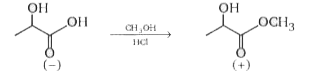
Esterification (shown below) is a reaction converting a carboxylic acid toits ester. Itinvolves only the carbonyl carbon. Esterification of (-) -lactic acid with methanol yields (+)-methyl lactate. Assuming that there are no side reactions, what is true about this reaction ?
A
`AnS_(N^2)` process has occurred, inverting the absolute configuration of the chiral center
B
`AnS_(N^1)` reaction at the chiral center has inverted the optical rotation
C
A diastereomer has been produced, diastereomers have different physical properties including optical rotation
D
Optical rotation is notdirectly related to absolute configuration, so the change in sign of rotation is merely a coincidence
Text Solution
Verified by Experts
Chiral center is not affected during the reaction so change in sign ofrotation is merely a coincidence.
Topper's Solved these Questions
ALCOHOL,ETHERS AND EPOXIDES
MS CHOUHAN|Exercise LEVEL-2|24 Videos
ALCOHOL,ETHERS AND EPOXIDES
MS CHOUHAN|Exercise SUBJECTIVE PROBLEMS|1 Videos
5C ALKYL HALIDES
MS CHOUHAN|Exercise LEVEL-2 (SUBJECTIVE PROBLEMS)|1 Videos
ALDEHYDES AND KETONES
MS CHOUHAN|Exercise LEVEL-2|20 Videos
Similar Questions
Explore conceptually related problems
Consider the following reaction involving two acids shown below : formic acid and HF. Which of the following statements about this reaction are true ? (A) Formic acid is the strongest Bronsted acid in the reaction (B) HF is the strongest Bronsted acid in the reaction (C) KF is the strongest Bronsted base in the reaction (D) KO_2 CH is the strongest Bronsted base in the reaction (E) The equilibrium favours the reactants (F) The equilibrium favours the products (G) Formic acid has a weaker conjugate base (H) HF has a weaker conjugate base
(a) Explain esterification reaction between acetic acid and ethyl alcohol as example. (b) Boiling point of alcohol is greater than the boiling point of hydrocarbons of coparable molar masses, Why? (c ) What is the effect of -NO_(2) group on the acidic strength of phenol?Give reason.
MS CHOUHAN-ALCOHOL,ETHERS AND EPOXIDES-SUBJECTIVE PROBLEMS