Home
Class 12
CHEMISTRY
Di-tert-glycols rearrange in the presenc...

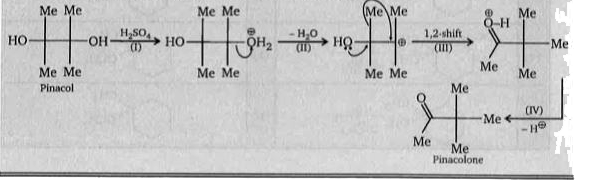
Di-tert-glycols rearrange in the presence of acid to give `alpa`-tertiary ketones. The trivial name of the simplest glycol of this type is pinacol, and this type of reaction therefore is named pinacol rearrangement (in this specific case, the reaction is called a pinacol-pinacolone rearrangement). The rearrangement involves 4 steps. one of the hydroxyl groups is protonated in the first step. A molecule of water is eliminated in the second step and a tertiary carbocation is formed. The carbocation rearranges in the third step into a more stable carboxonium ion via a [1,2] rearrangement. In the last step, the carboxonium ion is deprotonated and the product ketone is obtained.

What is R.D.S. of pinacol-pinacolone rearrangement?

A

I step

B

II step

C

III step

D

IV step

Text Solution

Verified by Experts

The correct Answer is:

A, B

`II^(nd)` step (R.D.S.)
Promotional Banner

Topper's Solved these Questions

  • ALCOHOL,ETHERS AND EPOXIDES

    MS CHOUHAN|Exercise SUBJECTIVE PROBLEMS|1 Videos
  • ALCOHOL,ETHERS AND EPOXIDES

    MS CHOUHAN|Exercise SUBJECTIVE PROBLEMS|1 Videos
  • 5C ALKYL HALIDES

    MS CHOUHAN|Exercise LEVEL-2 (SUBJECTIVE PROBLEMS)|1 Videos
  • ALDEHYDES AND KETONES

    MS CHOUHAN|Exercise LEVEL-2|20 Videos

Similar Questions

Explore conceptually related problems

Di-tert-glycols rearrange in the presence of acid to give alpa -tertiary ketones. The trivial name of the simplest glycol of this type is pinacol, and this type of reaction therefore is named pinacol rearrangement (in this specific case, the reaction is called a pinacol-pinacolone rearrangement). The rearrangement involves 4 steps. one of the hydroxyl groups is protonated in the first step. A molecule of water is eliminated in the second step and a tertiary carbocation is formed. The carbocation rearranges in the third step into a more stable carboxonium ion via a [1,2] rearrangement. In the last step, the carboxonium ion is deprotonated and the product ketone is obtained. How many products obtained in above reaction?

Name the simplest ketone.

, Product of rearrangement is :

Name the type of reaction in which energy is abdorbed.

In case of C_4 pathway, in the first step is

What type of reaction aldehydes and ketones undergo ?

The following transfonnation involves a carbocation rearrangement. The carbocation is generated by protonation of the hydroxyl group, followed by the loss of water. Which bond has to migrate in the carbocation to yield the product indicated (after the deprotonation)

Which of the following will rearrange ?

The rate determining step in Cannizzaro's reaction is

MS CHOUHAN-ALCOHOL,ETHERS AND EPOXIDES-LEVEL-2
  1. Based on the above isomer answer the following (A to F). Which isome...

    Text Solution

    |

  2. Based on the above isomer answer the following (A to F). Which isome...

    Text Solution

    |

  3. Based on the above isomer answer the following (A to F). Which isome...

    Text Solution

    |

  4. Conversion (CH3 - CH3 rarr CH3 - CH2 - OH) " alkane " rarr alcohol is...

    Text Solution

    |

  5. Conversion R -CH2 - OH rarr R -CHO can be done by :

    Text Solution

    |

  6. Conversion R-CHO rarr R - CO2 H can be done by

    Text Solution

    |

  7. Coversion R - CO2H rarr R - CHO can be done by :

    Text Solution

    |

  8. Coversion R - CHO rarr R - CH2 -OH can be done by :

    Text Solution

    |

  9. Reduction R - CH2 - OH rarr R - CH3 can be done by :

    Text Solution

    |

  10. Which of the following is true for 3- methylbutanal ?

    Text Solution

    |

  11. This problem is an introduction to the planning of multistep syntheses...

    Text Solution

    |

  12. Which of the following is true for 3- methyl-2-butanone?

    Text Solution

    |

  13. Which of these methods would serve to prepare 1-phenyl-2-propanol?

    Text Solution

    |

  14. Match the Column (I) and (II) .

    Text Solution

    |

  15. Match the Column (I) and (II) .

    Text Solution

    |

  16. Ratio of moles of formaldehyde obtained in the reaction (1) and reacti...

    Text Solution

    |

  17. Di-tert-glycols rearrange in the presence of acid to give alpa-tertiar...

    Text Solution

    |

  18. Di-tert-glycols rearrange in the presence of acid to give alpa-tertiar...

    Text Solution

    |

  19. Di-tert-glycols rearrange in the presence of acid to give alpa-tertiar...

    Text Solution

    |

  20. Di-tert-glycols rearrange in the presence of acid to give alpa-tertiar...

    Text Solution

    |
