Home
Class 12
CHEMISTRY
Which of the following btea-keto carboxy...

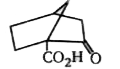
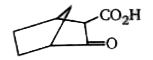
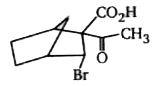
Which of the following `btea`-keto carboxylic acid does not undergo decarboxylation on heating?

A

B

C

D

None of these

Text Solution

Verified by Experts

The correct Answer is:
A

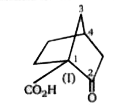
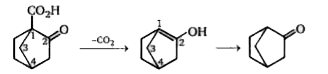
`beta`-Keto acids undergo decarboxylation through the keto form via a cyclic T. S. which results in the formation of the enol form of the ketone product. The enol then changes to the more stable keto form. If decarboxylation of the given `beta`-keto acid could follow this route, then:

If we draw the acid as shown in (I), it can be seen that the methylene group forms a bridge, which is perpendicular to the cyclohexane ring.

The enol produced would have a double bond in the 1, 2-position. Thus, C - 1 is `sp^(2)` - hybridised and therefore the bond leading to the methylene bridge (1, 3) would have to be coplanar with the groups joined to C - 2 in the enol, i.e., the bridge would have to flatten. This would require the normal valency angles `(~109.5^(@))` to change to `~120^(@)`. Even if a compromise situation occurred, i.e., all bond angles involved (`angle`s 1, 3, and 4) underwent change, the resulting strain would be very large, too large to be expected for it to occur. Hence, it is reasonable to argue that since decarboxylation does occur, it does so through a route requiring a much higher activation energy than that required for the usual route. Hence the difficulty of decarboxylation. (Bredt.s rule)
Promotional Banner

Topper's Solved these Questions

  • ALDEHYDES AND KETONES

    MS CHOUHAN|Exercise LEVEL-2|20 Videos
  • ALCOHOL,ETHERS AND EPOXIDES

    MS CHOUHAN|Exercise SUBJECTIVE PROBLEMS|1 Videos
  • ALKYL HALIDES (ELIMINATION REACTION)

    MS CHOUHAN|Exercise LEVEL-2|25 Videos

Similar Questions

Explore conceptually related problems

Which beta - keto acid shown will not undergo decarboxylation ?

Which of the following does not have carboxyl group

Which of the following elements does not form oxy acids?

Which of the following undergoes hydrolysis ?

The carboxylic acid which does not undergo Hell Volhard Zelinsky reaction is :

Which of the following is not a substrate for decarboxylation?

Which of the following compounds will undergo decarboxylation on heating ?

Which of the following is the correct order of decarboxylation of beta -keto carboxylate anion ?

MS CHOUHAN-ALDEHYDES AND KETONES-LEVEL-2
  1. Which of the following btea-keto carboxylic acid does not undergo deca...

    Text Solution

    |

  2. Select the best choice for example (A to L) from the examples (a to n)...

    Text Solution

    |

  3. The following questions refer to the compounds (A to G) shown below :

    Text Solution

    |

  4. Match of the column :

    Text Solution

    |

  5. Complete the following table.

    Text Solution

    |

  6. Consider the following reactions and answer A and B. Suggest a re...

    Text Solution

    |

  7. Consider the following reactions and answer A and B. Yield of eac...

    Text Solution

    |

  8. Degree of unsaturation present in compound (A + B + C) is ?

    Text Solution

    |

  9. Within each set, which compound should be more reactive toward carbony...

    Text Solution

    |

  10. Match the Column (I) and Column (II). (Matrix)

    Text Solution

    |

  11. Consider reactions A through F. Those carbon atoms undergoing change, ...

    Text Solution

    |

  12. Consider the possible formation of an aldehyde or ketone product when ...

    Text Solution

    |

  13. Wittig reaction : The reaction of a phosphorus ylide with an aldehyd...

    Text Solution

    |

  14. Wittig reaction : The reaction of a phosphorus ylide with an aldehyd...

    Text Solution

    |

  15. Wittig reaction : The reaction of a phosphorus ylide with an aldehyd...

    Text Solution

    |

  16. Wittig reaction : The reaction of a phosphorus ylide with an aldehyd...

    Text Solution

    |

  17. Wittig reaction : The reaction of a phosphorus ylide with an aldehyd...

    Text Solution

    |

  18. Wittig reaction : The reaction of a phosphorus ylide with an aldehyd...

    Text Solution

    |

  19. Match the column :

    Text Solution

    |

  20. Reactant (A) is :

    Text Solution

    |

  21. Product (B) is :

    Text Solution

    |