Home
Class 11
PHYSICS
Three particles A, B and C are situated ...

Three particles A, B and C are situated at the vertices of an equilateral triangle ABC of side d at time `t=0.` Each of the particles moves with constant speed v. A always has its velocity along AB, B along BC and C along CA. At what time will the particles meet each other?

Text Solution

Verified by Experts
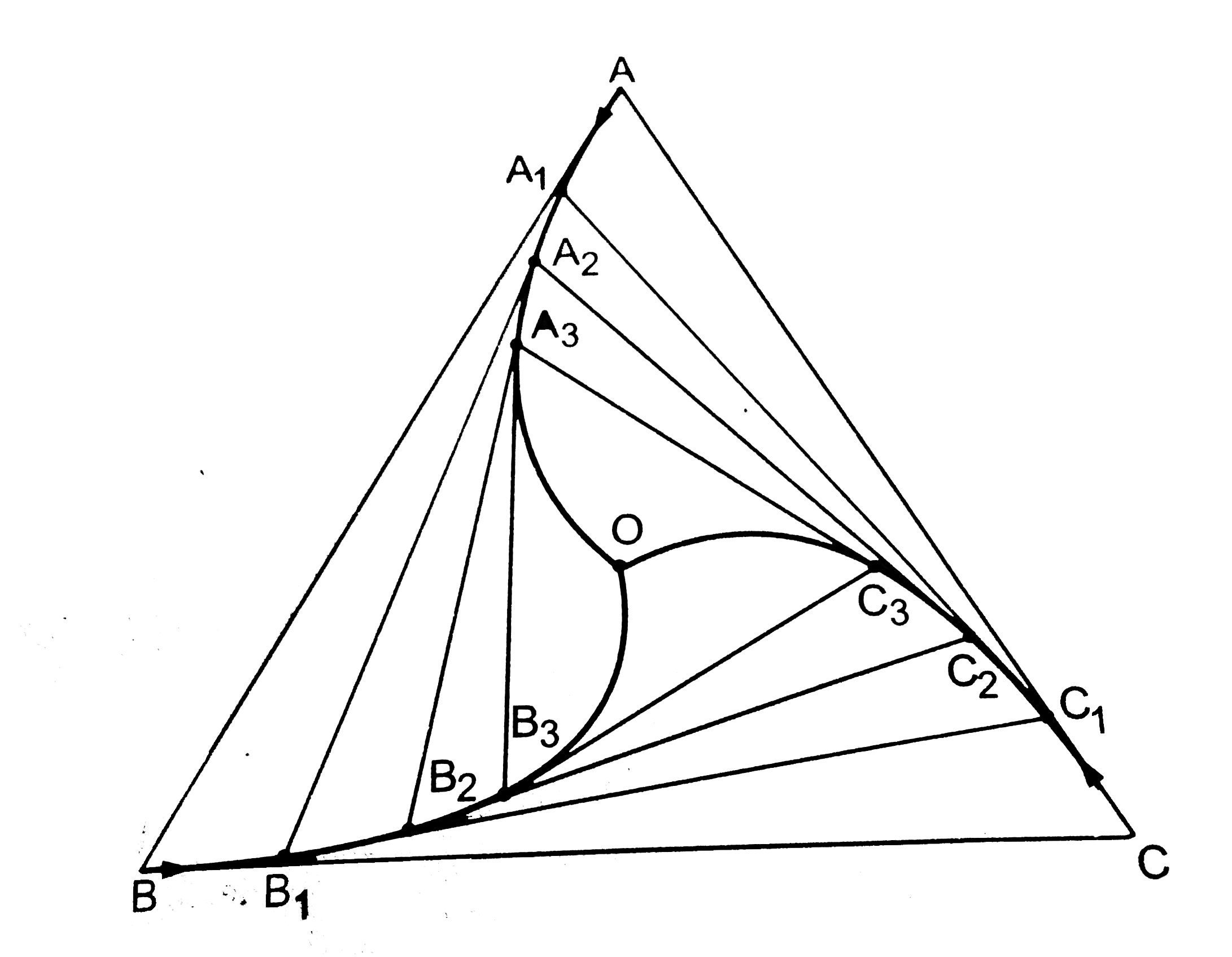
The motion of the particles is roughly sketched in figure.

By symmetry they will meet at the centroid O of the triangle. At any instant the particles will form an equilateral triangle ABC with the same centroid O. Concentrate on the motion of any one particle say A. At any instant its velocity makes angle `30^0` with AO.
The component of this velocity along AO is `vcos 30^@`. This component is the rate of decrease of the distance AO.
Initially,
`AO=2/3 sqrt(d^2-(d/2)^2)=d/sqrt3`
There the time taken for AO to become zero
`=(dsqrt(3))/(v cos 30^0)=(2d)/(sqrt(3 vxxsqrt3)=(2d)/(3v)`
Alternatively : Velocity of A is v along AB. The velocity of B is along BC. Its component along BA is`v cos 60^0 =v/2`. Thus, the separation AB decreases at the rate
`v+v/2=(3v)/2`
Since this rate is constant, the time taken in reducing the separation AB from d to zero is
t = `(d)xx(2)/(3v) = (2d)/(3v)`.
Promotional Banner

Topper's Solved these Questions

  • REST AND MOTION : KINEMATICS

    HC VERMA|Exercise Question for short Answer|14 Videos
  • REST AND MOTION : KINEMATICS

    HC VERMA|Exercise Objective -1|13 Videos
  • REST AND MOTION : KINEMATICS

    HC VERMA|Exercise Exercises|51 Videos
  • PHYSICS AND MATHEMATICS

    HC VERMA|Exercise Exercises|34 Videos
  • ROTATIONAL MECHANICS

    HC VERMA|Exercise Exercises|86 Videos

Similar Questions

Explore conceptually related problems

Three particles, each of mass m are situated at the vertices of an equilateral triangle ABC of side L as shown in the figure. Find the moment of inertia of the system about the line AX perpendicular to AB in the plane of ABC

Three particles of masses 1.0 kg 2.0 kg and 3.0 kg are placed at the corners A,B and C respectively of an equilateral triangle ABC of edge 1m. Locate the centre of mass of the system.

Six particles situated at the corners of a regular hexagon of side a move at a constant speed v. Each particle maintains a direction towards the particle at the next corner. Calculate the time the particles will take to meet each other.

A circle of radius unity is centered at thet origin. Two particles tart moving at the same time from the point (1, 0) and move around the circle in opposite direction. One of the particle moves anticlockwise with constant speed v and the other moves clockwise with constant speed 3v . After leaving (1, 0) , the two particles meet first at a point P, and continue until they meet next at point Q . The coordinates of the point Q are

Three rigit rods are joined to form an equilaterla triangle ABC of side 1 m. Three particles carrying charges 20 muC each are attached to the vertices of the triangle. The whole system is at rest in an inertial frame. The resultant force on the charged particle. A has the magnitude.

If three cars A, B and C move with velocities along directions on that road side, what is the vector hidden in this case.

A(3,2,0),B(5,3,2) and C(-9,6,-3) are the vertices of triangle ABC. If the bisec-tor of angleBAC meets BC at D then D is

A particle of mass m moves in the XY plane with a velocity v along the straight line AB If the angular momentum of the particle with respect to orgin O is L_A when it is at A and L_B when it is at B, then.

A particle of mass m is kept on the top of a smooth sphere of radius R. It is given a sharp impulse which imparts it a horizontal speed v. a. find the normal force between the sphere and the particle just after the impulse. B. What should be the minimum value of v for which the particle does not slip on the sphere? c. Assuming the velocity v to be half the minimum calculated in part, d. find the angle made by the radius through the particle with the vertical when it leaves the sphere.

Two particles A and B , each carrying charge Q are held fixed with a separation D between them. A particle C having mass m and charge q is kept at the middle point of the line AB. If particle C is displaced through a distance x along the line AB. What will be the time period of the oscillations.

HC VERMA-REST AND MOTION : KINEMATICS-worked out Examples
  1. A man at a speed of 6 km/hr for 1 km and 8 km/hr for the next 1 km. Wh...

    Text Solution

    |

  2. The I.Sc lecture theatre of a college is 40 ft wide and has door at a ...

    Text Solution

    |

  3. The position of a particle moving on X-axis is given by x=At^3+Bt^2+...

    Text Solution

    |

  4. From the veloicty time graph of a particle given in figure describe th...

    Text Solution

    |

  5. A particle starts from rest with a constant acceleration. At a time t ...

    Text Solution

    |

  6. A boy stretches a stone against the rubber tape of a catapult or gulel...

    Text Solution

    |

  7. A police inspector in a jeepis chasing a pickpocket on a straightroad....

    Text Solution

    |

  8. A car is moving at a constant speed of 40 km/h along a straight road w...

    Text Solution

    |

  9. A ball is dropped from a height of 19.6 m above the ground. It rebound...

    Text Solution

    |

  10. A stone is dropped from a balloon going up with a uniform velocity of ...

    Text Solution

    |

  11. A football ils kicked with a velocity of 20 m/s at an angle of 45^0 wi...

    Text Solution

    |

  12. A helicopter on flood relief mission, flying horizontally with a speed...

    Text Solution

    |

  13. A particle is projected horizontally with a speed u from the top of pl...

    Text Solution

    |

  14. For a projectile, projected at an angle, the resultant velocity is :

    Text Solution

    |

  15. A bullet is fired from a rifle which recoils after firing. The ratio o...

    Text Solution

    |

  16. A man can swim in still water ast a speed of 3 km/h. He wants to cross...

    Text Solution

    |

  17. A man can swim at a speed of 3 km/h in still water. He wants t cross a...

    Text Solution

    |

  18. A man standing on a road has to hold his umbrella at 30^0 with the ver...

    Text Solution

    |

  19. A man running on the horizontal road at 8 km h^(-1) find the rain app...

    Text Solution

    |

  20. Three particles A, B and C are situated at the vertices of an equilate...

    Text Solution

    |

